His eye never slept. He sought out literary and cultural endeavors and made the acquaintance of those behind them, in order to link the circles together and set direction moving.
He visited me one day at my house in 1930, while the battle to replace the Mandate with a treaty was crystallizing and taking form, and that day I enjoyed a delicious, graceful conversation — the conversation of a man of rare intelligence, to whom God had given such gifts as His heavenly bounty willed. He spoke to me of the necessity of women's entering the political arena and the political parties, and asked me why I did not occupy myself with politics. I said: "Had I been living with a brother or a husband, I would have acted on your view; but I am a woman alone, living with a young daughter now standing at the gates of life."
He said:
"You and your daughter shall work together. Women's hands are indispensable!"
I said:
"Or do you forget that we are in the East?"
He asked my opinion of Arab unity and of the destiny of Lebanon, and I answered him frankly, and my frankness found a welcome echo in his heart...
He was in perpetual motion: no literary figure or women's group came to the East but he hastened to set out his arguments and hearten the supporters. So he made contact with the delegations that passed through Beirut in 1935 on their way to attend the Istanbul congress. He befriended Mademoiselle Clara Candiani, correspondent of the newspaper Le Figaro, and accompanied her on a journey to the interior. When she returned to France she began publishing in her paper article after article. She had been won over, and she threw herself into defending the right of a people that asked only to be an ally and a friend. As for the practical result, it was a retribution that
came down upon her head. She said to me, the day I visited her in Paris, as she bade me farewell at the door:
"Tell Riad Bey and my friends over there that I have lost my position at Le Figaro!"
*
Those who will write history will not wonder at the events of 1943 and their consequences. The man of struggle who lived thirty-three years with no care but a cause that ate from his plate and drank from his cup and slept in his bed — that man of struggle kept both sight and insight open; for months and years he had been awaiting
the opportune moment, and when it passed by he seized it — say rather, he bound it fast between his hands so that it could not escape. And from that hour, the name of Riad el-Solh entered the register of history.
*
O my friend of the noble heart, Mrs. Fayza, bereaved in him of husband and brother and comrade and son! Consolation and patience! It is pride enough for your two hands that you were the companion of a man of struggle whose like in gifts fate rarely bestows, and that you have a rightful claim to an ample share of his struggle and his striving.
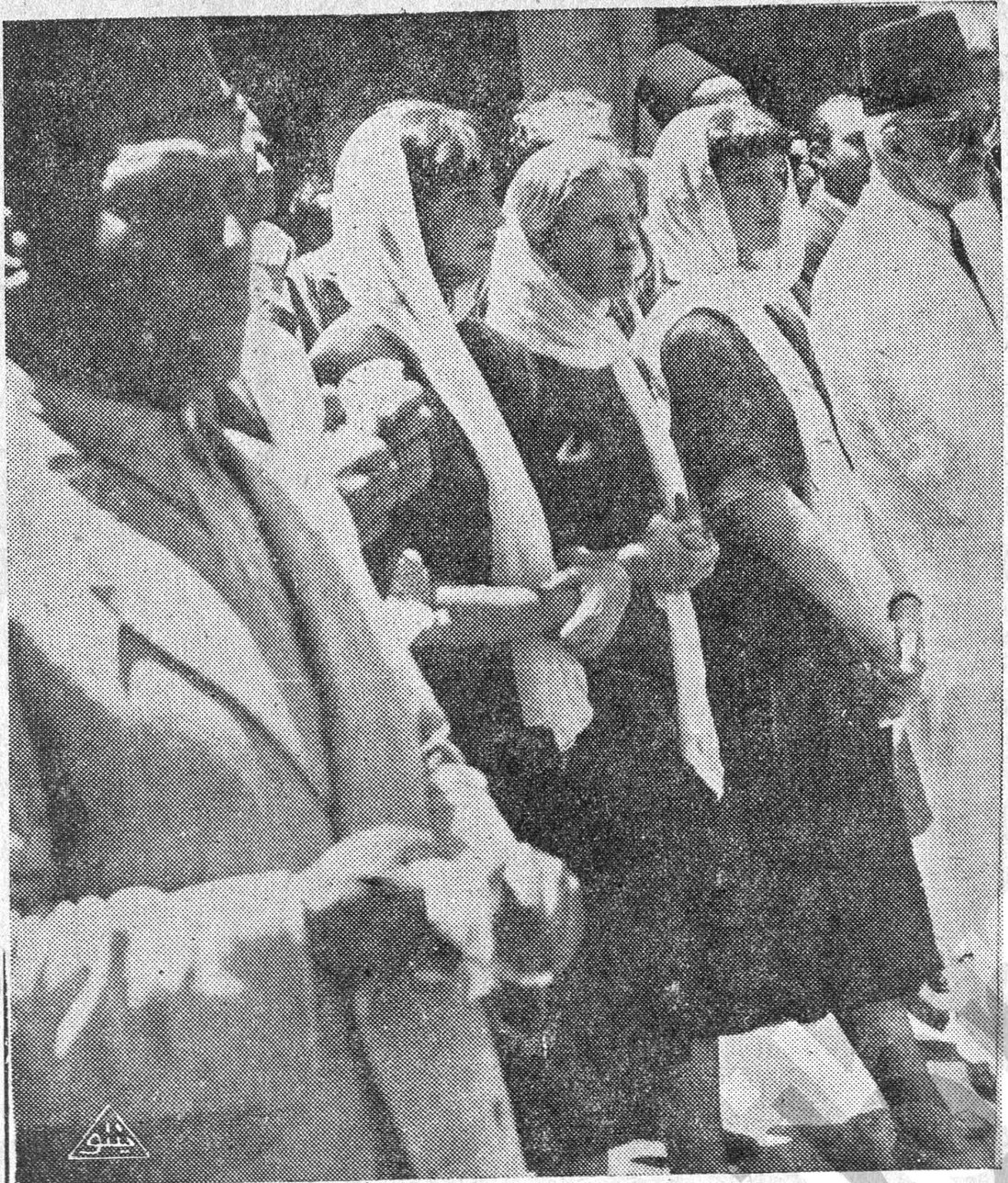
An eloquent picture of daughters bereaved of a tender father:
Alia, Mona, and Lamia el-Solh behind the bier.