

We can tell a person's character by many means: by observing his talk, his gait and his gestures, his dress, his deeds — and also by observing his room, his house, and the kind of furniture in it.
I once entered the home of a Lebanese family in one of the villages, and in the reception room my eye was caught by covers of gleaming white over the long, old-fashioned seats, and by furniture simple in appearance, with no trace in it of taste or of modern art — except that the room as a whole was well ordered and clean. But no sooner had I entered the bedroom and the kitchen than I noticed the difference between the reception room and the rest of the rooms. The bedroom was dirty and ill-kept, and the kitchen in a pitiable state of meanness and sanitary neglect. It became clear to me that the people of the house had deliberately set out to show their guests the best they had, and to appear outwardly other than they truly were within. That is the disease of the love of show, widespread in most circles, and it holds true of many aspects of our life, not of houses and their furniture alone.
There are two rules that must be observed in furnishing the modern home. First, that we give its rooms equal importance, in observance of the principle of unity, and not confine our attention to the reception room. Indeed, the most important parts of the modern house, in the eyes of the men of hygiene, are the kitchen and the bathroom, because they are the chief pillars of healthy living — and health is the most important thing in the family's life. The modern kitchen must be spacious, always clean, with polished floor and walls, well ventilated, open to the sun, modern in its furnishings, equipped with means of carrying off waste through closed pipes and with modern appliances for cooking, washing dishes, and preserving food, so that a part of it may be used for taking meals if the house has no dining room. Likewise the bathroom must be fitted with shower piping and with means of heating water and draining it in a sanitary manner. What shows us the importance of the kitchen and the bathroom and its appurtenances is that these parts of the house must be cleaned and washed every day with water and mop, once or more, while for the rest of the house a washing once or twice a week suffices, along with the daily sweeping and dusting.
The second rule that must be observed in choosing furniture is to adopt simplicity and a small number of pieces, for modern taste inclines toward simplicity, toward economy limited to the necessary, and toward the avoidance of embroidery and ornament. This is unlike the old taste, which inclined to a multitude of furniture and effects and to excess of decoration.
This modern evolution in taste goes back to the change in the ways of present-day living. We live today in an age that demands speed and lightness of movement. Furniture simple in form, straight of line, free of curlicues, suits this kind of living, because it is easy to
move and to use;
it requires of the craftsman no long time to carve its parts, nor of the housewife a long time to clean it and care for it, and it does not hamper her movement about the house from one side to the other. Modern furniture shows us, in its parallel lines and level surfaces, the inclination of modern art toward Greek simplicity and beauty at one and the same time; for despite its simplicity it reflects refined taste in its form and in the design of its parts.
You enter a modern house after passing through a short corridor, or an outer entrance that looks upon the street and separates it from the house, and you find yourself in the hall or in the reception room. If you cast a searching glance at the pieces of furniture, you will see them divided into circles or units, each made up of parts facing one another, suited to the sitting of a circle of people. Here some chairs face a principal seat that forms a center of attraction; there another circle surrounds the radio, or the bookcase, or the fireplace set against the wall. Thus, since the room is for
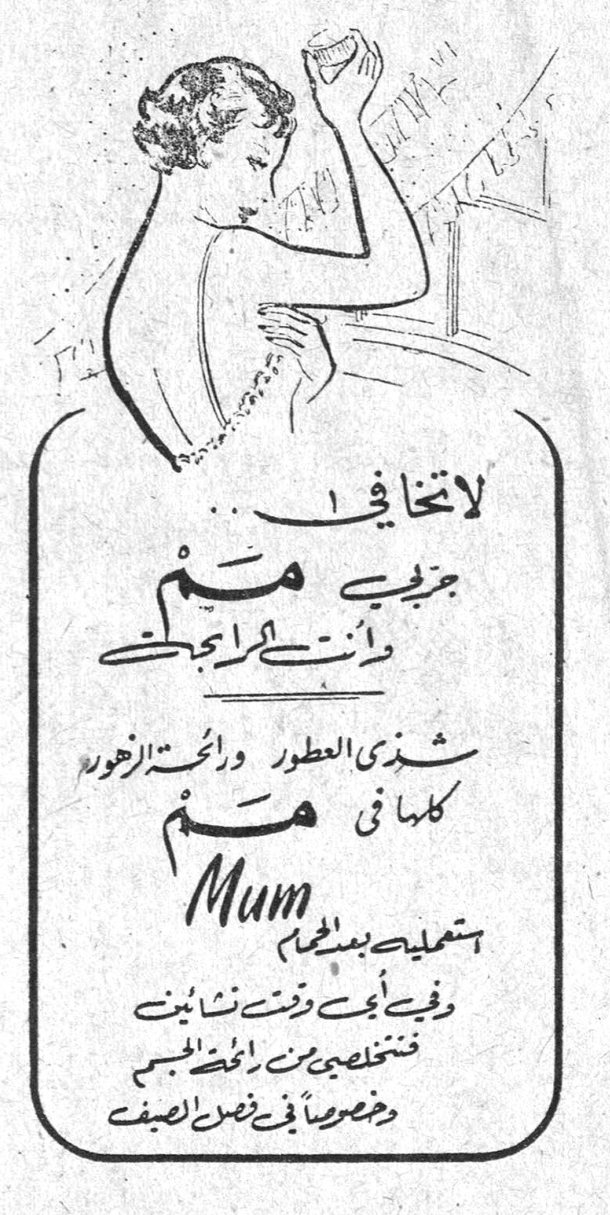
Advertisement: Mum, to Banish Perspiration Odor
Have no fear
Try Mum
wherever you sit
The fragrance of perfumes and the scent of flowers —
all of them in Mum
Mum
You use it after the bath
and at any time you please,
and you rid yourself of body odor,
especially in the summer season