sitting, we see its furniture
arranged so as to allow a number of visitors, or of the household, to sit together facing one another — for rest, for conversation, or for reading — without making the least change in the placement of the furniture. Between the circles of furniture are easy passages, for each of their parts has been set near the next, facing the axis of attraction. The paintings or pictures are near the pieces of furniture, forming part of the whole, and the beholder can easily examine them and enjoy their sight. Every piece of furniture in the room has its value and its use: on the walls a few artistic paintings, facing one another, not exceeding three; and near one of the walls a large carved chest with a side opening, used for keeping certain vessels, while its top serves in place of a table for the tea things and the like — thus fulfilling two purposes at once and saving space in the sitting room.
The idea of saving space is very widespread in our present time, because of the high cost of lodging and the crowding of populations in the cities and elsewhere. You may enter the bedroom and notice there two facing seats, used for sitting by day and for sleeping by night, both of them comfortable, ample in form, Eastern in origin; the Franks call it a "sofa," and its original name in our Arabic lexicon is "suffah."
Or you may see a seat with a table joined to one of its sides, on which the sitter leans, or which he uses for setting down the tea plate or the ashtray. Then you look at the front side of this attached table and find within it a shelf, or two shelves, that make of it a small bookcase.
Or you find a room small in size that yet appears larger than it is, because its walls and curtains are light and gay of color, ranging
between white, pale blue, beige, and off-white. That is because light colors give the idea of breadth and spaciousness, unlike dark colors.
And there is a room oblong in shape that nonetheless appears square. Why? Because the broad pieces of furniture have been set along its short side, against the shorter wall, while the pieces of little breadth run along the long wall; and by this arrangement the room appears square.
What strikes you most in the modern house is the harmony of its colors. Most of the walls, or all of them, are of light or neutral colors, forming thereby a fine setting that brings out the lines of the furniture: among them beige, off-white, dusty yellow, petrol green, pistachio, and tahini. That is in the sitting room. As for the bedrooms, their walls are white, or pale blue, or faded rose, suggesting stillness and tranquillity to the sleeper. Where the seats are wine-dark or deep in color, you will find behind them walls of a warm color such as beige or tahini, while a white wall goes well with furniture of a cool color such as light green and blue.
If you turn your gaze to the ceilings, you find them white, or lighter in color than the walls — the opposite of the floors of the rooms. You notice also the height of the ceiling, for it is better suited to the climate of hot or temperate countries. Likewise the windows and balconies, numerous, ensure good ventilation in the houses together with rays sufficient to destroy germs; over them hang curtains straight of line and light of color, which soften the sharpness of the sun without shutting it out.
I close with a list of observations that sums up this talk:
1 — The reception room contents itself with comfortable seats ranged in circles, to which are added the bookcase, which must exist in every home; a musical instrument such as the piano, or the radio; the fireplace, if it is necessary; and a few paintings, sparingly, on the walls.
2 — We should use the local color, or the Eastern style, in furniture, for it is more expressive of
our character — on condition that we lighten its ornament and make its pieces more restful and
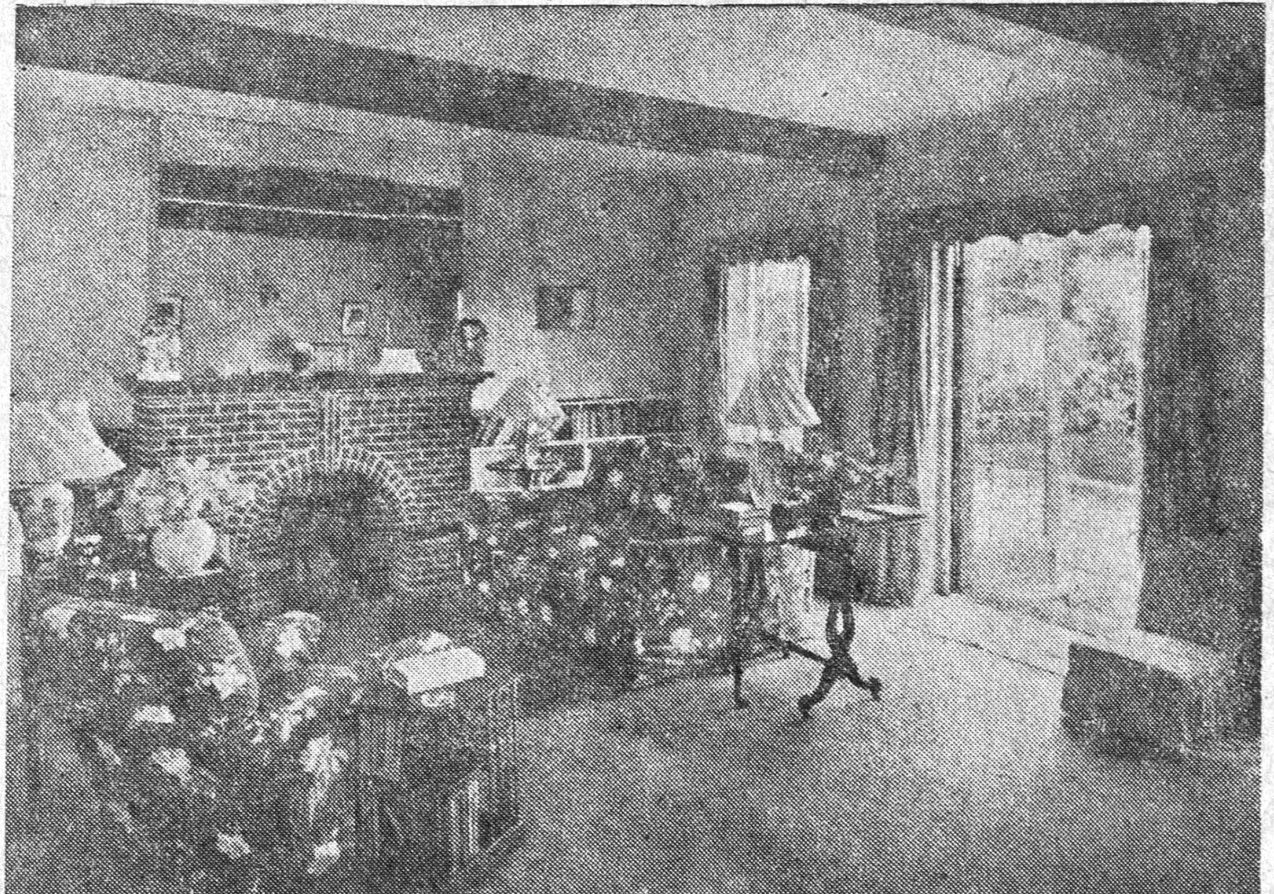
A sitting room... in the modern style