Nahla Marwa's name is not new to The Woman's Voice, but this is the first article of hers the magazine has published since her departure for America last summer, where she is now specializing in child education — the subject for which she worked long before her departure, and for which those who know her are certain she was created.
In New York State there is a large number of colleges of education whose task is to graduate women and men teachers for the various schools.
In these colleges the student, man or woman, spends four or five years after completing secondary studies in study, learning, and testing, in preparation for entering the teaching profession. This is a general law that applies to every person who thinks of taking up teaching as a profession, throughout the entire United States.
Some of these colleges are devoted to elementary teaching and kindergartens, and some specialize in secondary and higher teaching. All these colleges belong to the state, and their number exceeds thirty in New York State alone. The same holds in every state, in proportion to its population. Every person who wishes to teach in an elementary school must spend these four years in study and in experimenting with the newest methods under the supervision and
care of professors specialized in education. Each of these colleges has an elementary school attached to it, in which the students conduct their experiments and apply the theories and rules they study. This school is in truth a laboratory, most completely and modernly equipped for application, experiment, and testing.
It appears that the American state, like the states of the other advanced countries, took care to establish these colleges after it became clear to it what great importance specialization in this branch possesses. Nor did it stop at this; it enacted a law forbidding all schools, without exception, to accept any candidate to teach in them unless he has completed his studies in one of those colleges which they call the "State Teachers College." Even if a student has studied at the greatest universities and graduated with a doctorate in a branch other than education, he is not accepted as a teacher in an elementary school unless he returns to one of the said colleges, specializes there for four new years, and obtains its diploma.
The elementary school and the kindergarten are a fundamental element in the educational and cultural preparation of the rising generation here in America. Elementary education is compulsory up to the age of sixteen; and the elementary school, in addition to its capable specialist teachers, is equipped with all the means and instruments of study that pupil and teacher need, in school and outside it. Every school likewise has a special budget of its own, from which it spends on whatever supplies and needs may arise, without delay or neglect — and without extravagance or waste, of course!... For the Americans consider that the first and most important care must be given to children and youngsters in the years of the elementary stage, because this care makes of the nation's little ones lion cubs in whom good may be hoped for, and prepares them to be the sound men of the future.
The Americans' care for their little ones does not stop at the school; it goes much farther than that. In every city, large and small, and even in every village, there are playgrounds for children, and libraries for them
equipped with books suited to their ages, and gardens and cinema houses. They have everything the grown-ups have, but in a form that helps develop their minds and bodies and guarantees them a strong, sound upbringing — all under the supervision of trained specialists who carry out the tasks entrusted to them in the most complete fashion. All these houses and institutions are paid for by the state or the municipalities; they are therefore public, frequented by all the
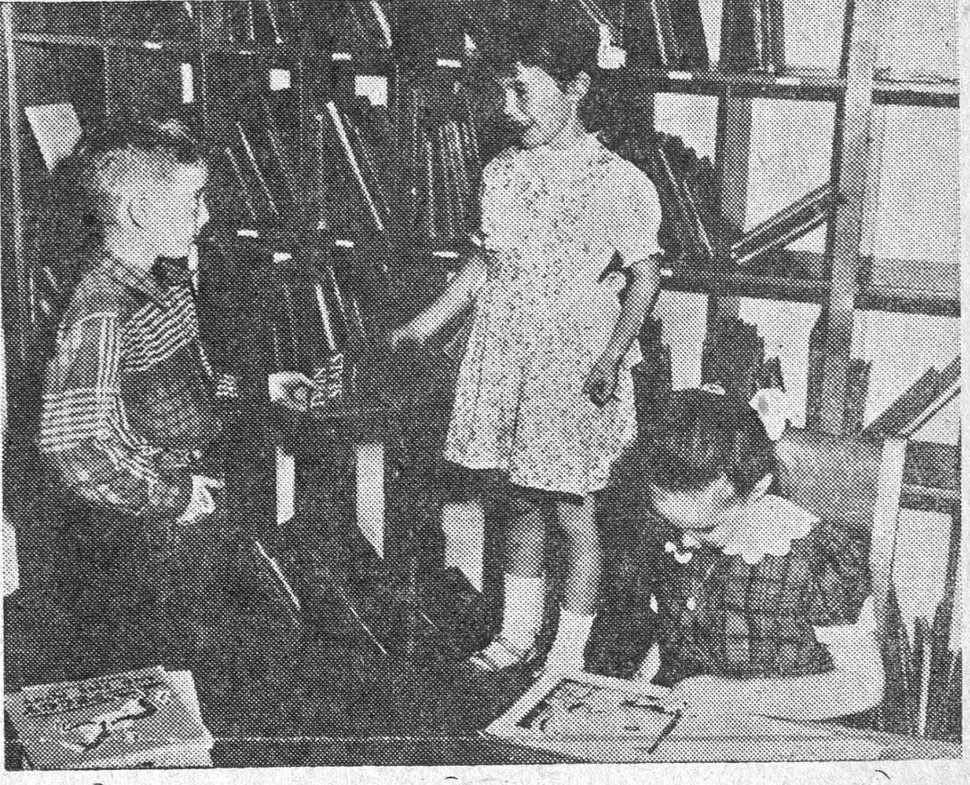
A model of one of the children's libraries