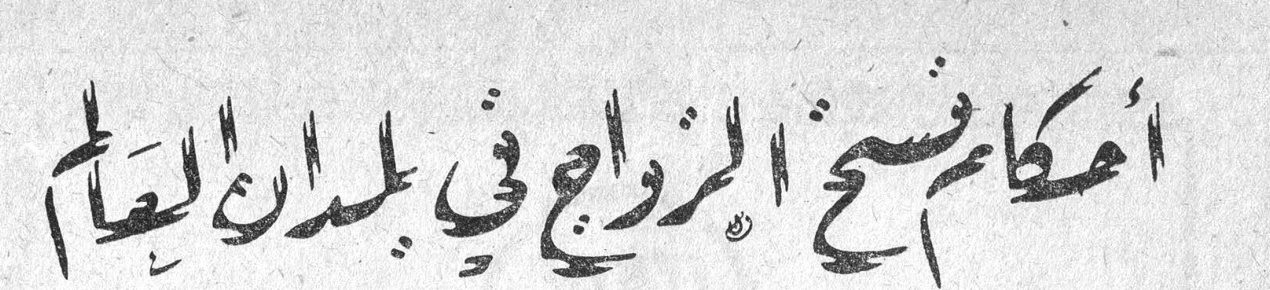
In late April 1951, the Committee on Women's Rights, an offshoot of the Economic and Social Council of the United Nations, held its fifth session.
At the committee's request, the Secretary-General of the United Nations drew up a comprehensive report on the status of women in the various countries of the world, devoting an entire chapter of this report to "the laws of marriage dissolution." We have decided to convey it to the readers of "The Woman's Voice" for its interest, and because we have
previously conveyed to them a chapter on "the laws of marriage" in the different countries.
At its fourth session, held last year, the United Nations Committee on Women's Rights adopted a resolution requesting the Secretary-General of the United Nations to obtain from the member states and from the non-governmental organizations precise information regarding the position of woman in the personal status laws of the various countries, and to submit to it a detailed report of this information.
In what follows we review the regulations concerning the dissolution of marriage — including legal separation, divorce, and remarriage — as stipulated in the personal status laws of the countries covered by the report of the Secretary-General of the United Nations.
(1) Separation:
It may be said in general that both man and woman enjoy, in most countries of the world, equal rights of recourse to the legal proceedings leading to legal separation or the dissolution of marriage. It is obvious that legal separation between spouses plays a prominent role in the Catholic
countries which do not recognize the principle of divorce.
In Italy, for example, a marriage is voided only in the event of death, and a legal separation between the spouses may take place under the conditions set forth in Italian law. Among these conditions is the commission of adultery. However, the provisions concerning the commission of adultery differ for man and woman, since that law admits no legal separation between spouses on account of the man's commission of immorality, unless it is attended by circumstances which the wife considers injurious to her dignity. The wife may also have recourse to the courts for separation from her husband if her husband refuses, without reasonable cause, to provide her a dwelling or to support her.
In Spain, separation takes place on account of the wife's commission of adultery, or the man's resort to violence to make his wife change her religion or to force her into prostitution... This resembles the law followed in the Latin American countries such as Chile, Argentina, and Brazil. In Peru and Mexico, however, the law recognizes and sanctions divorce.
In France, the law provides that if a separation occurs between the spouses, the wife resumes the exercise of her civil rights; it also provides that the wife is forbidden to bear her husband's name after her separation from him.
In Holland, the man has no right — as a result of his separation from his wife — to dispose of her property, and the woman for her part can obtain a warrant from the court entitling her to dispose of her movable wealth as she wishes.
In the Philippines, the man has the right to appeal to the courts for separation from his wife on account of her commission of adultery, and the woman likewise has the right of appeal if her husband takes the path of concubinage and cohabits unlawfully with another woman. The law there provides that the husband must remain at his wife's side during the time the court considers his suit.
As for Britain and Northern Ireland, separation is granted if the court is satisfied with the grounds advanced by the wife: such as the husband's assault, his aggravated cruelty, his desertion of her, his neglect to provide a livelihood for her and her children, or conduct of his that might drive the wife to take up prostitution as a trade. The court also requires the man to make regular payments to cover the maintenance of his wife and of the children entrusted to her custody.
In the Union of South Africa, the wife separated from her husband is considered the