No one denies the dark role that illness plays in a person's life, and the grave repercussions that ravage the patient and those around him alike.
I shall not go into the scientific theories, where we find what may save the patient — nor into any answer from the moral side, which is capable of making illness appear as an instrument of good.
The one matter to which I shall give my attention is the social side.
I shall therefore try to study the important issues that cause the many diseases here in our country, where there is nothing to protect a person from disease or to work at shielding him from it; and I shall try, in particular, to set before you some important cases, private and public, which I encountered in the course of my training in the fight against tuberculosis.
We ask first: does not the first problem arising from cases of illness stem from the family's income budget?
An ample, steady budget works like magic in these families that we must care for.
How do these families eat? How do they dress? Where do they live? How do they raise and bring up the little ones, whose number in a single home ranges between six and eight or ten, and perhaps more, while the father often earns no more than two or three liras a day?
The family rents a wretched room to live in, without water or electricity, renting it for ten or twelve liras a month.
The hardship of living for these people is doubled by the problem of total and partial unemployment. Many workers work two days against three days of idleness. Add to that the high cost of living and the paltry wages.
How, then, is one to escape the crisis of illness that besets these human beings?
We find no way out except in redoubled nourishment. And in this troubled material condition, the disease runs rampant in surroundings neglected in matters of health. These cases become alarming and frightening when tuberculosis infections begin to creep among the members of a family. And what happens then?
Sometimes the patient goes and consults a charitable physician; if he has tuberculosis, the physician directs him to go to the dispensary to be treated against tuberculosis. Very often the patient is taken to a neighboring or nearby dispensary, where he is directed to a social welfare office that cares for him and treats him. But his family — to what fate does it fall? At the outset it faces an additional expense added to the necessities of life. Want multiplies little by little, and often the parents seek the necessary food in vain. The matter is graver still if the patient was helping the family manage its affairs: the family is then
forced to keep the children from school, if they were attending, ceases to renew their clothes, and lowers their level of nourishment. The tragedy grows sharper if the patient was the family's helper and its sole breadwinner — then it is truly a catastrophe.
It is necessary to pause over the cases of certain mothers who are hurled back into pain at a sudden parting, or into a state of no assurance about what is to come. Allow me now to introduce you to some of these families.
J. S., a workman for twenty-three years, unemployed for six months, father of five children. We were asked to go quickly to look after the family, at the direction of the social service for the fight against tuberculosis.
After great effort and an exhausting walk through the sands of Musaytbeh, under the burning rays of the sun and amid flying dust, we found J.'s home. And what misery we saw there!
A small room, damp in winter, scorching in summer, with a single opening, rented at 15 Lebanese liras a month. The owner of this room is trying to throw the family into the street, because it has not paid the rent for seven months. The furnishings of the room consist of an old bed and a child's bed, two or three chairs, and a
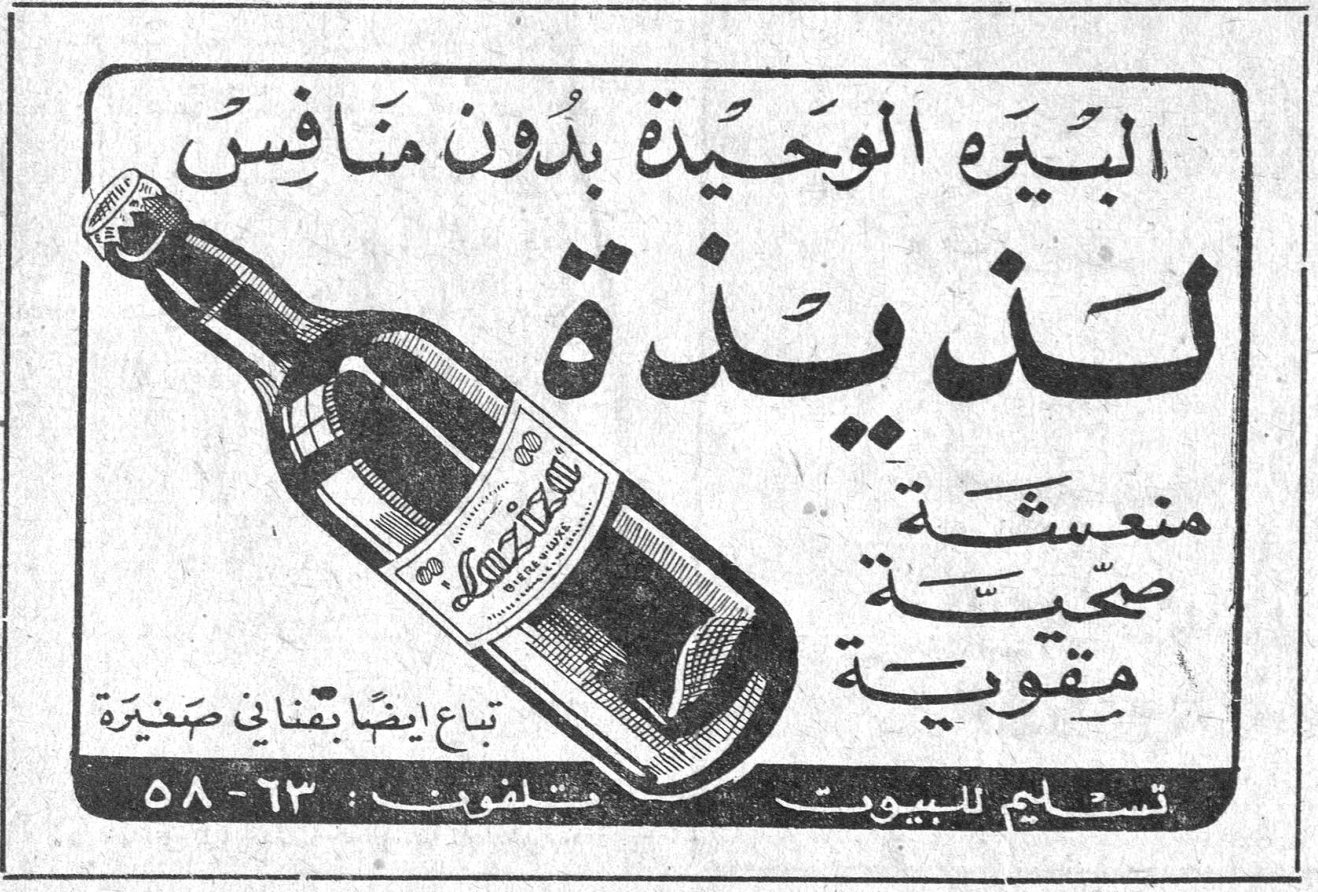
Advertisement: Laziza Beer
The one beer without a rival
Laziza
Delicious
Refreshing
Wholesome
Fortifying
Also sold in small bottles
Home delivery
Telephone: 63-58