loved for three years, because her family insisted on his marrying her quickly — and this in order to go on contributing to the help of his family.
But what happens if the illness drags on?
In the face of these painful, distressing cases, what can we do? On what effective element can we rely?
On the medical side we have the free examinations at the dispensary for the fight against tuberculosis, and the devotion of the doctors and the social workers — the succor of them all is valuable and great. Free hospitalization in a sanatorium likewise has its effective influence, and the credit for that belongs to the Ministry of Health.
But on the social side, how are we to help these poor people mired in misery?
We sought help from the houses of charity — as numerous as the rites and communities of Lebanon — and it was generous. It was begging on our part, but an honorable begging. The charitable associations have concerned themselves with the social side, and one of them gives us a monthly assistance of ten Lebanese liras, granted to a family so long as one of its sick is in the sanatorium. Besides the help of the charitable associations there is individual help. And we must rely on this individual help alone when the patient is a stranger to Lebanon, for there exists in Lebanon no free sanatorium for strangers.
We petitioned the Ministry of Health and Public Assistance —
and our request was granted — for the creation of assistance cards in the orphanages for the children of the sick. We could also wish that a government budget enabled one child of each tuberculosis patient to enter the orphanage at the government's expense; but alas, it is a mere wish.
The labor insurance law, when it is applied, will resolve a large part of the crisis. We had occasion to look after the case of a working girl of twenty who works at the Régie for a weekly wage of fifteen Lebanese liras. She entered employment in October 1949 and began to cough in October 1950. She was treated by the Régie's physician for a time, and was afterward admitted to the sanatorium once it was known that she suffered from this disease. She entered the hospital in January 1951.
We were overjoyed to learn that the director of the works where she was employed comes to visit her constantly, which heartens her, and that he paid her the salary of her three months of illness.
In some official departments an employee is helped if struck by some illness, provided he is on the confirmed staff.
We greatly hope that the project of prevention of disease and insurance of the sick will be realized in Lebanon. It is essential to create an official body to care for these poor unfortunates, so that fate does not fling them into beggary, and so that they are not left prey to the disease which strips them of their strength and of the means that would help them secure the life of their families.
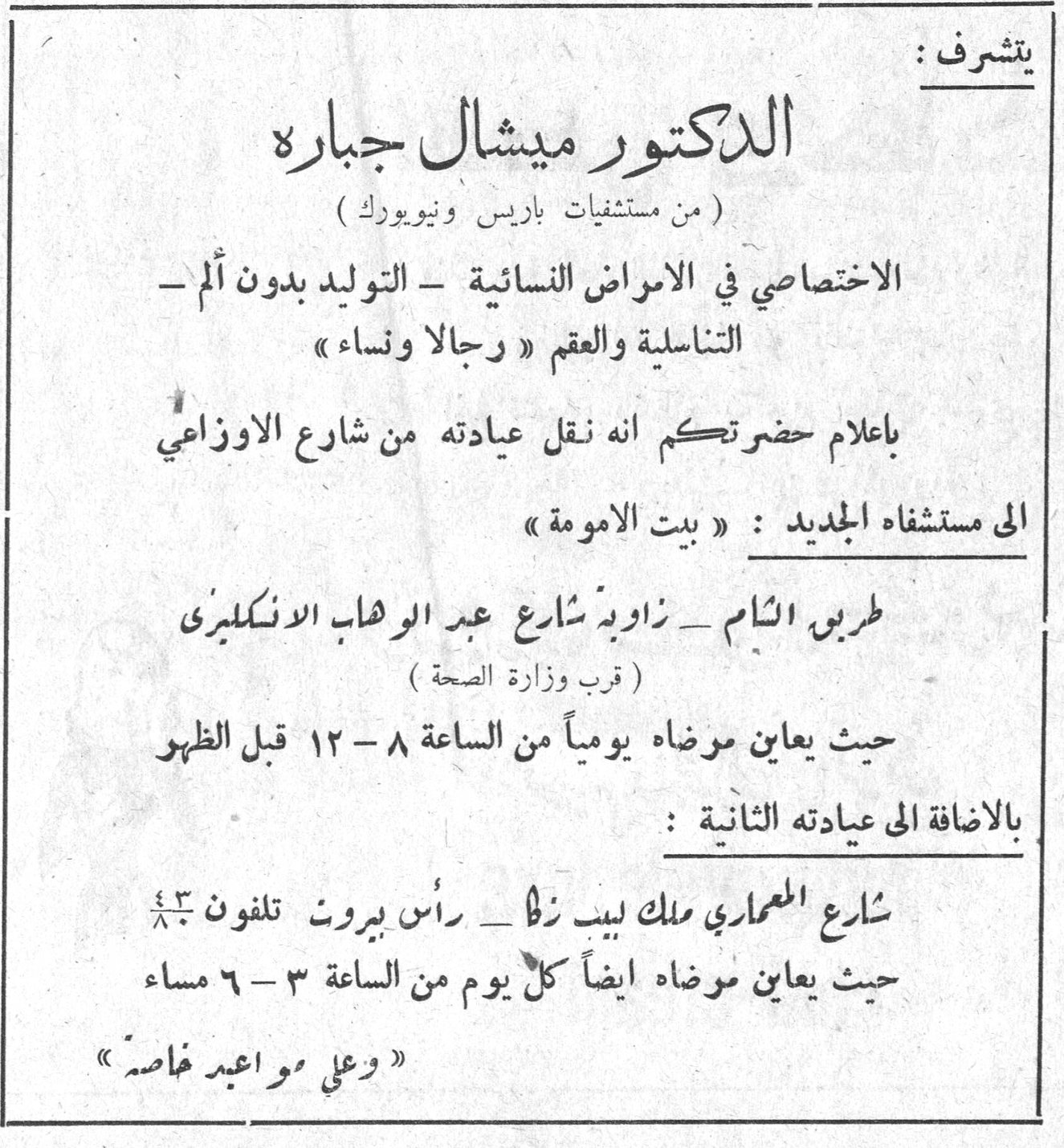
Advertisement: Dr. Michel Jabara
Dr. Michel Jabara
(of the hospitals of Paris and New York)
Specialist in women's diseases — painless childbirth — genital diseases and sterility, "in men and women"
has the honor of informing you that he has moved his clinic from Ouzai Street
to his new hospital: "The Maternity House"
Damascus Road — corner of Abd al-Wahhab al-Inklizi Street
(near the Ministry of Health)
where he sees his patients daily from 8 to 12 before noon
in addition to his second clinic:
al-Ma'mari Street, building of Labib Zala — Ras Beirut, telephone 42...
where he also sees his patients every day from 3 to 6 in the evening
"and by special appointment"