
Modern literature is distinguished by its penetration into psychological studies which the older literature neglected absolutely, and by its care to trace the states stirred up by the awakening of emotion in the young, or its aging in youth, or its coldness in the old. These are new circles and arenas which modern literature opens, and which yesterday lay in the forbidden unknown.
What are life's impressions upon the fresh souls of the young? How do poetry, art, and music work upon certain dreaming little girls? And what do they feel before certain palaces shut in the face of their imagination?
In the story published here, Mrs. Elena Silveira, the Brazilian woman of letters who has become known to the readers of this magazine, tells us everything charming and delightful.

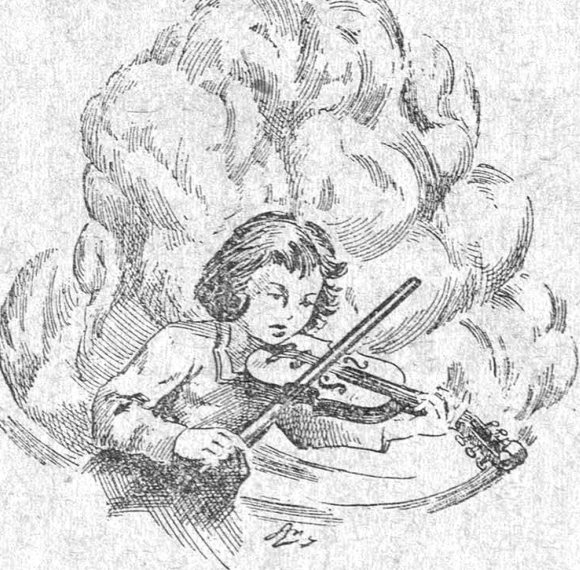
In that period, the period of my violin lessons, I would go twice a week to Dona Mirtes's house and spend the rest of the days waiting for the lessons to come; my heart had bound itself to my teacher and to the world of melody, and I gave myself over to her, and both became part of me — for Dona Mirtes's thin, graceful hands had the power to make of the violin a tormented being that moaned, giving voice to the sorrows of the whole world.
And my teacher was generous: after the lesson she would play for me whatever I wished; and she was indulgent and tender toward my first years of girlhood, thirsty for everything beautiful and imprisoned within a narrow horizon — the horizon of Casa Branca, the country town where we lived.
And when the melodies poured down upon me and built about me a dome in which enchantment echoed, my teacher would change — in my eyes — from a spinster, neat of dress, artless of glance, fidgety of movement, into another person created for me by my sweet dreams! The traces of the years would be wiped away from the thin face bent over the violin, from the sparse hair
and the worn-out body, and I would see her a beautiful young woman, burning with the heat of youth, whom no one had heeded, so that she withered away waiting for the prince of her dreams!
In those minutes my imagination would take revenge upon the life that had been so hard on my teacher: it would create for her a bewitching beauty, set beside her an adoring young man, and lodge her in a house of luxury and elegance surrounded by an English garden with green
terraces sloping down and down to the shore of a blue lake...
And when the violin's last notes died in the air, my teacher would lean tenderly over me, and I would breathe the scent of cologne and see her sweet face, its wrinkles traced like threads; the tears would spring to my eyes, and she would kiss me in silence, and I would take leave of her with a gesture, emotion gripping
my throat so tight that not a word came out.
•
As for my madness for music, it showed itself the day we went down to the city of São Paulo to spend a few weeks, and my family took me to a cinema hall.
A man appeared on the stage and began to play the violin, and the colored lights poured over him and gave him a strange shape. He began to play a piece by the composer Dvořák, and the melodies rose little by little until they took possession of me and of my senses. The hall darkened, and everything around me vanished: the face of a boy among the spectators whom I had begun to love vanished; the beauty of my elder sister Livia vanished; everything vanished, and nothing remained but the graceful hands and the angular face — that demonic face bent over the violin. I yielded like one given a drug, and went with the melodies into an enchanted world, and plunged into deep, clear waters, and kissed — as they do in the cinema — the face of an unknown young man over whom yellow lights poured.
The melodies strolled over my tender girlhood as along a red road going deep into the earth, passing... and passing... descending with me into fathomless chasms, then drawing me up and walking with me and showing me unknown horizons and unfamiliar landscapes.
When the hall was lit again I was