of Western Europe and Latin America, their laws closely resemble the Napoleonic Code, which holds that the husband is responsible for defending his wife and her honor, while the wife in her turn is responsible for following in her husband's train and taking his guidance; she must always dwell with him and
follow him to the place he chooses to reside in.
There are other Western states whose laws rest in origin on the said Napoleonic Code, but which have departed from it in order to bring the position of the married woman more and more into harmony with the social development that has taken place since that code was laid down in 1804. In France, for example, the law provides that each of the spouses owes the other fidelity and assistance; yet although they are equal in their family duties, the penalty the law has imposed on the woman, should she break this fidelity, is severer than the man's. If the wife is convicted of adultery, for instance, her punishment is imprisonment for a term rang
ing between three months and two years, while the husband is punished only by a fine if he commits adultery in the conjugal home. An amendment was introduced into French law in 1942, by which the woman was granted new rights: this amendment gave married women the same legal rights that men enjoy, so that the woman now shares with her spouse the direction of the family in both the moral and the material respects.
Nor did women's rights in France stop at this limit: it became her right to take her husband's place as head of the family during his absence. The right to choose the place of residence still rests with the husband, but it is no longer an absolute right: if the dwelling the husband chooses for his family's residence involves material or moral dangers threatening the family's existence, the wife may obtain an authorization from the court to select another dwelling for herself and her children.
In Belgium, the woman is obliged to dwell with her spouse wherever he wishes. The two spouses must also contribute to the household
expenses to the extent that the circumstances and condition of each permit.
In Italy, the spouses are subject to what the duties of living together, fidelity, and assistance dictate to them. Add to this that the woman's fidelity to her spouse is a duty that must remain in force even if a separation occurs between them. Italian law provides that for any man who kills his wife who has separated from him, or inflicts any harm upon her because she has violated the sanctity of her fidelity to him, imprisonment alone is all the punishment that falls upon him... The husband in Italy is the head of the family, and the wife must follow him to the dwelling he chooses for his residence; however, the new law enacted in 1942 recognized the legal personality of married women.
In Germany, the law differs from the Napoleonic Code and the other codes derived from it, for it proclaims mutual duties between the spouses with respect to their married
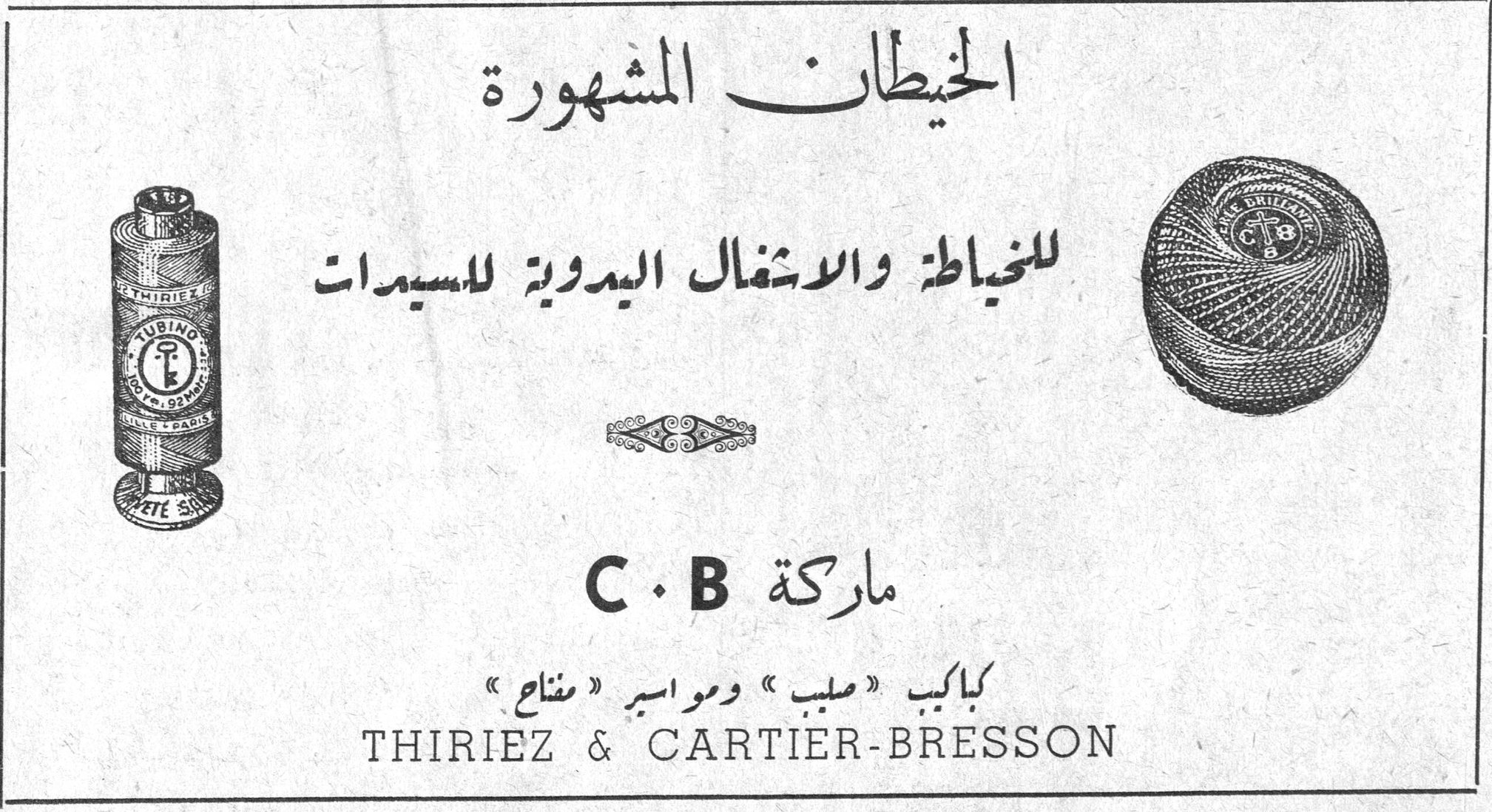
The Famous Threads: Thiriez & Cartier-Bresson
The famous threads
for sewing and for ladies' handwork
Brand C.B
On "Cross" spools and "Key" tubes
THIRIEZ & CARTIER-BRESSON