The Parliamentary Committee on Administration and Justice held a meeting, attended by the Minister of Justice, and studied the bill providing that woman be given her political rights.
At the close of the meeting the journalists asked Mr. Abi Shahla about the result the committee had reached, and he said that it had approved, by majority, giving woman her political rights, so that she will be an elector and eligible for election. We found, likewise, that there is no need to amend the Constitution, for it did not deprive woman of her rights. A subcommittee has been formed to put the law in its final form, and I believe it has only to propose the amendment of one of the articles of the electoral law, so that woman may have the right to exercise her political rights.
The Bill
A single article — The Lebanese woman is given the right to be an elector and to be eligible for election to the bodies of mukhtars and to the municipal and parliamentary councils, provided that the conditions required of males are fulfilled in her.
There shall be added to the electoral rolls the names of those women in whom the legal conditions are fulfilled, when these rolls are drawn up in accordance with the provisions in force.
The Statement of Reasons
The Lebanese woman has lately — especially since the Syrian woman was given her political rights — begun to demand that she be given these rights. In studying this subject from the legal standpoint, the question arose as to what ought to be done should opinion settle upon granting the Lebanese woman her request: must the Constitution be amended, or can an ordinary law suffice, amending the provisions relating to the election of mukhtars and of the municipal and parliamentary councils?
From a review of the Constitution it appeared that Article 21 pro
vides that every Lebanese citizen who has completed twenty-one years of age has the right to be an elector, provided the conditions required by the electoral law are fulfilled in him; and that Article 7 provides that all Lebanese are equal before the law, enjoying equally civil and political rights without any distinction among them. The word "Lebanese" occurring in this article covers males and females from the linguistic standpoint; and from the legal standpoint the legislator did not intend to distinguish between males and females, and did not enter into details, but referred the matter to the law concerned with elections.
The provisions of the Constitution, then, do not conflict with giving woman the right to
vote; but the electoral laws confine this right to male Lebanese, as appears from Article 21 of the electoral law issued on August 10, 1950, and Article 16 of the municipalities law issued on November 27, 1947. Accordingly, we are in no need of amending the Constitution in order to give woman her political rights: an ordinary law suffices for that.
And since the electoral rolls have hitherto been drawn up with the names of males only, and since adding women's names to them requires a special effort, we have seen fit that the departments be given sufficient time to prepare the electoral rolls at their legal times, women's names being added to them when they are drawn up in accordance with the provisions in force.
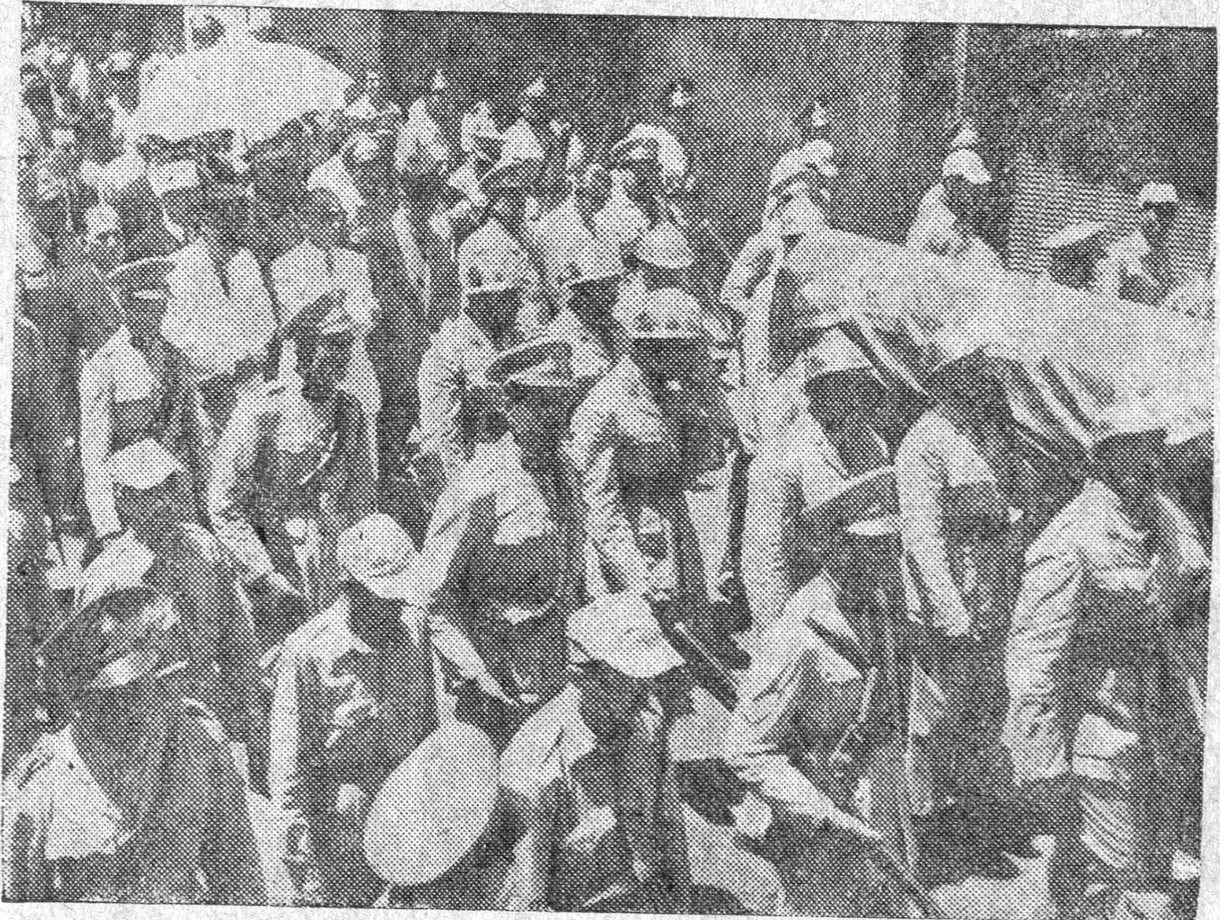
Beirut escorts to the grave His Eminence Sheikh Muhammad Tawfiq Khalid, Grand Mufti of the Republic.
* Lebanon and the Islamic world have lost a pillar of religious law and piety with the death of His Eminence the Grand Mufti of the Lebanese Republic, Sheikh Muhammad Tawfiq Khalid. God took him unto His mercy at the beginning of last month in Bhamdoun; mountain and coast were shaken by the enormity of the loss, and grief spread among all the sons of Lebanon.
To the men of religious law and piety in general, and to the bereaved sons of the departed and his honored family in particular, our warmest condolences.