"reversible death," because life can return, or be recovered by swift and effective means, if the principal organs are sound and no disease has ravaged them. The second stage he calls "final death" — that from which there is no return. Here, for example, is a drowned man pulled from the water unconscious; here is a motorist found slumped over the steering wheel with the garage doors shut upon him and the car's engine running. The doctor comes and feels no pulse and can make out no breathing; he sends for a respirator (a breathing apparatus); the minutes speed by — and behold, life has returned to them.
On Dr. Carrel's view, this stricken being had died — died a real death as far as his consciousness and his body as a whole were concerned. And between those who answer the summons of the respirator and live again, and those whose case proves beyond help so that they remain dead, there is a difference: in the first group the principal organs have not yet been destroyed.
And what do those say who have been saved from death by drowning? You will find them always saying that they never suffered any racking distress after the first struggle for rescue; that overwhelming anguish lifts, and after it comes a rest like the doze of a sleeper. One of those who survived after drowning — Grant Allen, the famous English writer — wrote:
"I knew, and it settled in my soul, that I had once experienced death, and this had the greatest effect in making me indifferent to it. Death, like sleep, is free of pain. In death a man finds no pain to oppress the soul; the pain he meets lies in what precedes it — in the struggle and in the sense of its approach — and even this pain is less than what a man feels when a leg of his is broken or a tooth pulled. I felt no creeping of fear within me."
True science explains to us what we meet at the hour of death:
the cause of what we experience in it is the effect of the dissolution that creeps through the organs. Each heartbeat is weaker than the one before it in its power to drive the blood through the veins of the body; and as the pressure of the blood steadily fails, a calm and a rest steal over the brain, owing to a gentle numbness whose source is
the drying up of the well-spring of the body's vitality. For that mighty wave of human energy has begun to recede, like the ebb tide drawing back into the great sea of universal life, slipping away into depths far from its roaring surge! Then the body of the living relaxes, and receives the most wondrous of life's events with a soul at peace.
• Dumas, the French novelist, was on his deathbed, and his faithful servant was in a corner of the room sobbing like a child. Dumas turned to him with eyes over which death had spread its veil, and said in a voice carrying the rattle of death: "Do not weep, my friend; if I need you in the life to come, I shall send for you."
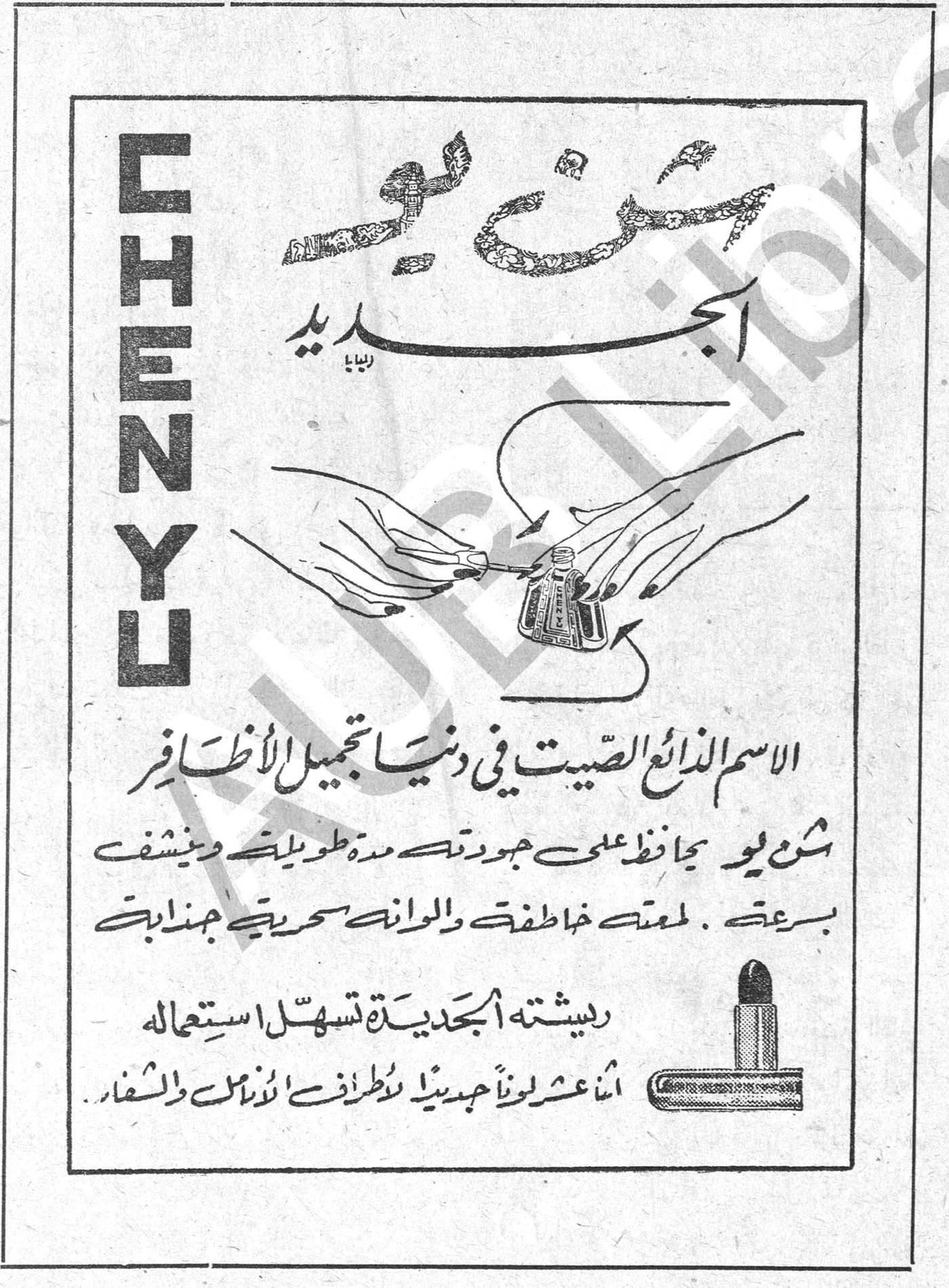
The New Chen Yu — CHENYU
The new Chen Yu
The name renowned throughout the world of nail beautification
Chen Yu keeps its quality for a long time and dries quickly. Its sheen is dazzling and its colors magically alluring.
Its new brush makes it easy to apply.
Twelve new colors for fingertips and lips.