A Lebanese girl recounts to us the Girl Guides' journey on foot from Jezzine to Falougha
I saw her just after her return from a journey unlike any that people are used to. Her forearms and neck were reddened, her cheeks aflame from walking and from spending ten days in the open air. She said:
Many of my companions used to shake their heads and shoulders and say: You join the Girl Guides troop and go from place to place, with the ground for your bed and the sky for your blanket? What frivolity is this — what madness, rather! How could it enter our minds to leave our comfortable homes, our delightful parties and evening gatherings, to sleep in the forests and on the ground like savage tribes?
If my reader will follow me, she can judge which of us was right — my companions or I.
We set off, in God's name, by car to Jezzine. We were ten girls: Maud Moussa Nour, Ghita Wehbe, Céline Kalzi (from Aleppo), Milia Lahd, Edvick Dabromouth, Odile Dondel, Stella Barouk, Thérèse Haj, Manon Shleila, and I, Lubna Nader. From Jezzine we carried our packs on our backs and set out on the road to the village of Bater, which lies 8 kilometers from Jezzine. The peasants along the road would stop us and ask where we were going, and invite us to take coffee in their houses, whispering among themselves that we would never manage to reach Bater — yet they encouraged us and wished us a safe arrival. The road between Jezzine and Bater has not yet been reached by "the blessing of asphalt," and walking it is hard. After
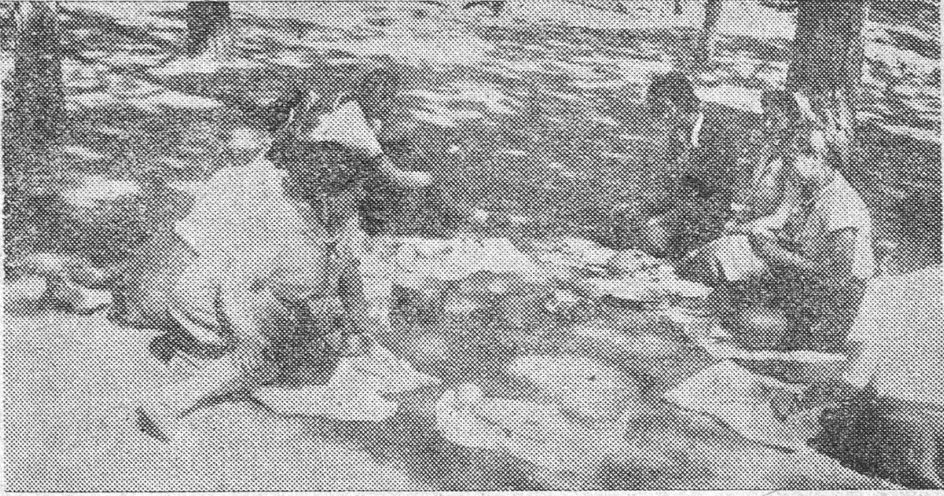
The lunch hour among the pines
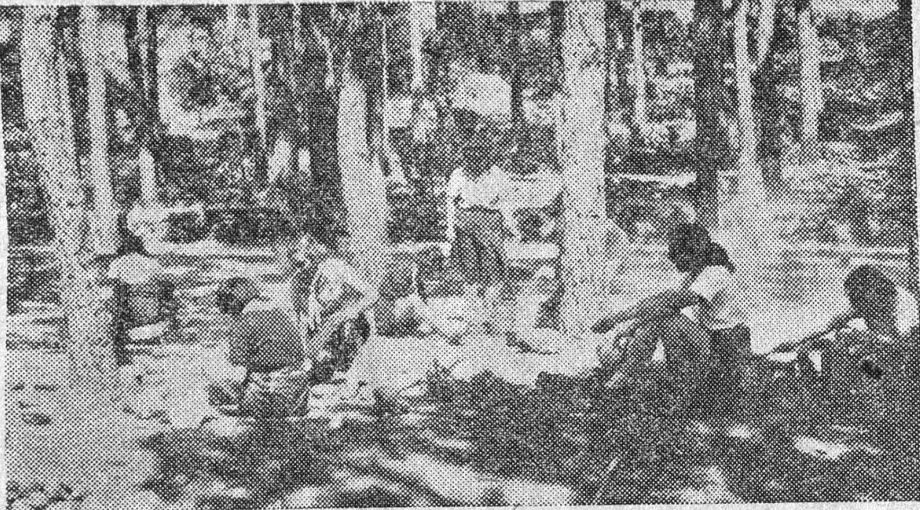
The camp girls cooking their meal
a two hours' march we reached Bater, and there the generous countryman Adel Bey Hamdan and his wife, a lady of abundant kindness and refined breeding, welcomed us warmly and fed us a delicious supper. On the roof we undid our packs and belts and lay down in the moonlight, after saying the evening prayer together. We stretched out gazing at the clear sky studded with glittering stars above our heads; we were tired, and we sank into a deep sleep.
That night was the first time we slept on hard ground with nothing over us but a single blanket. On the second day we rose early and bade farewell, regretfully, to that hospitable Lebanese house, and set out toward Moukhtara, on a road not free of dust and pebbles, but beautiful for the vines and fig trees along its sides and for the enchanting views it overlooks: there lies a great green valley, with little streams running along its floor.
We walked singing songs at the top of our voices, their echoes filling the air around us. When we reached Moukhtara we were dead with fatigue. But it was a fatigue dispelled by the kindness of Kamal Bey Jumblatt and his refined lady, his wife, who brought us into the beautiful gardens and said to us, "These gardens are yours."
After a fine supper in the house of the scion of the Jumblatt family, we sang in the palace garden amid the rustling of the branches and the murmuring of the waters.
We kept thinking that but for this journey we would have remained ignorant of this region of our country, and we asked ourselves how a person can love his homeland without coming to know its parts. Which of us knew the Chouf before today — save those who were born there? We used to hear of the Lebanese spirit of hospitality without ever coming to know it.
After Moukhtara we set out on the longest stage: Beiteddine, then Ain Zhalta. The road is well