it depends on the residents' own wish and on their capacity for work.
Q: Is there a library in the home? A: There is nothing in the library but religious books.
Q: Is there a radio in the home, from which the aged may listen to music, the news, and the like? A: An atmosphere of asceticism and worship prevails in the home, and so there is no radio set in it.
Q: How do the aged spend their time? A: They pray at six in the morning, take breakfast at seven, pray again at nine, lunch at eleven, pray at half past three, and take supper at seven in the evening. After supper they pray and go to sleep.
Q: Do quarrels break out among the aged? A: No; the aged live in complete harmony and concord, and a spirit of brotherhood prevails among them all.
Q: Do they go on any excursions? A: No, they take no excursions; some of them have not the
strength to move about. But some go to visit their families on certain occasions.
Q: Are there employees in the home who draw monthly salaries? A: No; there are eight nuns in the convent besides the superior, and they carry the burdens of the home — except for a cook, who is paid a wage.
Q: Do you accept new members into the family of the aged? A: We accept them in extreme cases only, since the home's budget does not permit increasing the number of the aged.
Q: Do you suffer from a financial crisis? A: We are always in need of money. We have no savings whatever; what we receive, we spend.
*
And we went strolling through the home. Here is the church, built in the splendid Roman style. Here is the room of the bedridden among the aged, whom the nuns take pains to feed. Here are the sleeping rooms — spacious, clean, comfortable. Here is the great kitchen, which runs on Butagaz. And here is a little room in which a bed has been placed, and on it sat an old woman 110 years of age — a collection of bones and protruding veins, and wrinkled, discolored skin.
I asked her: How old are you? She stretched out her arm to show me the date of her birth pricked in with a needle — but I could make out nothing, for the wrinkles hid the truth.
I said to her in a loud voice: When were you born? She said: The year forty! I said: You mean you were born in 1840? — She nodded her head in assent.
I said: Whom do you remember of the people of that age?
After some hesitation and wander
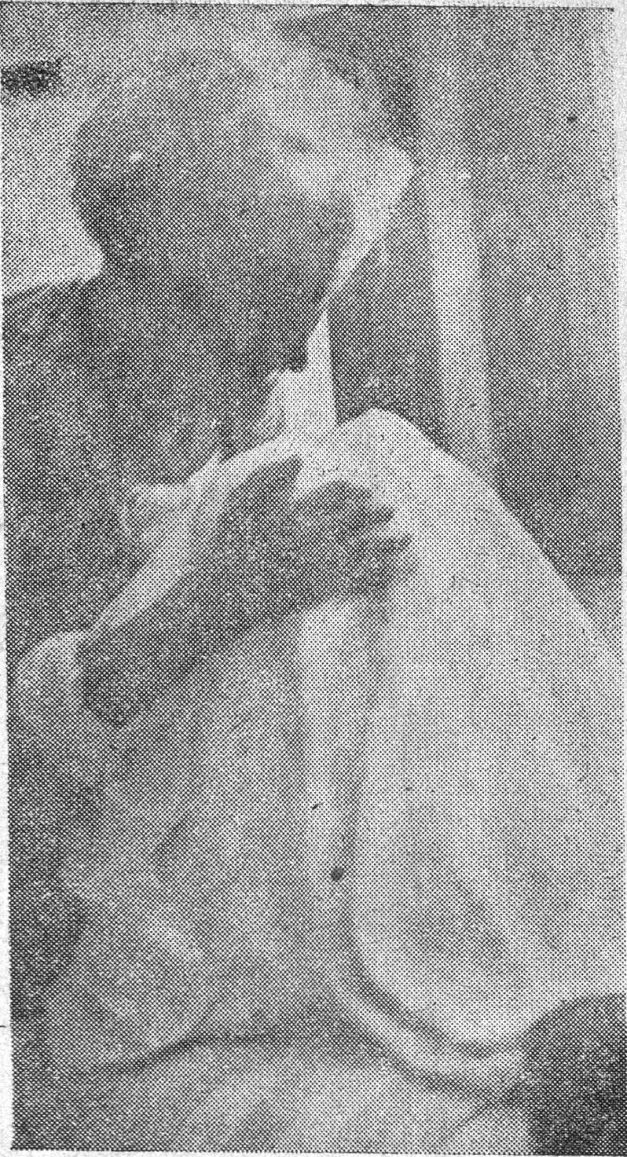
She is 110 years old, from Baabda, and the convent's superior says that she taught His Excellency Sheikh Beshara El-Khouri, President of the Republic, in his childhood.
ing of mind she said: The Emir Bashir was a good man. I left her, wishing her long life.
It seems that old women never lose their sense of humor, however the years pile up upon them; for as I was about to enter the old women's dining room, one of them, standing at the threshold of the door, said to me: Come in and have a look at these young girls!
And so the tour of the old people's home came to its end. I bade farewell to its superior, Mother Cléante, and its engineer, Mr. Bakhos, and thanked her for her kind hospitality, wishing the home every progress and success, and hoping that it may find from the state and from the people's organizations the support and backing it deserves.
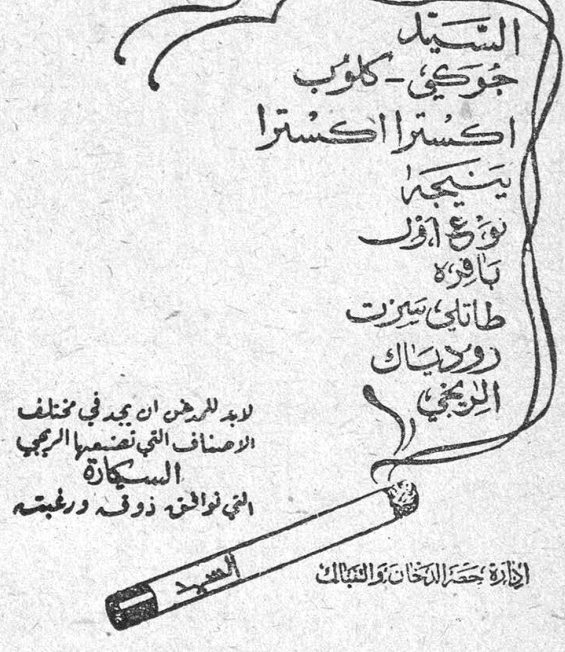
The Tobacco and Tombac Monopoly Administration
Al-Sayyid
Jockey Club
Extra Extra
Bitijeh
Bokzar
Panora
Tabaq Tabzit
Rodiak
Al-Zaki
So that every man may find, among the various brands it offers, the cigarette that suits his taste and his desire
The Tobacco and Tombac Monopoly Administration