
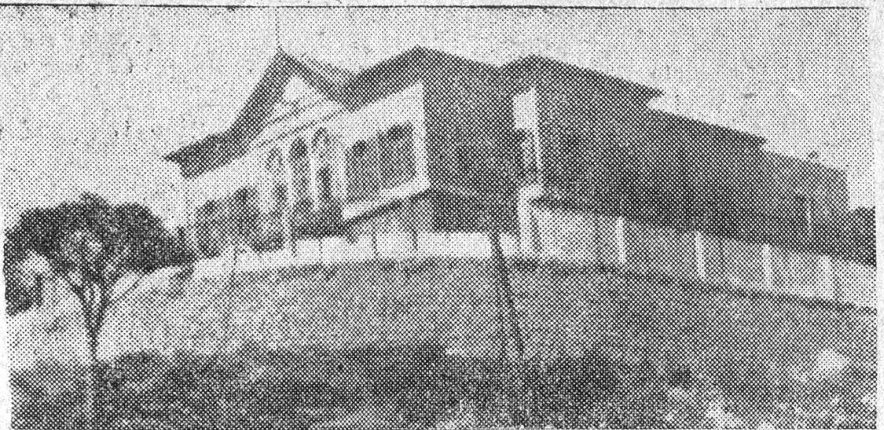
When one rises nine hundred meters above sea level, and the automobile brings one to the village of Bhersaf — a name perhaps taken from the view of the sea, which from that region looks like a clear mirror — then the automobile climbs on to the famous Bhannes sanatorium, then carries one eastward about a single kilometer... one sees a large house standing on a high summit, a house that has no like among the houses of Dahr al-Sawan: a government serail formerly, and the juvenile reformatory today.
On my way to the reformatory I met a juvenile, and I said to him: Where are you going, boy? He said: To the reformatory. I said: Are you under sentence? He said: Yes. I said: And where have you been? He said: I spent the feast holiday at our house. I said: You are under sentence, and they allow you to go home? He said: The director of the reformatory is lenient with the juveniles who conduct themselves well, and I am one of them. I said: And what is your crime? He said: Taking part
in a forbidden game of gambling. I said: And what was your sentence? He said: A single year, which I am serving in the reformatory.
Then the boy cut short the thread of my questions, saying: Let us hurry a little, sir, for I must be at the reformatory at the appointed time.
When we reached the outer gate of the reformatory, we found its director, Mr. Habib Halihel, awaiting us. And we went strolling in the reformatory's courtyard, looking out over a captivating view that bewitches eye and heart: here are Aley, Broummana, and Beit Mery; here Bhamdoun and Sofar; there the monastery of Mar Chaaya; and there Baabdat and Qornayel.
Then we began to speak of the subject we had come about.
Q: To which ministry does your reformatory belong? A: Our reformatory belongs to the Ministry of National Education.
Q: And when was it founded? A: It was founded on June 14, 1947. At first it was ringed with barbed wire and guarded by a force of gendarmes... but we soon turned away from this barren method, bound up with coercion; we abolished the gendarmerie post and replaced it with watchmen, whose task is to protect the reformatory from the outside, not to prevent the juveniles from escaping.
Q: And how many juveniles are under sentence? A: Sixty-three.
Q: And what are their ages? A: Their ages range between 12 and 18 years.
Q: And what are the crimes they committed? A: Their crimes are various; on the whole they have to do with theft and pickpocketing, moral offenses, forestry violations, and some cases of killing.
Q: And what are the lengths of the sentences? A: The juveniles' sentences range between one week and four years.
Q: A single week in the reformatory... and is that period enough to reform the juvenile? A: It once happened that a boy was sentenced to confinement in the reformatory for four days; he reached us with the term of his sentence already expired, so we returned him to his home.
Q: Where, in your view, lie the hidden causes of juvenile crime? A: The principal causes may be summed up as destitution and want, the loosening of family ties, the fading away of fathers' authority over their sons, and the spread of ignorance and illiteracy.
Q: Are the juveniles from the circles of the cities or from the villages?
A: Most of them are from the cities, and a very small minority of them from the villages.
Q: Did they attend schools before they strayed into the world of sin?
A: Nine percent of them attended the primary schools... and the rest are illiterate.
Q: And do you see to the teaching of the illiterate?
A: Not a month or two passes after an illiterate juvenile enters the reformatory before he sets about
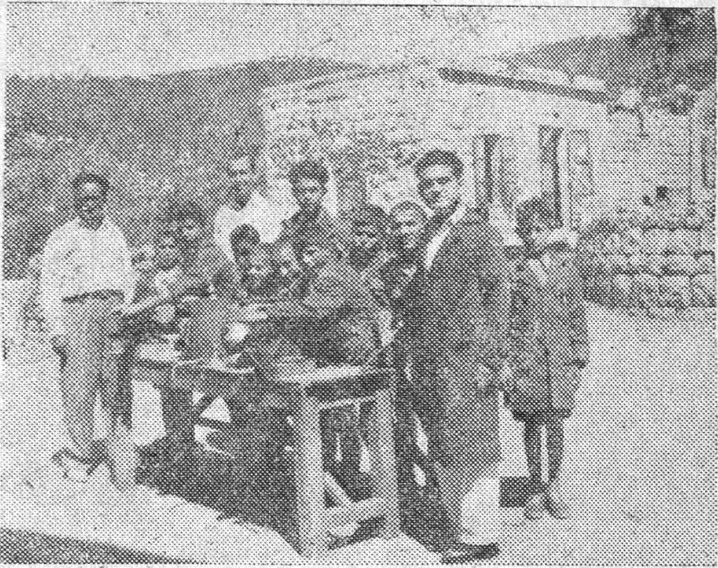
Pupils from the blacksmithing section of the reformatory