... This is the talk of childhood, of which one never tires, recorded by a literary mother about her clever, sweet little girl... Would that there were always to be found, among our mothers, someone to feed this charming section!
There is in her something of the leap of enthusiasm: if she grows enthusiastic over a thing, you will see her preening herself upon it and chattering about it, never ceasing to load your ears with what she believes until you concede her the point, whether you are convinced or not.
And there is in her something of the vanity of youth.. If she has adorned herself — and her adornment goes no further than tying a bright ribbon on one side of her head, or on both — you will see her step forward before the mirror and step back, then bow and strut; and hardly does she notice that you are watching her before she startles you with an answer such as this: I wanted to know whether I look like Marguerite in some of her roles or not — meaning Margaret O'Brien, the little film actress.
And there is in her a great deal of self-confidence — a confidence whose lack in me she sometimes finds fault with; for she believes that "Mama" is a coward, because she fears for herself or for her children the outcome of some long-drawn-out pain; and she will not desist, arguing and maneuvering, until she brings you an argument like this:
God, who you say loves all people, cannot possibly hurt those He loves.
She is, besides, in constant motion, wholly absorbed in it, with a great deal of astonishing attentiveness to what goes on around her.
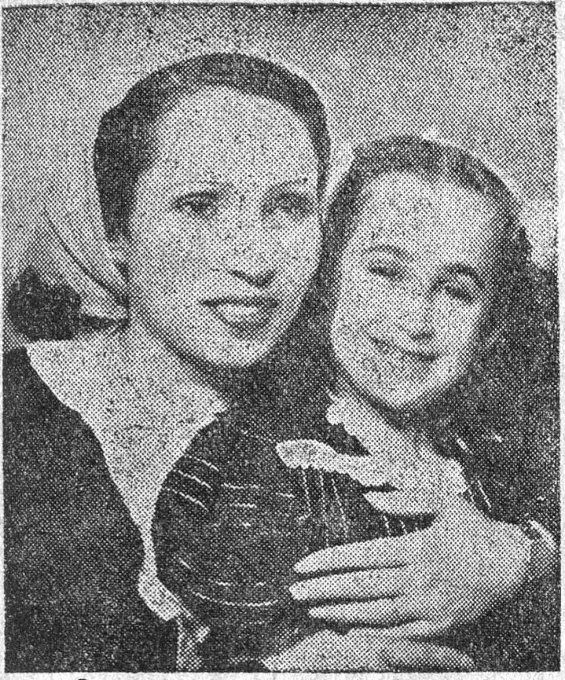
Such is my daughter Nasimah. She is seven years and a half old; yet despite this age you would imagine that she has already marked out her desired path, or nearly so, and picked out the bridegroom of her dreams — and then renounced marriage, saying that there is in it an injustice that falls upon woman, and that she will on no account bear this injustice; and she has revised her opinion of religion, after asking, and deducing, and observing.
As for what will become of her tomorrow, that only God knows; and as for how she will fare with life — life is hard, alas, on those of delicate feeling.
I saw her some days ago sunk in a mute, downcast silence — and I know she does not hang her head like that unless there stands between her and
weeping and sobbing only a whisper, or a touch. So I signaled to her father to act; he took her by the chin and raised her head toward him, and there welled up in the two olive eyes a flood of tears on the point of pouring down. He said to her: What is the matter, Nasimah? Tell me, and let me see...
She said, scarcely able to keep herself from crying: Those "literaries" — she meant the writers — I cannot love them. He said: What have you to do with them? She answered with an astonishing confidence: Because I am going to be a woman writer. He said: Then why do you not love them? She said: Because they said about Mayy — the great Mayy — many things that are not true. Did they not say of her that she went mad because she missed a collection of letters and could not find them? Mayy the writer could not possibly lose her mind over letters. So I said, thrusting myself into the subject — I had spent an hour, or the better part of one, debating this very subject with her father while she was absorbed in her games — Then why did Mayy go mad, Nasimah? Was it over the death of her parents? She said: Never, never! I, when you two die, shall not go mad — just as Mayy never went mad at all. Then she broke into a fit of sharp weeping which, as I rocked her upon my breast, seemed to me a mixture of grief over her parents, of loyalty to Mayy, of whom she had heard so much of late, and of fury at certain writers who had wronged Mayy while they meant to celebrate her memory!
*
And one evening she was repeating the prayer she had learned at her school — the prayer of the Virgin — from her companions, in a loud voice that disturbed my correcting of the copybooks of the class I teach; so I scolded her to stop, because God had heard her prayer the first time. She came to me with an innocent slyness, laughing, and said: I know why you scolded me. I said: Because you disturbed my correcting. She said: No — because I am reciting a prayer that is not of my religion. I said: And who told you that before? Every prayer is answered, Nasimah, and God listens to the Muslim woman as He listens to the Christian and the Jewess. She said: Then why does our nun tell the Muslim girls in our class not to join the Christian girls in the
prayer? I said: Perhaps she means that you should learn the prayer of your own people. She said hastily: Then come, teach me our