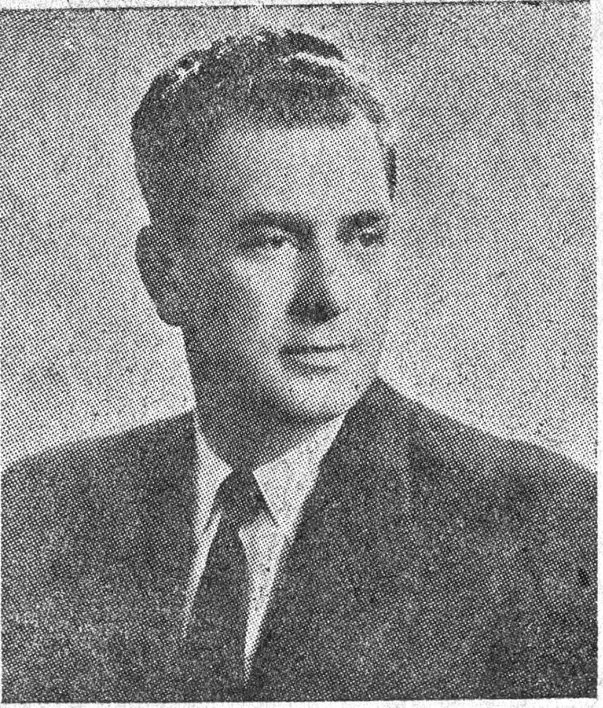
I resisted the bill out of my certainty that its passage today would produce the opposite result. In Lebanon we confront differing currents from the educational standpoint, in the home and in the surroundings, in the village and in the city. Add to this the plain difference in traditions and customs between one neighbor and the next, and among the sons of a single sect — nay, of a single family.
Q — You mean by this that you want to bide your time until the mentality is overturned. Then who is to overturn this mentality,
when you shut out from legislation the very element capable of overturning it?
A — I call your attention to the fact that any law which does not accord with the customs and morals of the country's people remains compulsion on paper. And if we enforce it, we go back tens of years. As for "overturning the mentality," and your saying that woman cannot do it so long as she remains far from legislation, my answer is that woman is quite able to overturn this mentality in her home and her surroundings, and to rely on time, which is the guarantor that will help evolution along. I point here to unveiling, which has become general "perhaps the honorable deputy means to say that it has nearly become general..." without any violence or clamor. I call your attention to the fact that twenty-five years ago people would throw silver water on a woman's clothes if she wore a short dress or changed anything in the familiar costume. And had a lawgiver driven women to unveil by force, he would never have reached the result we have reached.
Q — So on this account you want us to move along the road of equality slowly and gently, as in the matter of unveiling?? A quarter of a century before the custom of unveiling took hold "and it has not yet become universal" — and half a century before we gain equality in political rights, or more?? My friend, the wheel of civilization turns far faster than you suppose! In two years, or four, or five, the women of Tibet and Mongolia and the wilds of the Amazon will be in houses where they sweep and wash and cook on machines driven by atomic power! Yes, sir, the wheel is spinning at a tremendous rate, and you want the wheel of time to amble at its leisure, as in the tale of unveiling a quarter of a century ago!!
A — I am a practical man, madam. I want people first to acknowledge that woman is a complete human being before they acknowledge her political right. That is why I raised in the Administration and Justice Committee a point of the greatest importance, such as giving
For so long as we look on woman as equal to half a man in inheritance, we cannot look on her as man's equal, and her civil right is hostage to our will alone.
Q — And what is your view of restoring to her all the rights at one stroke — the civil rights and the political rights??
A — I shall go on defending my theory to the end: "the civil right first, then the political right" — that
is, evolution first, then the right. Compulsory education first, then the political right.
Q — Among the men who elect you in the South, do you have a crushing majority of quick-witted men who can read and write? And when you stretch out your foot to the shoeshine man, do you never think of the injustice done to me, and to this wife of yours, when you see that the shoeshine man possesses a right that we do not possess?
A — I know that "illiteracy" is a calamity. The illiterates among the men are no matter of pride for us; that is why I do not wish to pile affliction upon our affliction. And I hold that it would have been better for woman to come forward of her own accord to demand that education be made compulsory for boys and girls. Had she done so, she would have set up the proof that she treats the question from its very foundation — would that woman would first demand from man the rights of man.
The poll ends with the delegate pointing to the hundreds of times woman has demanded reform from A to Z — she has demanded it in the pages of magazines and newspapers, in petitions and from platforms, and nothing was vouchsafed by the men, and they lent an ear to nothing. That is why she wants equality in political rights, as a consecration of all the other rights — the rights of women and the rights of men.
And the young deputy, Mr. Ghassan Tueni, has a weighty opinion where woman's rights are concerned. He raised his eyebrows, asking with a touch of astonishment: "I do not know who it is that spreads it about in my name that I oppose the woman's cause! How could I possibly oppose a cause that is the very foundation of our modern renaissance, in which I believe and for which I work?.. It is the reactionary elements that take the negative stand toward woman, and I am not one of them, thank God!!"
Azar, the delegate meets Deputy Mr. Saeb Salam, and asks him for his opinion,