or a sound love. For true love is that which preserves for the lover his personality and his freedom; and in that case it becomes for the personality a source of richness, growth, and elevation — not a means of weakness, surrender, and self-effacement.
The last type: the independent woman — a type we find only in our present age. By her we mean a woman with a profession, by which she secures her economic independence and, in consequence, her social and personal freedom. She is no one's property. If she marries, her relation to the man is a relation of equality and mutual respect, not the relation of the parasite who depends upon another; and with this new feeling — the feeling of the sound creature who lives by her own self — the woman's personality is made whole and she becomes a sound human being.
But the woman with a profession does not cut her way through life easily; she meets with hardships that sometimes drive her to retreat, because the doors of work open to her are few and narrow, and so too are the paths of advancement. Above this, she is faced with the problem of reconciling her work with the performance of her duties as wife and mother; and if she grows weary under the multitude of duties, she sacrifices the one for the sake of the other.
Yet the working woman's problems are on the way to solution. Legislation protects her on one side, since the laws applied to men are applied to her; and where injustice touches her, we find her pressing her demand for equality in the matter of wages. Justice for workers and employees — women among them — in the fixing of hours of work, the raising of wages, and compensation in case of sickness or unemployment: all this is apt to draw woman to work, and to move her to share with man the burdens of livelihood and to join with him in building a better world.
As for the problem of household tasks, the working woman has
solved it by several means: among them, working part of the time rather than all of it, so that she may have leisure enough to attend to her house; and among them, the use of machines and ready-prepared foods, and cooperation with husband and children in the work of the house.
And if I may be allowed to comment on what Simone de Beauvoir has presented on the subject of woman's functions through the ages, I would say: the three types she has set forth, which represent woman's revolt against her lowly condition — I mean the narcissistic woman, the mystic woman, and the woman who drowns in the love of another person — are a development through which the women of the West passed in the middle stage that preceded
their modern development, and we rarely find its counterpart among our own women. For the Eastern woman, generally speaking, has not in her development gone beyond the primitive stage — that is, housework, the rearing of the child, and helping the husband in the work of the field and certain other tasks. In olden times there existed favorites and slave girls who played a role in the palaces of the caliphs and sultans; then this class died out with the dying out of its masters. And woman among us today passes suddenly from her primitive condition to the stage of the independent profession and creative work; and for this reason we find her transition slow when measured against the age of speed in which we live.
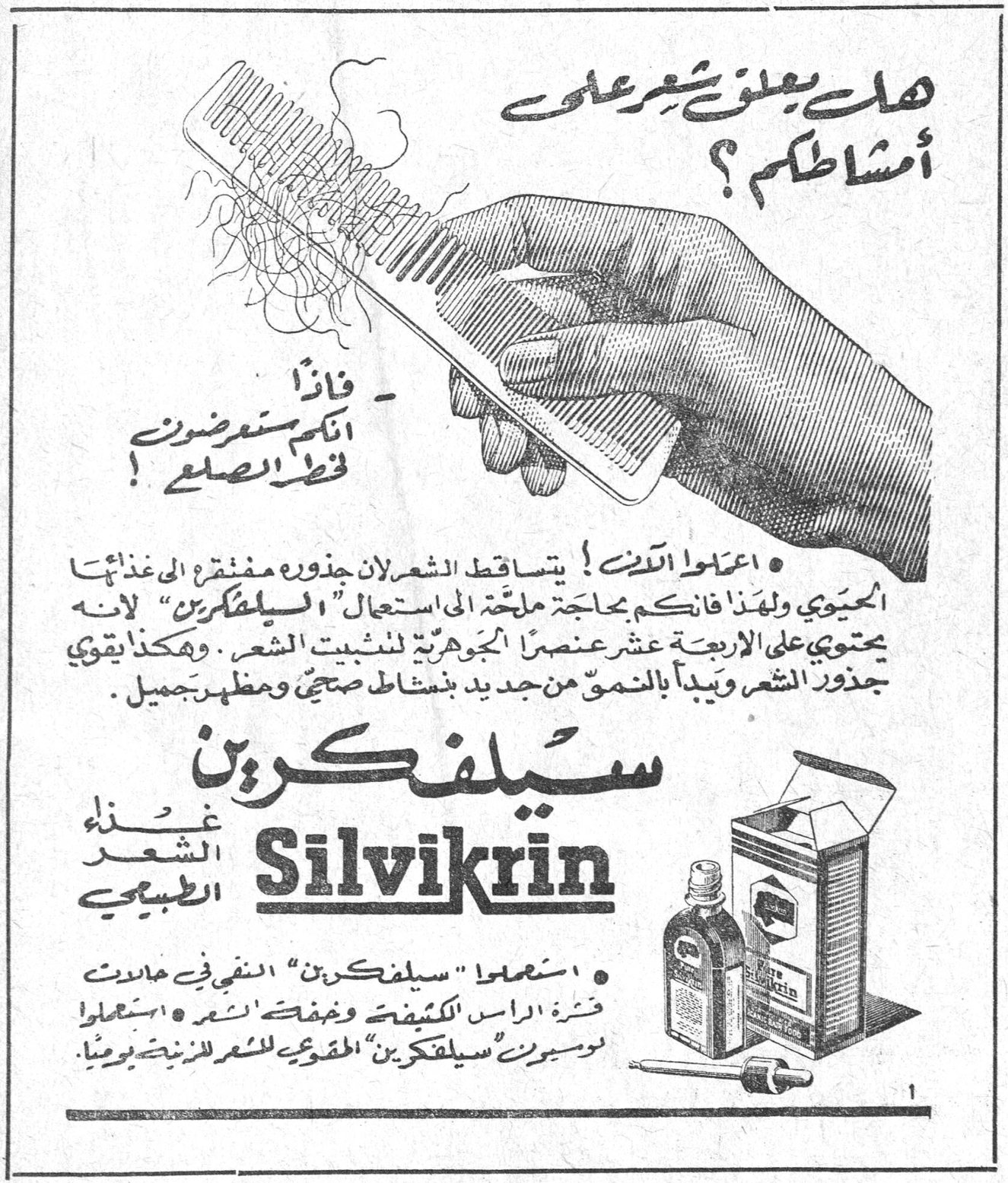
Silvikrin
Does your hair cling to your combs?
— Then you will surely be going bald!
— Act now! Hair falls out because its roots are starved of their vital nourishment, and for this reason you are in urgent need of using "Silvikrin," for it contains the fourteen elements essential for holding the hair firm. Thus it strengthens the roots of the hair and restores it to fresh growth, with healthy vigor and a beautiful appearance.
Silvikrin — the natural food of the hair
— Use pure "Silvikrin" in cases of heavy dandruff and thinning hair. Use "Silvikrin" tonic hair lotion daily as a dressing.