In Beirut there are two schools for those deprived of sight: the first belongs to the Evangelical Society, the second to the Swiss Union. There was also a charitable medical clinic for the blind, directed by Miss Bustani, which has since ceased its work; and there is a shelter for blind beggars and vagrants. The subject of this radio report of ours, however, is the Home for the Blind belonging to the Swiss Union, which stands in the Burj Hammoud district, on the Dora side.
This institution consists of a group of large buildings surrounded by a wall; to be exact, it is made up of six clusters of buildings containing one hundred rooms, divided into various sections: for the administration, the director's residence, quarters for the women and girls, quarters for the men and boys, the school, and the workshops.
As for the practical effect of this great institution, we can feel it in every one of our houses: the brooms, the brushes, the baskets, the chairs, and other straw wares are products of the Home for the Blind at Burj Hammoud.
We were received by the director of this institution, Mr. Karl Meyer of Switzerland, a man in the fourth decade of his life, abounding in energy, broad in understanding, an expert in the education of the blind. The blind boys address him as "Father," and the blind girls address his wife as
"Mother." We held a session in his office in which the conversation turned on this important institution. We said to him:
Q: When was this institute of yours founded?
A: The institute was founded in 1923 by a Swiss man named Theodor Weber, the delegate of the Swiss Society of Friends of the Blind. At first the institute was located at Ghazir; in 1928 I was appointed its director, so I came to Lebanon and set about erecting buildings of its own in Beirut — the ones you see today.
Q: And what are the sections of this institute of yours?
A: Our institute is divided into seven sections, namely:
First — a kindergarten and an elementary school for children deprived of sight.
Second — an elementary school for those deprived of hearing.
Third — a library in the Braille method for the blind, containing nine hundred books in Arabic, Armenian, English, French, and German.
Fourth — the music school, where the blind pupils learn to play certain musical instruments and to sing solo and in chorus.
Fifth — a medical clinic made up of three rooms.
Sixth — workshops for straw wares of every kind.
Seventh — a store located in Souq al-Qazzaz in town, which
handles the sale of our wares wholesale and retail. It also handles the sale of raw materials to the homes for the blind in Aleppo, Jerusalem, and Ramallah — this with the aim of assistance, not of making profits.
Q: We have heard that you publish a magazine. What is it?
A: Yes, we have a magazine for the blind in raised letters, which appears once every two months; its subscribers are the pupils of this institute, scattered through Lebanon, Syria, Iraq, Palestine, Turkey, Greece, and France.
Q: And how many pupils have you?
A: The boarding pupils number 53 — 11 males and 42 women. The day pupils number 44 — ten females and twenty-two males. The staff and workers number fourteen. My wife and I serve as director and directress of the institute. The grand total thus comes to 96 persons.
Q: And do all of them study or work at the institute?
A: No; only sixty of them work in the various industrial sections while they study. The rest study
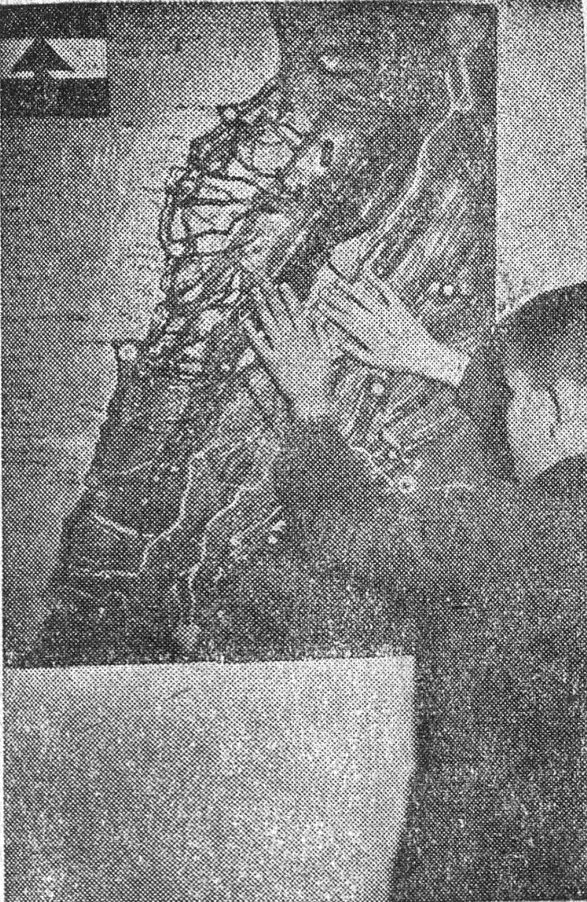
A blind man studying the relief map of Lebanon
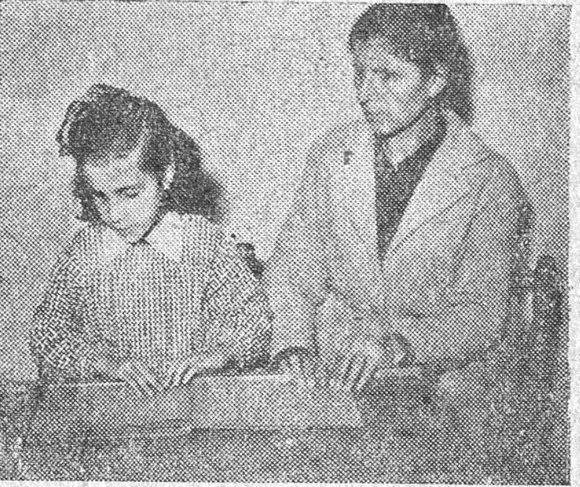
A little girl studying by the Braille method