and these were table covers the little girls had embroidered — handiworks that speak the efforts of the small ones and shine in their splendor with talent. My enthusiasm and admiration were not lost on the director; he warmed toward me — and perhaps he went too far in his confidence, for he plunged into complaining to me of the school's president and his fatuity, saying that everything he had in the school had come despite the president's contrariness and stupidity.
Then he stopped and said, in the tone of one betraying a grave secret: "It was I who brought Samir al-Shaarawi into this school, after the president had refused him and tried to accuse me of breaking the rules."
I said, "And who is Samir al-Shaarawi?" He stared at me, reproachful, astonished at my ignorance, and walked before me to a room, opened its door, and pointed to its walls, spread with bewitching hand-drawn pictures bearing the signature "Samir."
Samir al-Shaarawi is the son of Khattar al-Shaarawi. Look down into the valley — look hard, and you will see a room he called a house, which the olive trees almost hide. Those trees, and those vines on the four terraces, and the fig terrace at the edge of the dry channel, are all that Khattar al-Shaarawi owned. Yes — he also owned a donkey, and a double-barreled hunting gun. There Samir was born, and there his mother died when he was five years old. I have heard of fathers who all but worshipped their sons, but among them there is none who comes near Khattar al-Shaarawi in the madness of love. To his father, Samir was greatness itself whenever he felt smallness in himself, the palace on the summit whenever he turned his eyes about his hut, the dream come true whenever disappointment befell him. Samir would be everything, and every great deed. He dreamed of his son and his son's success sleeping and waking, until his dreams mingled with the facts of his life. Once a fleet admiral visited us — I
swear to you Khattar came to tell me that his son's flag would be hoisted over the fleets of the world. And one day he heard that a certain famous physician had drawn a bullet out of a wounded man's head, and the man recovered; so Khattar began to talk of the miraculous surgical operations Samir — Dr. Samir al-Shaarawi — would perform. And there are people in the village today who will swear to you they heard the father call his son "Doctor." And how often he let his gaze wander over certain mansions of the town of Aley, and shook his head: "You will see people, in days to come, look at Samir's palace and laugh at these mansions."
The truth is that the village folk pinned the charge of madness on Khattar, for he was forever talking of his son and proclaiming that he would spread his banner over the world. As for the child, he could not understand his father's sayings; nor were there many signs of genius in him. Rather he was much given to absent-mindedness, like one swimming in a mirage. Often he would stand gazing at things that caught no one else's attention. His playfellows among the boys nicknamed him "Abu Fahmeh," because he was forever carrying a piece of charcoal with which he blackened the walls. Once his father nearly came to blows with an entire family, when they discovered that the child Samir had drawn upon the family tomb an animal with long ears and four hooves.
Yet the father, for all his appearances of madness, knew perfectly well that his son's success hung on his schooling, that schools require money, and that his struggle with the earth yielded him no surplus. So he had recourse to tact and to courting us: in me he found affection and kindness, and in that president he discovered arrogance and haughtiness. But Khattar did not despair. In summer he would present me with the birds he shot, and some grapes and figs. In autumn he would bring me a
basket of green olives. In winter he was the first of the villagers to appear, to lend a hand shoveling the snow from the roof of the orphanage and school. And at every celebration he would go round the guests with the pitcher, and applaud the visitors and the speakers.
I was away in Beirut before the school opened, when they had begun registering the pupils. Khattar came out of his house in his best clothes, his face aflame with joy, saying to his son: "You
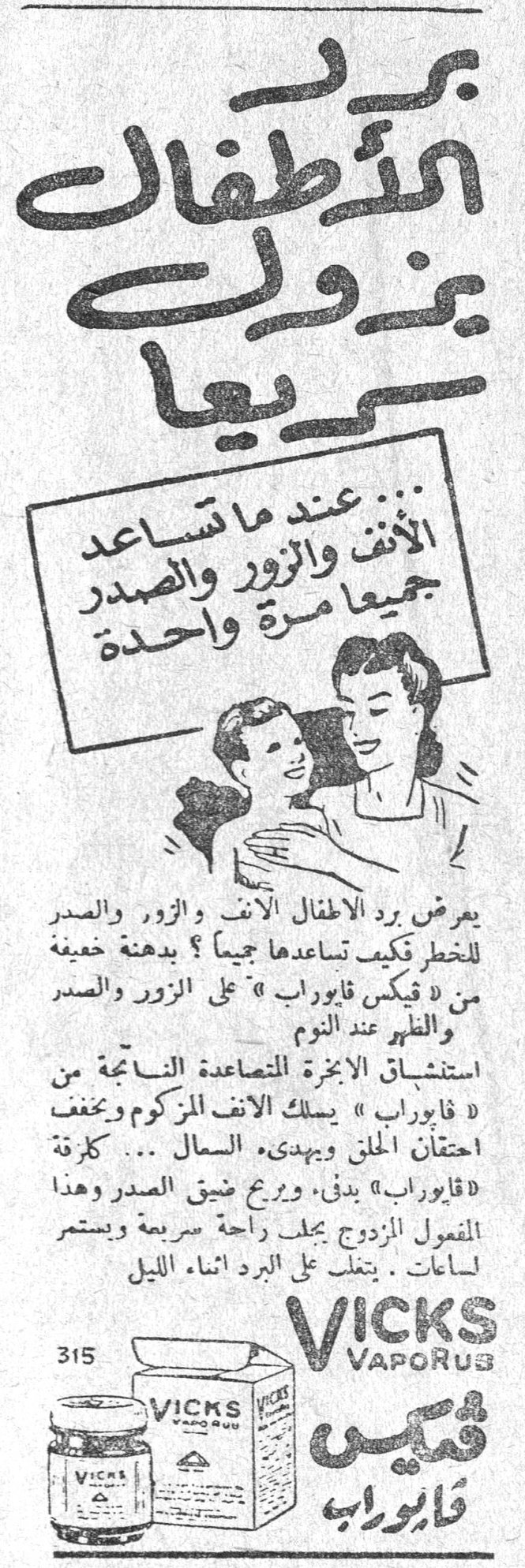
Vicks VapoRub
Children's colds can be relieved quickly
...when you help the nose, the throat, and the chest all at once
A child's cold puts the nose, the throat, and the chest in danger — so how do you help them all? With a light rub of "Vicks VapoRub" on the throat, chest, and back at bedtime.
Breathing in the rising vapors given off by "VapoRub" clears the stuffed nose, relieves congestion of the throat, and calms the cough... Like a poultice, "VapoRub" warms and eases tightness of the chest, and this double action brings quick relief and lasts for hours. It works on the cold through the night.
VICKS VAPORUB
Vicks VapoRub