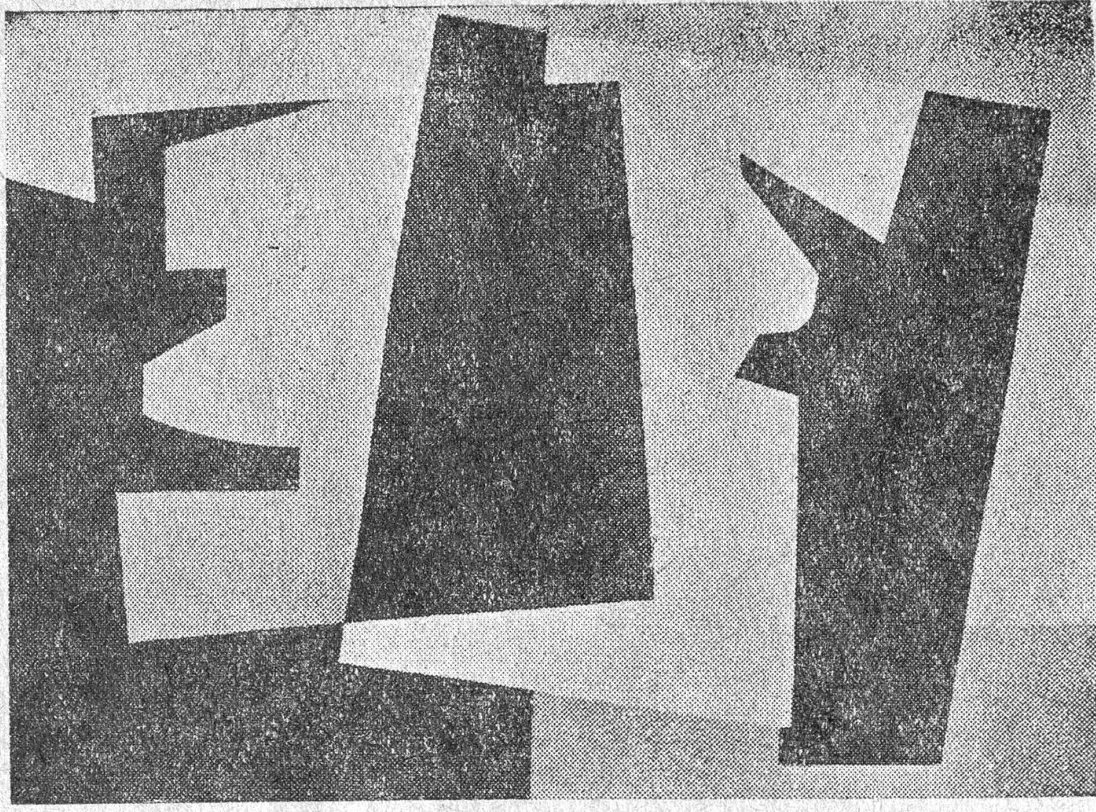
This painting expresses the idea of contradiction; in the two drawings one notes strength of personality and of will.
art develop into what it has lately become?
— No — in my last year before leaving for Paris I moved a good distance away from realism; but when I arrived in Paris I devoted a whole year to going deeply into realism, Le Réalisme — this despite my conviction that it is not of the spirit of our modern age. I worked a great deal at sculpture and painting from the nude model — but my soul was not content with this, and my development was nothing but the completion of the faith that was within me; and I am still in continuous development.
— And which of the Parisian artists deserves the greatest credit for guiding you in this direction?
— My contact with the artist Fernand Leger had the greatest effect on my guidance and my development, though I never inclined toward his manner at all.
— I should like now to ask you to enlighten me about these canvases, which look strange to my eye — I can hardly understand anything in them!
— Whoever wishes to understand this art must first possess a deep artistic culture — and a deep understanding, too, of the development of the idea of beauty in the world. The idea of beauty acknowledged in the age of the Renaissance is not the universal rule by which the arts of every age must be understood. Once man has freed himself in his thinking, it is not very hard for him to understand the art of abstraction, or what they call L'art Abstrait.
— And what exactly do you mean by that expression?
— I mean the elimination of the subject from the picture, and the expression of feelings by means of colors, lines, and composition.
— And if you eliminate the subject, from where do you draw your inspiration for painting the canvas?
— The geometric forms that
appear in the canvas are the artist's own creation and invention —
As for their sum, it always points to the artist's personality — to his feeling, his faith, his memory, his childhood, and so on.
— Looking at your canvases, I can hardly tell the worth of one of them from its sister. How, then, do the critics judge, for instance, the excellence of a canvas, and the superiority of one artist over another?
— The art critics, with the artistic culture and long experience they possess, can easily judge the production of artists — and the measure of their strength of personality — or clarity of mind — or confusion or flabbiness, and so forth. All of that reveals itself to the critic's eye through the composition, the colors, and the lines.
— And why has the modern school of abstract art dispensed with the subject, and dispensed likewise with the idea of depth, which requires light and shadow?
— It dispensed with the subject because we consider it outside the province of the art of painting, La peinture. The subject requires speech, and speech belongs within the circle of literature. And since the art of painting is concerned
with colors alone, we have concentrated our attention on bringing out the virtue of "color" itself, without joining to it other arts such as literature, psychology, sociology, and the like... And this same virtue of bringing out pure colors is what required dispensing with depth, which demands the mixing of two or more colors to express distance or nearness, light or shadow. All of these have vanished from the art of abstraction — and nothing remains but the pure colors, which the artist handles with knowledge and skill.
— The Beirut papers spoke of the exhibition you held in Paris last May. Will you not tell us something about it?
— I held an exhibition at the Galerie Collette Alendy for fifteen days, and its results were so encouraging that I intend to return to Paris, as soon as circumstances permit, to hold a second exhibition.
— And do you not intend to hold an exhibition here in Beirut before you leave for Paris?
— Of course — and I am preparing for it now.
— When and where will you hold it?