
"Boycotting foreign goods"... a campaign led by the rising youth, its banner raised by a body of Arab citizens. And when the Arab nationalist youth march, everyone follows, for the youth's campaign is the campaign of struggle, the campaign of success, the campaign of sincerity and work. Taking part in the presentation of the subject are the Misses Fahima al-Hakim — a candidate for the degree of "Master of Science" in education and psychology — and Asma Mouakket, likewise a candidate for the "Master of Science" degree, in philosophy; and Messrs. Mounah Khouri and Hamed Jabbouri; all of them students at the American University of Beirut.
Moderator of the session: In'am al-Saghir
Mounah: In this stage through which the Arab world is passing, we consider it the duty of the Arab nationalist youth to undertake positive work to solve, in full, the problems we face. But before beginning the work, we must first come to know these problems and understand their essence clearly. Once we know them, we can join awareness to work, and thus our success will be the greater. The most prominent of the problems facing us is the problem of the loss of this nation's unity, and our failure to feel our own identity as an Arab society. There are kinds of colonialism whose outward face is political and military, but whose reality is economic colonialism, first and last. Hence the economic front, which the conscious youth take in hand, is the one we wanted as a front of our struggle — yet we did not want it as a front to which we give all our attention. We do not want it to be the only front that opens before us a field of work... What moves us to give it this attention is our belief that colonialism is economic in the first degree, with political and military colonialism following after. And
since its economic being is a sound being, we have concentrated our efforts to create the economic being as a being worthy of survival.
Hamed: I should like to add a complement to what my colleague has said... The campaign aims at two things:
First: the Arab individual as a human being.
Second: the aspect of struggle against colonialism in general.
As for the Arab individual, this campaign aims to make him feel his responsibility and bear a share of the sacrifice it is his duty to make. If we address the Arab woman and the Arab man — without distinction — we want each of them to bear more than the individual bears in the civilized nations. In America, for example, or England, or other nations complete in their structure, the individual's duty is proportionally less than that of the Arab individual. Our society, then, requires of the individual the duty of taking a serious, resolute stand against the enslavers, just as it expects him to rise in the revolt of the noble man who wants freedom, and wants life and immortality...
Asma: I insist on the point that a citizen's duties differ according to the circumstances of the country to which he belongs. In a country, for example, that is still defending itself in order to attain existence, the citizen belonging to that country is expected to carry the responsibility laid upon him more than in other countries. We must banish the words "difficult" and "impossible" from our vocabulary. Western society aims at luxury, not at existence, as is our case. Our duty is first to feel our responsibilities, then the problems of our countries, and then to search for the means by which to solve our problems — and the boycott of foreign goods is one of the means of realizing these aims.
Fahima: Woman's share as a citizen is a great share, and her duty in this mission is a great one, for woman is half of society; and if she demands her rights, she must perform her duties as a citizen as well. Among
these duties is that she should feel, and make those around her understand, that a country which has not gained its independence economically has not gained it politically...
In'am: Do you not believe that woman plays a greater role than man in this field?
Asma: Of course, for woman is a part of society; she lives her nation's pains just as man lives them; but
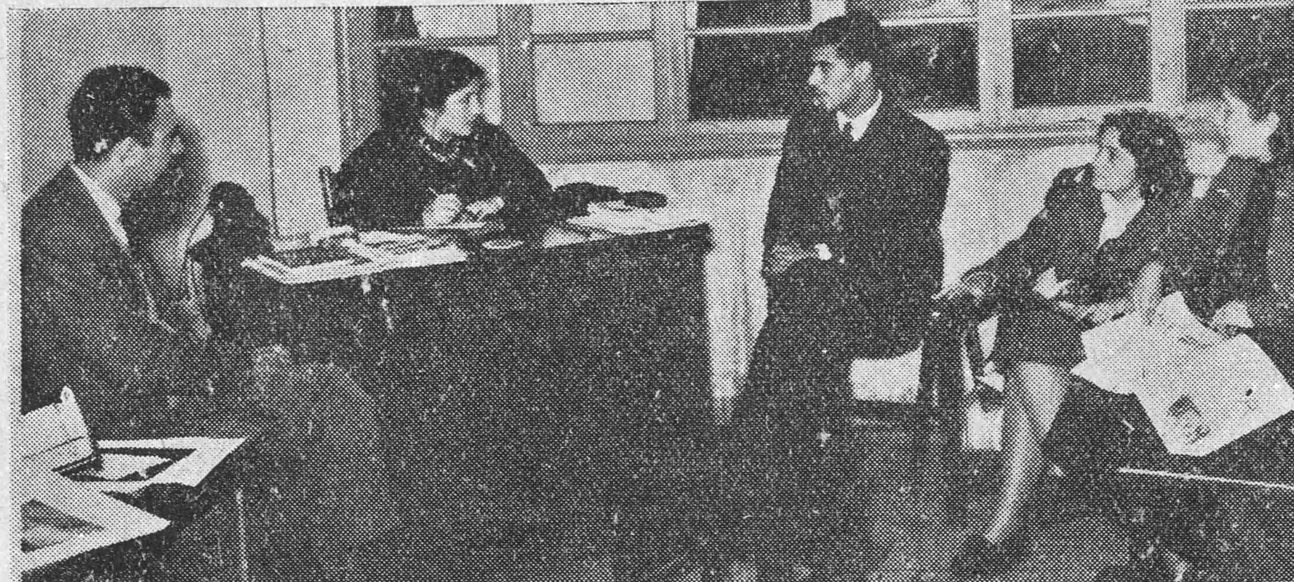
From the right: Fahima Hakim, Asma Mouakket, Hamed Jabbouri, In'am Saghir, and Mounah Khouri