On the raging battlefront between man and disease, there emerged man the doctor, devoting himself to the study of the arts of disease, attempting to prevent it, to cure it, or to lighten its burden. Three tasks have occupied the doctor ever since he came into being, fighting in man's ranks against the ranks of disease: warding off sickness, curing ailments, and easing the pain that is in them.
And man the patient has harbored, against man the doctor, a reproach since the beginning of these human wars against diseases of every kind. Just as the kinds of disease are many and the arts of their behavior strange, so too have the arts of man the doctor in fighting them multiplied: at one stage he was a sorcerer or a charlatan, then an experimenter without guidance, and after that a man of science — diagnostician, then healer, then preventer.
And the reproach of the patient — or of the man who is not a doctor — against man the doctor kept growing and developing along with the developments of the arts of medicine itself, down to this very day; the methods of disease have developed along with the development of the methods of medicine, and the reproach itself has developed until it too has become an art, or very nearly.
What, then, are the elements of this reproach — what are the patient's grievances against the doctor?
The doctor, wherever he is found, forms a minority unit in his surroundings, and the patient's reproach of the doctor is nothing but the reproach of the majority against the minority, or a contest between these two classes of mankind — that contest of many shapes, causes, and ends, which has continued since man existed and will continue until he passes away: a reproach or contest or
struggle between giver and taker, or rich and poor, or learned and ignorant, or strong and weak, or oppressor and oppressed, or exploiter and exploited, or ruler and ruled, or the one in the right and the one in the wrong, or teacher and pupil, or lover and beloved, or male and female, or individual and society, or describer and described — or, if you will, mind and body, or science and faith, or life and death, or health and sickness... A duality in the nature of man, its fires raging as the one half challenges the other; and this continual, straining challenge is man himself: by it he exists, and by nothing else.
The patient's grievances against the doctor are but one chapter among the chapters of this eternal tug-of-war in the duality of human nature. Every one of man's ages has witnessed different manifestations of this reproach, until in this age of ours we are entitled to add, in this field, a front of war or of reproach between patient and doctor, alongside the war-front that exists in origin between man and disease.
Perhaps the arts of medicine have never multiplied in any age as they have multiplied in this one — and this not only on account of the advance of medical science and the growing entanglement of man's social life, but on account of the piling up of the various arts of the past one upon another, and their gathering, all of them, side by side with the newest arts... Thus we see today the sorcerer doctor, the empiric doctor, and the scientific doctor, curative or preventive, all at one time... each of them contending in the war against disease on the front of the man who is not a doctor — to ward off, to cure, or to ease pain. Three classes of doctors, with three aims; and today the grievances of the sick man, or the man who is not a doctor, pile
up against all these classes and all these aims in a way that calls even for public reckoning...
It is no secret that reproach has its source in failure, in one form or another; and were it not for failure — in warding off, in curing, or in easing pain — there would be no cause or occasion for reproach at all. This failure arises either from a fundamental deficiency in the knowledge from which the doctor draws his art or his science, or from a personal deficiency in the doctor himself in his application of the principles of this knowledge to the sick man or the healthy one, or from a cause that has to do neither with knowledge, theoretical or applied, but with the material compensation paid to the doctor for his wielding the weapon of this knowledge in his fight on the front, with man, against disease. To demonstrate these various kinds of failure, some details must be recounted...
How many individuals among us, one wonders, have consulted doctor colleagues and gained no benefit from their prescriptions, then gone back to them a second time and a third,
and gone back to buying new medicines without obtaining any benefit, then gone off to consult others and still others, each time leaving the doctors' clinics either with requests for analyses and X-rays or with prescriptions upon prescriptions, and curses from one doctor upon another, while the symptoms grew worse instead of weaker — until they despaired of medicine and doctors, and decided,
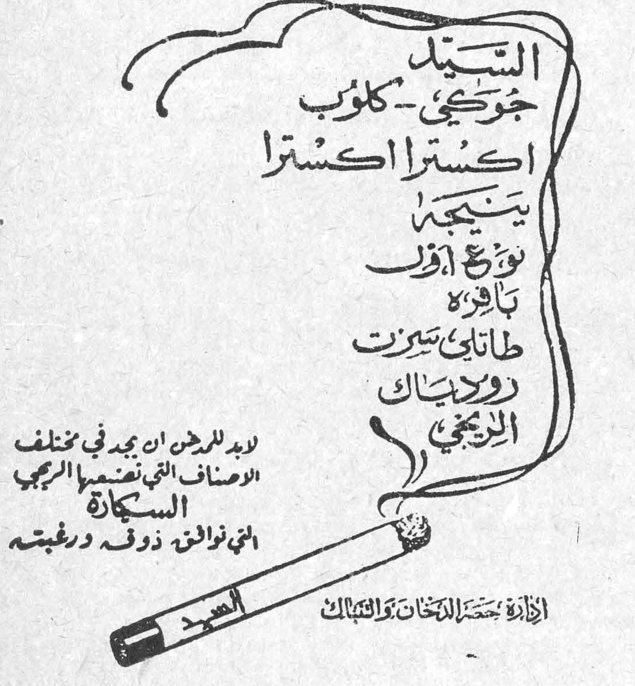
The Tobacco and Tombac Monopoly Administration (the Régie)
Al-Sayyid
Georgie Club
Extra Extra
Natija
First Grade
Tafih
Tabati Sikirt
Rudyank
Al-Zinji
The smoker is sure to find, among the various brands produced by the Régie, the cigarette that suits his taste and his desire.
The Tobacco and Tombac Monopoly Administration