heeding the advice of neighbors and friends, to consult the practical doctors: the bonesetter, or the priest, or the sheikh, or the midwife, or the practical nurse, or so-and-so renowned for giving injections. These prescribe for them herbs, or cautery, or fasting... to no avail; so they go back to licensed doctors, only to leave their clinics with empty pockets and costly prescriptions, found only in Europe and America, or Russia, or found nowhere except at such-and-such a pharmacist's and no other, or found only with the doctor himself — but at an exorbitant price on account of its scarcity. In despair they are forced to pawn the jewelry, or sell the plot of land, or borrow a sum at interest, in order to try these modern medicines, powerful in their effect, God willing... Then before long the futility of these, too, becomes plain to them, despite the dearness of their price and the rarity of their supply, and so they give themselves over to the quacks — the astrologers and their like — who cauterize their bodies at the places of pain, or tie a thread in such-and-such a spot in the hope that an ailment may vanish from their bodies in some other spot... And thus each one of them will have begun with a simple ailment, which defied a doctor who misdiagnosed it, so that it grew intractable upon the patient's spirit and upon his pocket, and cost him the consultation of a second doctor and a third, and the price of successive analyses and prescriptions, after which he was forced to resort to unlicensed doctors, and from them to quacks — and all of it to no avail. The patient comes out of all this melee gravely ill, empty of pocket, amply stocked with medicines, and stripped of all confidence in medicine and doctors.
And how many persons among us have needed a medical certificate for employment, or travel, or marriage, and could obtain it only from doctors appointed by the companies or schools or institutions or governments — and find no one who trusts these certificates, because the reputation
of doctors' attestations is like the reputation of the testimony of porters, or of drunkards: it has no truth, no value, and no ground whatever for reliance in time of need or in emergencies.... Whoever wishes obtains it, and in an unprofessional way... for a known sum.
Or is there not among our honored readers someone who knows stories upon stories of doctors banding together, to conceal one of their number's erroneous diagnosis, or in an attempt to do unjust harm to one of their number's reputation, or of brokerage among some of them for others, or for a group of pharmacists or laboratory owners, or of collusion on the part of some of them with cheap agents from outside the profession, who stand in the paths of the sick to snare the simple among them into the traps of the greedy, exploiting colleagues? I speak as a doctor, but I speak with the patient's tongue; and I know full well that defaming my profession before the people does no honor to my personal dignity, neither in the eyes of my colleagues, nor perhaps in the eyes of the people either, whom I am defending on this occasion. Public defamation is a method of criticism that is destructive and wrong, and wrong does not mend wrong.... But I know at the same time that the dignity of my profession in the eyes of the people can no longer be defended by a cover-up of closed ranks, for its stories are current among all the people, and the patients' reproach of our colleagues has no end.... whether on account of the deficiency in the science of medicine itself, or on account of the ignorance of some of them, as individuals, of that science, or on account of their fees, and the lengths to which they will go for the sake of the pocket's interest at the expense of the honor of the profession and the interest of the patient... I am confident that I am defaming no particular colleague here, for that is not permissible under any circumstances; and I divulge no secret when I say that the standing of the doctor in society at the present time is no
longer what it once was — that standing at which fingers used to point, sacred, respected, insofar as it was a means of putting science at the service of the patient's benefit before the doctor's, so as to ward off disease or cure it or ease its pain. It has become, on the contrary, a mere trade for earning a living... The doctor rejoices at people's sickness, because he lives at the expense of their sickness; the doctor grows in wealth the more people grow in sickness, and the more his surroundings grow in epidemic. If this wealth were at the expense of the patient's wealth alone, the matter would be somewhat tolerable; but it is at the expense of his wealth and his health together, and at the expense of the wealth and health of the healthy whom the patient himself supports, at
the very same time... Is it not misery enough for the patient that he is stricken with disease, without there being added to
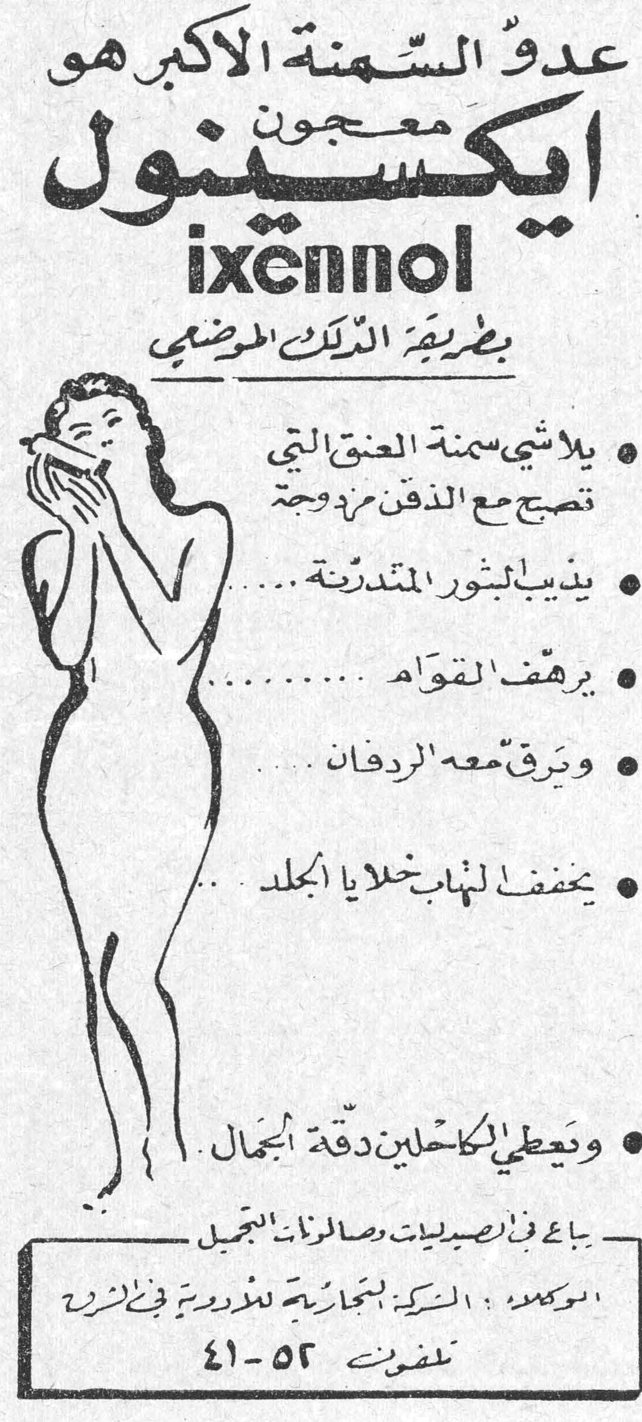
Ixennol Paste
The greatest enemy of fat is
Ixennol
Paste
ixennol
By the method of pleasing massage
• It banishes the fat of the neck, which together with the chin becomes a double chin
• It melts away nodular pimples...
• It refines the figure...
• And with it the hips grow slender...
• It reduces the dullness of the skin's cells...
• And gives the ankles the fineness of beauty
Sold in pharmacies and the fine al-Razi shops
Agent: the Commercial Distribution Company in al-Zarra
Telephone 41-52