the best means of preserving the kitchen's tidiness and cleanliness is to paint its walls in dark colors. But this is the very error and the source of the trouble, for the rules of health and cleanliness require us to clean away that dirt, not to work at hiding it. And how can we manage that if we cannot see it? From this you see, madam, that the colors of the kitchen walls must be light and soft, so that you can see whatever dirt clings to them, and so that there may be harmony between those colors and the blazing light that the sun's rays give us in our country.
Pictures are counted among the things that have a great effect on the beauty and luster of the home. Most ladies are fond of adorning the walls with beautiful pictures, and in this they are right. Beautiful pictures, hung in suitable places, lend a room a luster and beauty beyond its own luster and beauty. But pictures often become a cause of a room's ugliness and the loss of its luster, when a great number of them are hung on the wall. For a room whose walls are clothed in pictures becomes a picture gallery more than a room. Then too, a profusion of pictures in a room tires the eye and suggests anxiety and unease. Add to this that a picture, if it is not set in a well-made frame and tightly sealed from behind, may become a fertile breeding-ground for all sorts of insects, especially in the summer season. So if you wish, madam, to adorn the room with pictures and to create in it a calm, restful atmosphere, you must choose your pictures with care and arrange them on the walls in a suitable, artistic way.
And do not forget, madam, that the place in which flowers are set has a great effect on their beauty. Deep-colored flowers are not to be placed in corners
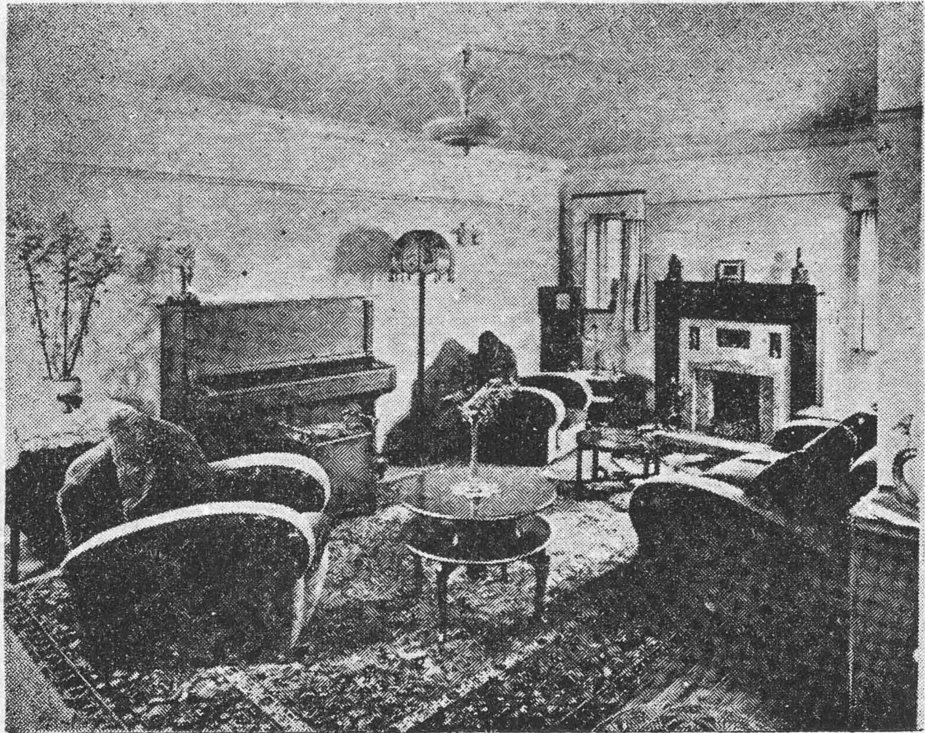
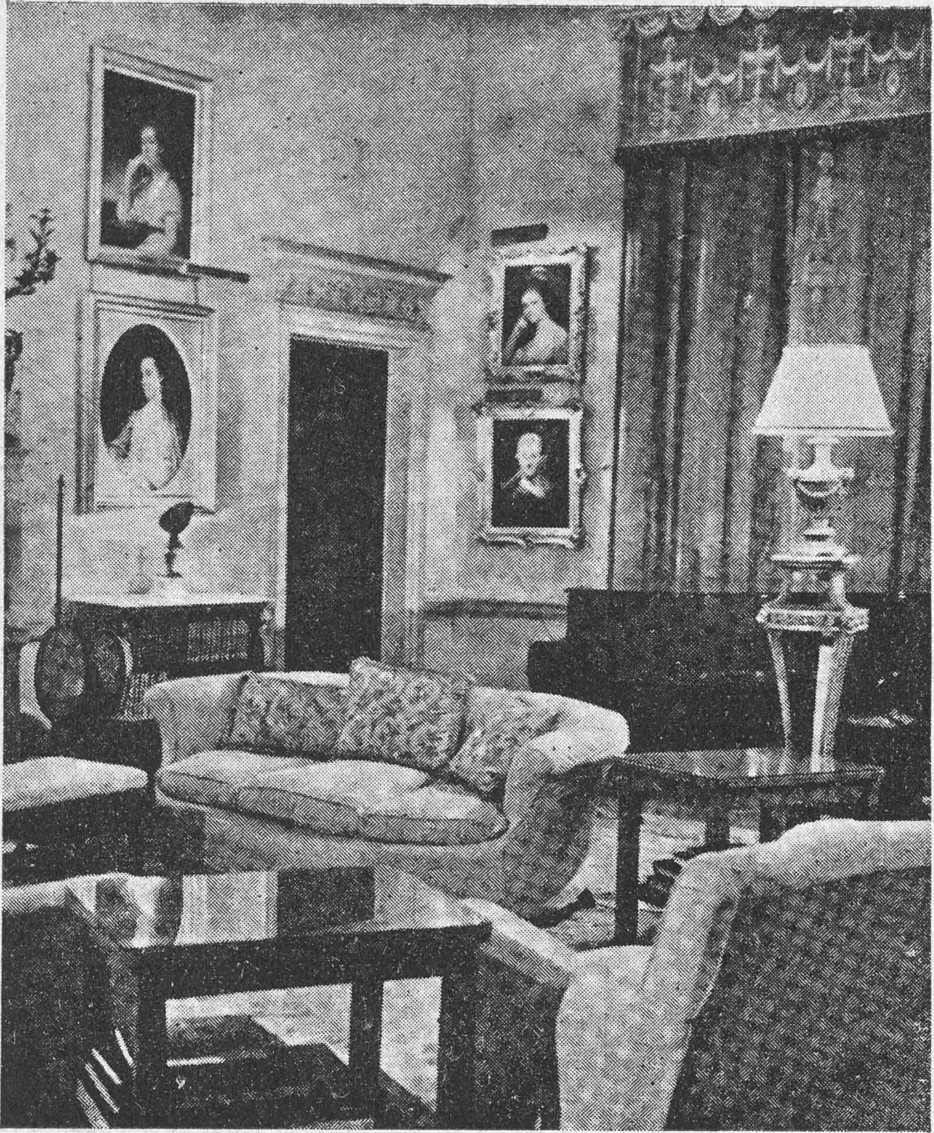
Part of a modern sitting room, with pictures hung on its walls in a manner that harmonizes with the room's furniture and its general appearance.
with little light, for they cannot be seen; only flowers of light color suit such places, so that they may be seen.
There must also be harmony between the color of the place on which the vase is set and the color of the flowers. White carnations, for example, are not to be placed on a white cloth. And the color of the vase must be considered in relation to the flowers placed in it: carnations, for example, are placed in a vase of white crystal. Nor is it wise to set a large mass of flowers inside a small room, for this makes the room look smaller in size than it is. And it is essential to observe the proportion between the color of the flowers and the furniture and its style. For example, the sunflower, whose color is intensely yellow: if it is placed in a room whose furniture is of oak — the wood nearest in color to yellow — these flowers look weak; whereas if they are placed in a room whose furniture is of walnut, they appear in their full strength and their loveliest form. The places on which flowers are set differ according to their position in the room. If the vase is set in a place specially prepared for it in the wall, the viewer sees it from one side only; in this case the flowers in the vase are arranged to face one way only. But if the vase stands in a place where the eye sees it from all sides, then the flowers must be arranged in the form of a circle.
And if the flowers have