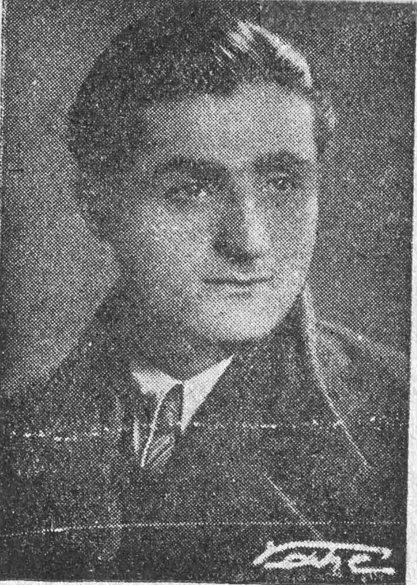
Of His Qualities
Fouad Suleiman was an aristocrat in spirit and in body, aristocratic of face — in it a nobility the small-souled never know, and a brow that never bowed in the abasement of shame: never once did he suffer any man's slight upon him, nor did he ever hire out his pen or his heart to anything he did not believe in.
And Fouad carried within his breast a heart as innocent and pure as the hearts of children, and like certainty itself, unclouded by any shadow of suspicion or doubt. And oh, that confidence of his — how splendid it was in him! And oh, that fiery enthusiasm with which he pulled his companions upward — always upward — as though assuring them: "I shall walk you to the summits, and I trust in myself that I dare the summits..."
And to his wife Josephine and his three children he was the faithful beloved and the tender father. He was happy in his ten years of marriage, to the farthest reach of the ideal family happiness a man could wish... And his sweetest hours were those he spent in his own house, among his family, creating around them an air of innocent gaiety and sweet jesting.
How noble he was, Fouad Suleiman: friend, husband, and father...
A J Sh
To My Friend Fouad Suleiman
Rushdi Ma'alouf
O Abu Rabi'!
How short this spring you gave to your Rabi', and to Rabi's mother, and to Rabi's brothers! And how near to it the autumn!
*
You lived, of the spring, the lifetime of its rose.
And you gave to life what the rose gives: sweetness of fragrance, sweetness of contentment, harmony of color, and a hedge for truth and for beauty!
*
O Abu Rabi',
my heart trembles, and chokes on the ink in its mouth, when it sees me writing of your death, while its pen-nib is still wet with the ink that flowed on your wedding day!
*
And in my ears still ring those words you said to me when I visited you in the hospital after my return from America: "Where is your poem of elegy for Fouad?" I could not be sure whether your words were reproach and jest, or a sense of the calamitous truth; but in either case, I did not want you to say them!
*
O Abu Rabi',
with your death fell silent a free tongue, a bitter pen, and a heart as noble as hearts can be!
*
A tongue whose daring the daring themselves admired, and whose manner all coveted — in pouring out the talk of friendship, in giving the lesson, in probing deep national reform!
*
And a pen that spared you the whip, and the cannon, and the atomic bomb! Never once did you move it except that it might be the thorn against whoever sought to ravish the rose!
*
Or that it might be the rose for whoever deserved it...
*
And how many a poem of yours your lofty art meant as a bouquet in the hand of Arabic poetry — and that modesty hid it away, the modesty whose secret harmony with that confidence of superiority I have not understood to this day!..
*
For you outran us to truths that made plain to you the vanity of fame and all that goes with it: you published no diwan and signed no article, but borrowed names — and made of the borrowed names men of letters!
*
The last of them "Tammuz," for whom our waiting and our longing will be long — in the fellow paper, al-Nahar!
*
And with your death fell silent a heart that loved, and knew how to love; that was loyal, and knew what loyalty is! It narrowed until no room was left in it for rancor or hate, and it widened until there dwelt at ease in it your friends — and they are many — and your homeland — and it is great — and your hopes — and they were boundless!
*
O Abu Rabi',
how short this spring you gave to your Rabi'.
*
Unless your fragrant name and your pure spirit become the two elements of a true spring, to shade your children and keep them, until your dream, and the hope of him who loves you, is fulfilled in them by God's help — then your heart may rest easy in heaven, and your soul feel mercy and repose.
15