shelter for aged priests of all communities.
Between 1930 and 1937 I took in some of the wretched who bore infirmities; their number reached fifty.
In 1937 I agreed with the government to accept a number of the blind and the crippled.
In 1938 I agreed with the government also to accept some inmates of the Asfuriyyeh, from among the quiet insane.
In 1939 I concluded an agreement with the municipalities of Beirut and Tripoli to accept some of the feeble-minded and the crippled.
Q: Do you rely in your works on foreign aid?
A: No. Our institution is purely national, and we receive no aid whatever from foreign institutions.
Q: And who directs the affairs of all these institutions of yours?
A: Nuns who have consecrated their lives to good works; they number one hundred and twenty. They do all the work: nursing, cleaning, preparing the food, washing — even the work at the ovens.
Q: And on which doctors do you rely?
A: Here — that is, in the hospital for mental diseases — we rely on Dr. Edouard Azouri and Dr. Georges Estephan, and on the two resident physicians, Dr. Salim Hatem and Dr. Henri Jinan; and at the invalids' shelter we rely on Dr. Joseph Saleh.
We made a tour of the Deir al-Salib hospital and found it built on the most modern and most exacting arrangements, and we feasted our eyes on the enchanting scenery that surrounds it. Then
we returned with Sister Brigitte to the invalids' shelter.
Among the inmates we saw was a former chief judge of Syria, who is mute, deaf, and blind; he trusts no one but the nun — he feels her sleeve and his features brighten; but if one of the inmates touches him he raises a clamor and storms.
There is a young man who plays the accordion constantly, but he brays like a donkey.
There is a small girl afflicted with dropsy in the bone of her head, and the head has begun to swell.
There are those who crawl on their sides... or who never move at all.
There are those who never leave their beds at all, and the nuns feed them through tubes.
The strange thing about these unfortunates is that they believe in a speedy cure; even the aged among them believe that they will surely return to their former youth and vigor.
The number of the shelter's inmates has reached two hundred and fifty, men and women.
The government pays the shelter a lira and a half daily for every invalid whom it sends.
Thirteen nuns work in the shelter.
I asked Dr. Joseph Saleh: What is your opinion of treatment by electric shocks — electroshock?
A: Electroshock treatment is of little use in nervous diseases. It once happened that the doctors administered electric shocks to a woman patient, and the result was that she was stricken with paralysis of one side; then they gave her further shocks, and her other side was paralyzed.
Q: And is there a scientific method for lightening the burden of the disease on the sufferer?
A: You know that the brain performs various functions, and modern medicine tries to separate the parts of this brain from one another — such as separating the part of thought and will from the remaining parts, so that the patient comes to care about nothing at all.
Q: And how is this separation brought about?
A: It is done by means of special cutting instruments that enter the head through the temples.
Q: And has this operation succeeded?
A: This operation has been performed in Italy and in America, but it has not borne the desired fruits.
*
We left the invalids' shelter full of admiration for the man of mighty humanitarian projects, Father Yaacoub the Capuchin, who celebrated his golden jubilee some weeks ago, and full of appreciation for the humane Sisters who have consecrated their lives to the service of those in whom humanity has given up every hope and expectation.
As I was going out of the shelter the doorkeeper stopped me — a young man who is half-witted — and said to me: Where do you come from?
I said: From the radio station. He said: Give my greetings to Sister Thérèse, and ask her to come visit me!
Then he asked me: And what is your name? I said: Najati.
He said: Good-bye, Monsieur Jacques!
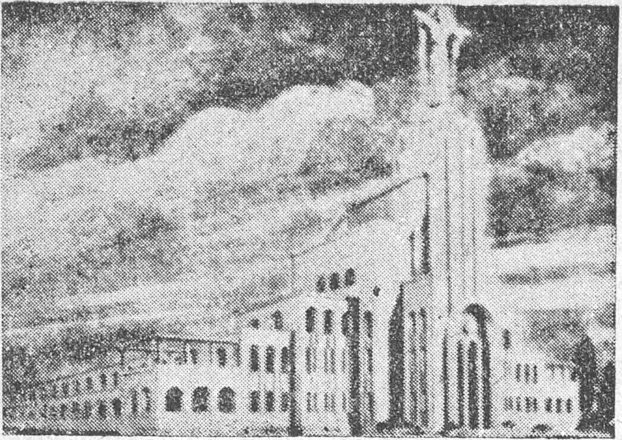
The Monastery of Jesus the King
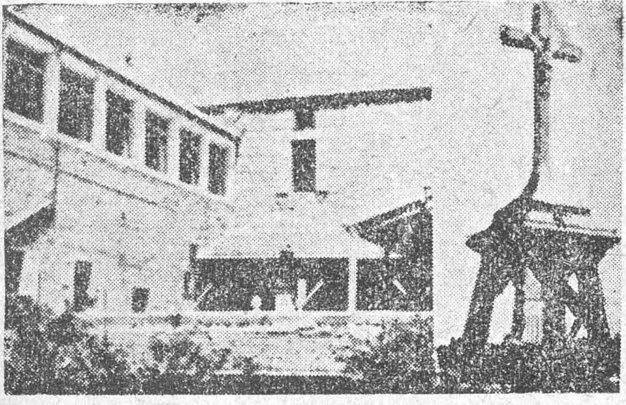
An orphanage and a cross
Our Lady of Charity