certain impressions...
Q: Such as!
A: We have some strong women's pens that have won a distinguished place in the world of letters, but they still form a tiny minority... for there are pens still cutting their way; and what I hold against the pen-holders of this second class is that the idea is not the most prominent element of their talks... there are those who care for composi-tion-style more than for the idea, and for the plain ease which the broadcasting style requires... This is a general phenomenon which it would be unjust to confine to women's writing, for it seems to me that most of those who supply the broadcast-ing houses with programs fancy themselves before an audience facing them, so they mount the steed of eloquence and raise their voices to an oratorical pitch.
Q: At the very time when the microphone demands a calm, even voice...
A: And a style of short, concentrated phrase.
Q: How did you feel when you faced the microphone for the first time?
A: My acquaintance with the microphone — and let us bow to the Language Academy's usage and say "the midhya'"... my acquaintance with it began before I joined my work, for I used to record the stories I sent to the program at the station's office in Beirut; but that did not prevent me from feeling a certain awe when I faced the midhya' for the first time with a live talk — I mean an unrecorded one — though that awe vanished entirely after a short companion-ship with the midhya'...
Q: Do you take part in the Woman's Program with talks and material you write yourself?
A: Of course, when need requires. And I make a point of presenting a monthly story.
Q: I have discerned in your writings from the start a partic-
ular bent toward the story; what incentives drove you to it?
A: The story was, and of course still is, the dearest of literary forms to my heart, since it is — provided it fulfills the conditions of the successful story — a truthful reflection of the human soul and of the environments and circumstances that surround it.
Q: What is the dearest story you have written so far?
A: I cannot specify; each of them has its place in my heart, and each has its own circumstances... In any case I am still at the beginning of the road, and my judgment on my modest collec-tion may be ahead of its time.
Q: That is more modesty than is
called for... I know also of your inclination to poetry — why do you not publish?
A: Because of my belief that the poets in any age are four... and my feeling that I shall never get beyond the fourth class... and besides, I hate distribution...
Q: Perhaps, Miss Samira, I have kept you overlong with questions at a time when you are fleeing the atmosphere of the studios... but I am confident that the gra-cious listeners have found in this sitting of yours much enjoyment and profit, and that from this moment they await your return on a coming holiday to hear you a second time. Thank you, my dear colleague.
A: And I thank you in your turn.
A Little Doctor

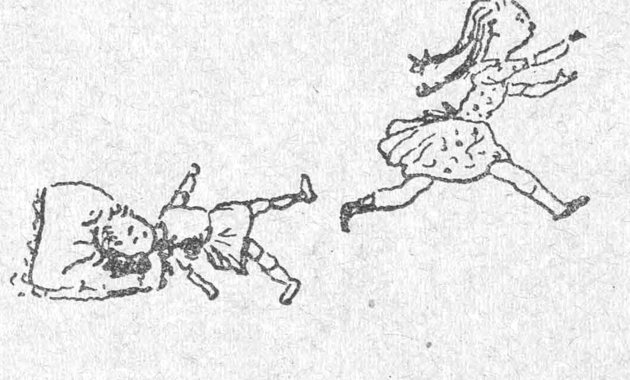
Little Marie had a pressing desire to become a doctor, and since she was no more than five years old, she treated her dolls and her playmates' dolls whenever need arose.
It happened once that she was summoned urgently to examine one of the neighbors' dolls, so she ran off in haste and left the house door open.
"Come back, Marie, and shut the door," her mother told her; but Marie did not come back, because the patient was in danger!...
"Come back at once, Marie; obey your mother and shut the door!" her father com-manded her this time. Marie came back reluctantly, mut-tering something, as though she had been kept from an important errand!...
After she returned to the house her mother asked her: "And how is your patient now?" "She died," said the little doctor, still angry. "She died while I was coming back to shut this door!!"
25