my presence is not for authority but for love as well, and for meeting their wishes. My children tell me about everything that happens to them, adventures and all, and so I have come to be widely informed about all the small details of their lives. When I sense danger I turn them away from the thing before harm occurs, and I try to do so with all caution and tact, so as to secure the result and secure their trust in me.
Halabi: Now, when there is a family of two or three children, whose temperaments and inclinations differ, how do we reconcile them?
Emily: In the past they used to say that the eldest child gives the example to the younger, and I never felt the weight of that saying; but now I understand very well that the younger of my children have been much influenced by the conduct of their eldest brother. For example, we used to call my third son 'the naughty one,' but now his conduct is excellent.
Nakkash: If the parents take pains over the upbringing of the first child, the upbringing of the remaining children becomes easier.
Emily: If a child remains shut up in himself, we do him wrong if we neglect him. It is wise, for example, to suggest to him that he is responsible for the running of the family's life; so we let the children share in opinion, and prove to him that his opinion has been taken into account. In this way there grows in him a personality and a self-regard that make him confident in himself, and at the same time we turn him away from certain questions that may arise at a particular age.
Nakkash: When do we begin that?
Emily: That depends on the child himself: there are children who mature before their time, just as others are late in maturing. And allow me to mention here, in passing, that the changes that
come over the girl and the boy at the age of adolescence are very important, and it is for the mother especially to give this period of her children's lives great attention. She must make them feel that it is a perfectly natural condition, and so relieve them of the feeling of the inferiority complex that so often arises at this age. We can draw their attention away from these matters by occupying them with sports, for instance, and with bearing responsibilities in the home; so I change their views and discuss with them until together we reach the sound solution. Likewise I explain every matter to them so that they may be enlightened, and so that we leave no room for friends to give them twisted or mistaken information.
Nakkash: This is a very necessary subject, but it is not our business today, for if we plunged into it we would never finish. It must be left for another occasion, to be examined in the detail it deserves.
Halabi: What, I wonder, is the method of upbringing that ought to be followed with a child of thirteen, say? I have a shy boy of this age; if we make remarks to him, he grows shyer still. How, then, do we handle the matter?
Emily: Problems are bound to arise in every family. So leave him room to open the matter to you and give you his opinion. If we leave them this room for inquiry and discussion until the desired result is reached, we shall have made him believe in himself and be satisfied that he has done something. The parents are the ones responsible.
Nakkash: And here each of the parents must respect the orders given by the other, even if they are mistaken. This makes us think before giving orders.
Emily: Likewise one must sometimes give way over unreasonable things, on the ground that the child still needs greater maturity and further progress.
Halabi: And how do we cooperate?
Nakkash: This too depends on the children themselves: we do not treat the difficult child as we treat the one of delicate feelings. In any case, they must be accustomed to turn to their parents not for authority alone, but in all their affairs, private and public.
Halabi: And the children must feel the presence of affection, but with a measure of firmness and force.
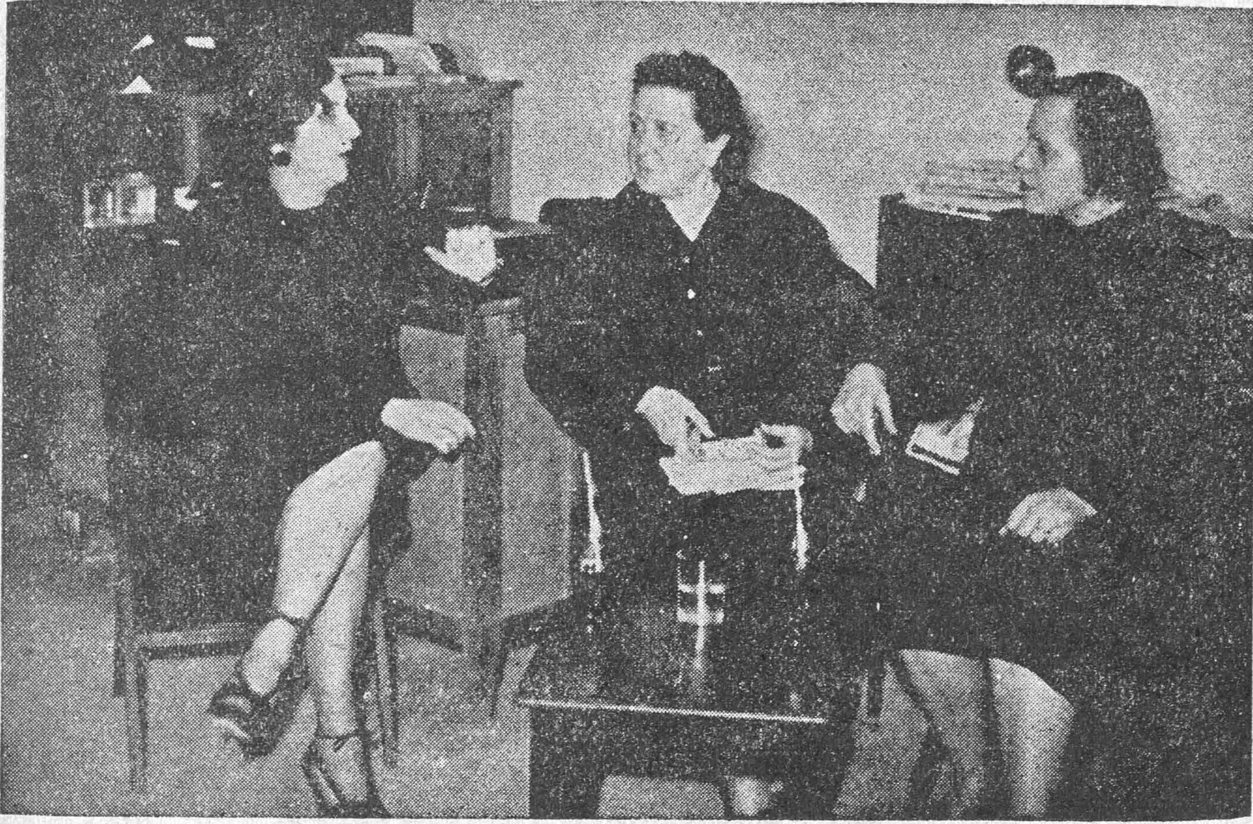
From the right: Mmes. Nazira Zain al-Din Halabi, Alice Alfred Nakkash, and Emily Fares Ibrahim.