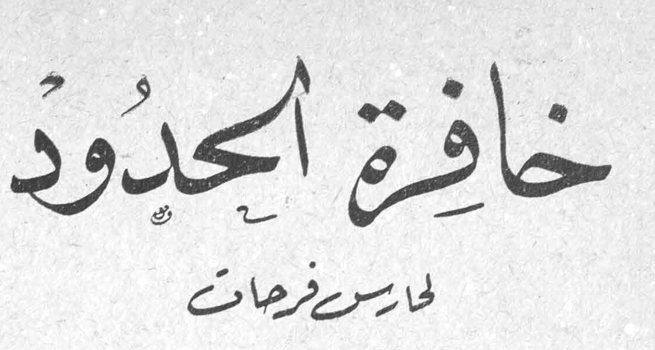
Like a runaway camel, Shams grew up in Barouk, leaping from rock to rock and bounding from one cedar to the next, herding the sheep with her carbine never leaving her arm, hunting birds and whatever wild creatures came her way. She rode horses, excelled at marksmanship, and challenged the horsemen at racing; her body was a frame hewn from the very core of the mountain, wonderfully formed, every limb of it in proportion. Then she left Barouk and moved with her father to a village near the Lebanese border adjoining the province of Acre. There she displayed heroism of every shape and color, repelled the marauders coming out of Palestine, and safeguarded the security and safety of the villagers, who, in praise of her rare heroism, bestowed on her the title of Guardian of the Border.
News of her heroism reached the council of the lord of the Beiteddine Palace, who admired her daring, confirmed her title, and sent her a steed from among the palace's finest horses, a rifle, and a quantity of ammunition — which fanned the spirit of heroism stirring in her depths. Then came Ibrahim Pasha's famous campaigns and his historic siege of the city of Acre.
After sunset Shams was, as was her custom, making her rounds on horseback when she saw on the far horizon a horseman crossing the border at tremendous speed, pursued by two other soldiers firing upon him. She knew the two pursuing soldiers for al-Jazzar's troops, and hurried to a bend in the road where she lay in wait and surprised the two soldiers with gunfire; they returned it in kind. It was a battle that lasted only minutes, after which the two attackers withdrew wounded, fleeing toward the border. No sooner were they gone than she hastened to the fallen horseman, thinking him one of her own countrymen, lifted him, unconscious, onto his horse's back, and brought him to her house to dress his wounds. When he opened his eyes and learned that he was under the protection of Emir Bashir, he cried out: "I am the messenger
of my master Muhammad Ali the Great to our lord the exalted Emir Bashir. Smooth my way to him at once." She answered him, her cheeks aflame with the fire of zeal and daring: "Oh, what joy is mine! I am your companion to him."
Shams mounted her steed and the messenger rode in her wake, no doubt as to the truthfulness of this stranger ever crossing her mind. In the still night, as the two riders crossed valley and hill, the ardor of heroism stirred in the messenger's blood — this Lebanese girl riding ahead of him unafraid. And as they were crossing one of the hills, to the music of the horses' hoofbeats, the messenger turned to Shams and said: "My name is Baha' al-Din; my mother is Lebanese and my father Egyptian, and I am proud, with exultation and pride, of one of my mother's countrywomen who saved my life. Before her I — the hero whose mettle the battlefields have witnessed — stood small and humbled, not knowing how to thank her for what she has done for me, nor with what tongue to declare my wonder and my esteem."
Shams spurred her horse on in silence, making no answer; but secretly she felt that this stranger's words fell sweetly upon her soul, and that something hidden played upon her feelings and her senses. She remained silent until the cocks crowed over the eastern reaches of Beiteddine, and as they neared the palace she bade the horseman farewell with this word: "Until we meet again — oh, what joy is mine!"
Only a few short hours passed after the messenger entered the palace and met Emir Bashir before the general call to arms was sounded and horsemen filled the palace square and its courtyards. Saadi hurried to her father when his diwan was empty to ask him what was afoot. The Emir clasped her to his breast, toyed with her tresses, and said: "My daughter, I am called upon to aid Ibrahim Pasha, whose soldiers are besieging Acre, and to help him to victory over al-Jazzar." Saadi was astonished, and answered her father: "You held back from aiding the master of the world and vanquisher of kings, the great Bonaparte, emperor of the French — and now, without hesitation, you rush to defy for the sake of this young adventurer of a commander?" Again the Emir clasped Saadi to his breast, studying the agitation the news had wrought upon her face, and soothed
her, saying: "He is our neighbor, Saadi, and the duty of neighborliness requires the utmost aid when calamity befalls him; and al-Jazzar is an intruder upon us — to say nothing of the kindness his father showered upon me when I stayed with him, honored and esteemed, and of the ties of kinship and blood and of our common interest. This young man whom you call an adventurer is the symbol of the young, struggling Egyptian nation. Ask history and it will tell you of the relations of Egypt and Lebanon since the days of the Pharaohs and of our ancient kings. If we succeed in purging our borders of intruders, we shall succeed in building prosperity and glory in this blessed corner of the East." Saadi was persuaded of the soundness of her father the Emir's words, kissed his hand, and withdrew content.
Let us return now and travel with Shams on her way home to her village standing on the border. After she had left Beiteddine behind and taken that farewell of Baha' al-Din, she fell to thinking of him anew — she who until now had thought of no one but her beloved, Shakir al-Khiyam, companion of Emir Khalil, eldest son of Emir Bashir. And behold, her heart split in two, embracing the two of them together in a single feeling, and she was at a loss how to explain this strange emotion. Her horse ambled on with her, dreaming, lulled by this strange musing. Night had let down its wing when she sensed a horseman galloping behind her; she reached for her weapon and cried: "Stand where you are, horseman!" — and she heard the horseman answer: "It is I, Shakir, O Shams. Are you still on your rounds at this hour? I have come for a few short minutes to bid you farewell; before dawn breaks I shall be riding in my master's company to Acre. Give me strength from yourself, that I may grow more valiant in war and bolder in mocking dangers. You are my soul's sister, Shams. I bid you farewell now. My greetings to your father. Pray for the victory of our young army and its Emir. Long live Lebanon, and long live the Emir! Until we meet again, Shams."
And for the first time a single tear glistened in Shams's eye as Shakir took his leave of her in the darkness of the night, and she cried: "Until we meet again, brother of my soul! God grant you victory! Long live Lebanon! Long live the Emir!"
At the walls of the city of Acre the Egyptian and Lebanese