
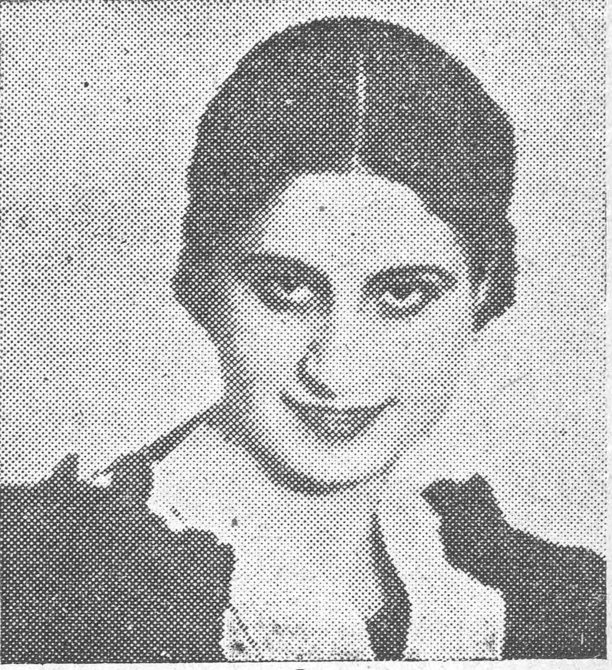
Dr. Edma Abouchdid
• The pioneer among Lebanese girls in obtaining the medical degree from the American University of Beirut.
• She specialized in gynecology in Paris, London, and America.
• She practiced medicine with success in Baghdad.
• Professor of gynecology at the Faculty of Medicine of the American University of Beirut.
• A model lady: she practices a liberal profession, and keeps her femininity.
• This session was broadcast from Radio Lebanon on "Woman's Talk."
Q — Last summer the papers wrote of your visit to the United States, to make contact with women's medical circles and acquaint yourself with the latest this branch has achieved. In this session of ours, Dr. Abouchdid, we should like you to enlighten us on the most important of these trends in modern gynecology.
A — According to my latest reading, I believe that progress in gynecology is confined to two fields, and we can begin speaking of them at once.
Q — First?
A — First: preventive medicine for the pregnant woman — that is, caring for her from the beginning of her pregnancy until the hour of delivery.
Q — But Dr. Abouchdid, I thought you meant to speak of the modern trends in gynecology — is "care of the pregnant woman" anything new?
A — Yes; in American circles it has become obligatory for the pregnant woman to place herself at the disposal of the specialist physician, who performs the necessary examinations and analyses on her. After that she remains under the doctor's supervision throughout the whole period of pregnancy: he examines her once a month until her seventh month, once every two weeks during the eighth month, and in her last month once every week...
Q — And this, as I see it, costs the mother heavy expenses, for you know better than anyone the fees of the specialist doctors here!...
A — No, not at all — and this is what I wanted to call attention to. In America, once the doctor has collected his fee for the first examination and the necessary analyses, he becomes responsible for carrying out all these examinations and for watching over the pregnant woman's state of health with minute care; and he encourages her to consult him whenever she feels the need of it, even outside the times appointed for her, for nothing — up to the time of delivery, on condition that she give birth at his hands, whereupon she pays the agreed sum. This is his principal task: to prepare the pregnant woman for a natural, healthy birth.
Q — And approximately how much is the fee he collects for this care?
A — The fees differ according to the pregnant woman's economic and social condition, and this is agreed upon at the outset; it is sometimes paid in installments, as the mother can manage. And
whatever the amount of this fee may be, in my view it is honestly deserved, considering the great benefit the mother obtains as a result of these examinations. Very often the doctor discovers certain cases of blood pressure, or heart disease, or tuberculosis, or diabetes, or kidney disease, without any previous signs — through the examinations, analyses, and X-rays he carries out on her. It then becomes very easy to treat the pregnant woman and the disease in its first stages, to look after the fetus and its position, and to assure safety and health for it and for its mother.
Q — A sound opinion; for the pregnant woman gives her fetus a great deal of her bodily strength, and consequently, as a result of this giving, certain points of weakness show themselves in her. Hence it is imperative for the wise mother to keep close to her doctor throughout the whole period of pregnancy, guided by his direction and counsel. And has this modern trend, Doctor, any connection with shortening the period during which the mother keeps to her bed after delivery? I remember that my grandmother used to compel my mother to stay in bed forty full days after every birth — and the mother was treated as though she were an invalid; she was not allowed a bath, for instance, until forty days had passed!
A — No, no — of that no trace remains in the modern trend. Now the mother may rise from her bed on the second day after her delivery, and return to her home after the fifth day. But this does not mean that care alone is what permits the mother to rise early; in my opinion our mothers were capable of rising as the arrangement is today, and their staying in bed was mostly owing to lack of knowledge, and to fear in particular. And this staying in bed longer than necessary was apt to weaken the mother.
Q — And this sagging of the abdomen which afflicts most of