to grumble at the doctor's shouting in our faces if we picked up one of the technical instruments to get acquainted with it. We would pick it up out of curiosity and love of knowledge, and the doctor would be angry with us because he was going to use it in a surgical operation and it was still clean from the sterilizing box! These annoyances and the doctors' shouting came to an end when we grew familiar with the sight of the instruments and knew when we might handle them and when to keep away from them.
"And I remember that for a long time I could not bring myself to eat meat: whenever I took up the knife and brought it near a piece of meat, it seemed to me it was the doctor's scalpel performing a surgical operation! — until a period of time passed during which I grew used to the sight of blood and of great wounds.
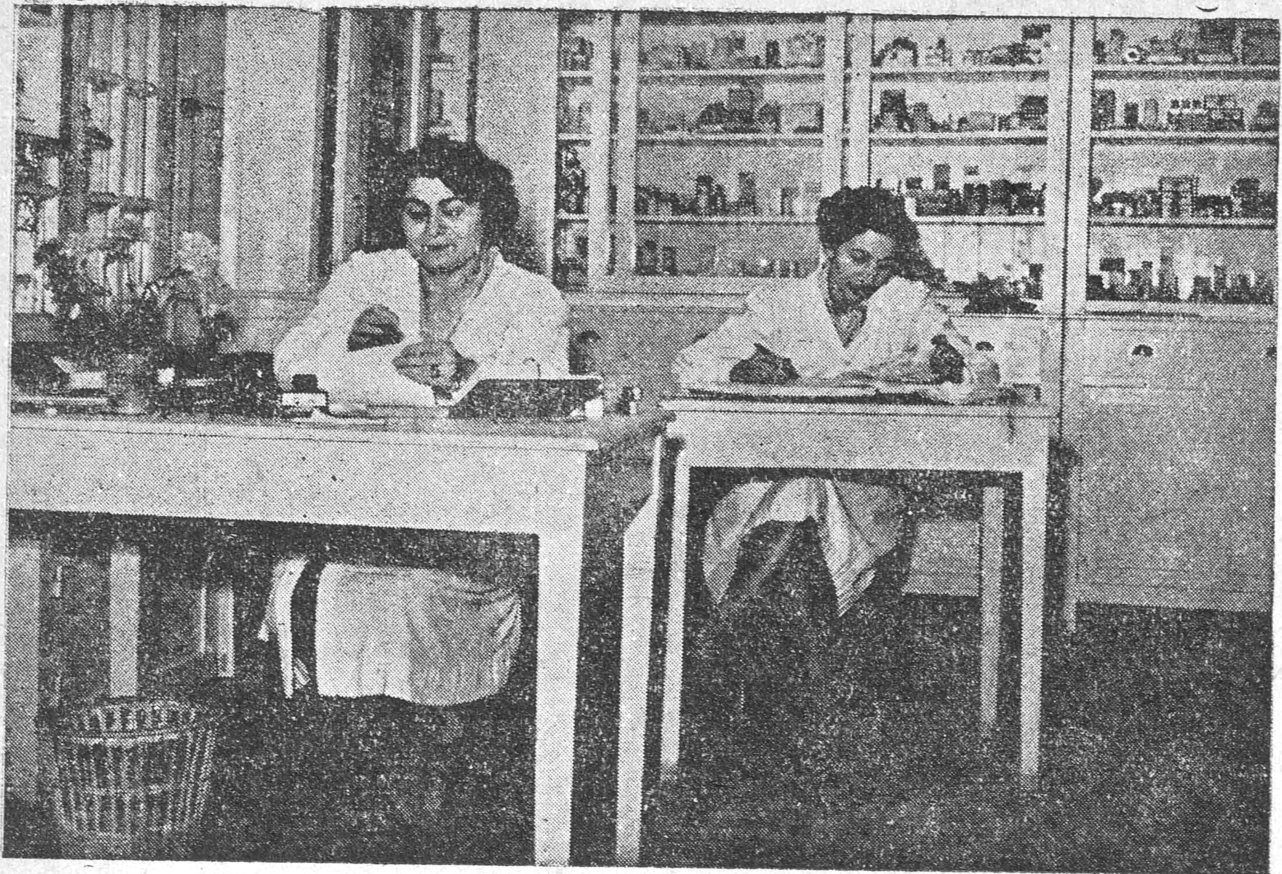
"But I find no annoyances in the pharmacy, except when the pressure of work eases; in those rare cases we begin preparing certain things we may perhaps need in the future.
These things are sometimes paper bags, or the preparing of medicines that are in heavy demand; and the employees often take advantage of these occasions to clean the pharmacy and the many shelves where the bottles of medicines and drugs are beyond counting.
Often, too, victims of accidents come to the pharmacy, and the nurses there give them first aid!
"How do you spend your free time?" "I cannot say that I have free time in the full sense of the word; but I spend such hours in reading, going to the cinema, and visiting friends, women and men."
She is one of those addicted to reading! She reads on various subjects, but she inclines to
reading about the customs and traditions of peoples; she feels then that she is making journeys in these countries she reads about or would like to travel to. She has a particular leaning toward psychological, analytical novels, and prefers reading in French. As for Arabic, she reads "the beautiful poetry we are famous for!"
When I asked her which of the Arab poets she loved best, she said: "Michel Trad, Said Akl (when I understand him), and Salah Labaki."
She inclines to seeing films based on real life, and after that, musical films.
And if she is tired at the end of the day, she amuses herself with solving "crossword puzzles."
I asked her about the kind of visits she pays, and she answered, laughing: "They are no different from all the other visits in Beirut!"
"Where and how do you spend your annual holiday?"
"I go to our village, Deir al-Ahmar, in the Beqaa. There I live the delicious life of laziness after the year's fatigue: I spend my time riding horses, hunting, and sitting up of an evening with the lively village folk! You will
ask what we do with our evening gatherings? We play backgammon sometimes, and we talk at other times!"
Despite her evasion of answering my remaining questions, I was able from other sources to learn another part about her during her holiday hours! She spends the greater part of her time supervising the crops of the land her family owns. Nor do the village folk forget that she is a nurse: they come to her with their aches and pains, and they affirm that to her belongs the greatest credit for the visit of the mobile Lebanese Red Cross dispensary to their village.
And her friends admire her constant gaiety, her quickness of wit, and her loyalty in friendship.
I said to her: "This is the last question: what is the dream you would wish to see come true?"
She answered: "I will not answer — that is a secret between me and the future."
As for me, I say: "May God fulfill all your hopes, Suad!"