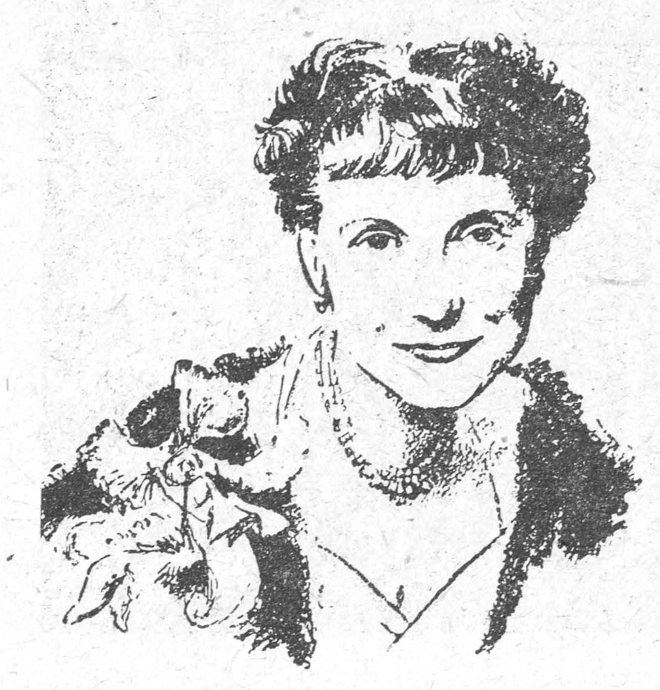
"Mamie," wife of General Eisenhower
Nothing works more powerfully upon the soul than a lesson carried out in deed — especially now that the language of talk and sermons has lost its force; how greatly we need deeds, not words, to prove our true greatness. And we have the best example in the life story of the most brilliant of foreign ladies of this age — one who, had she sought wealth, would have found it within her reach, or had she sought glory, could have monopolized it; for in her hand lie the reins of hidden rule: she may raise whom she pleases of the strivers, and cast down to the depths whoever crosses her. All this influence did not tempt her; rather she turned her back upon it, freely and gladly, holding cheap the glittering, gilded aims of mankind, and gave herself to her loftiest aim: how to be a good wife, a self-sacrificing mother, and a loyal citizen. She is Mrs. Dwight Eisenhower, whom good fortune did not spoil when her husband received the highest ranks of the army; today, when she is the wife of the greatest of commanders — or perhaps of the future President of the American republic — she is still, as she was thirty-five years ago as the wife of the simplest lieutenant in the army, looking in on her neighbors, cheerful and kind toward them.
We cannot but ask why Mrs. Eisenhower chose this humble path, and how she stood firm against the trials and temptations of this age? The matter is simple; it goes back to her first upbringing in the arms of her parents, each of whom kept to his own office: the father to earning, the mother to watching over the affairs of the house and rearing the children in the sound way, despite the wealth at her disposal. They oversaw everything that concerned their children and the home; and this serene, settled way of living took root in the memory of the gifted child, who was the delight of her circle — the neighbors' children vied to please her and offer her their services — and she possessed a great share of beauty both
of person and of character; and to this day she remembers those happy times with admiration.
Fate willed to add to the joys of her life a new joy by the choice of the right husband for her. In July of 1916 she was wedded to Lieutenant Ike Eisenhower in the city of Denver, where her mother had begun her own happy married life — so it was a blessed omen for the two young newlyweds, she nineteen and he twenty-five. Two days after her wedding she went to her husband's parents — and what a distance between the simplicity of their life and the splendor of Denver at her parents'! But love makes of the hut a palace, and of the colocynth sweetness; the music of her sweet voice was the proof of her happiness and contentment, and she never reckoned that what was in her eyes the most trifling of matters would become one of the vexations of her life — the art of cooking. She failed at this task, and she and her husband were forced to resort to restaurants; and a lieutenant's pay does not suffice for such extravagance. Then she remembered the last words of her mother: "Stretch your legs no farther than your carpet reaches" — and they cut into her heart like whips. At once she sold her wedding presents to cover the deficit, and set herself to draw upon her father's counsel; and she succeeded, and her husband succeeded
with her, for he rose to the rank of first lieutenant — that was at the beginning of the First World War. Then he was called to enter the war college in Washington, from which he graduated bearing honors, and he set out for Europe to compile a book on the heroes of the war; his wife accompanied him to Paris, and for the first time since their marriage a house of four rooms was set aside for her, which her friends envied her. As for her, her feeling did not change — even after her husband became a five-star commander, and her house became a palace to rival the President's palace and a place of pilgrimage for people and nation. It pained her if one of her friends called her by anything but her first name; she counted this advancement an ordinary duty, just as her own duty was to be the best of wives and the most devoted of mothers. Invitations rained upon her — banquets, dinners, parties, and evening gatherings — and she refused them all, especially after America entered the Second World War; she would answer every invitation addressed to her: "It is a disgrace that I should move about in the houses of gaiety and pleasure while our sons are drinking the cup of death and sorrows." She was to be seen nowhere but at the house of the Red Cross, seeking works of charity and benevolence.
She was once asked what her dearest wish was, and she answered: "To return to my old farm; the splendor of palaces does not tempt me, resounding titles do not delight me, and the sway of power does not dazzle me — all of them together are not worth one day among my friends at my old farm." And she works to attain this wish; for the worm of false grandeur has not touched her, as it has gnawed at many of the wives of the great men of this age; she has remained herself — modest, and loyal to the men and women who were her friends yesterday, today, and forever.