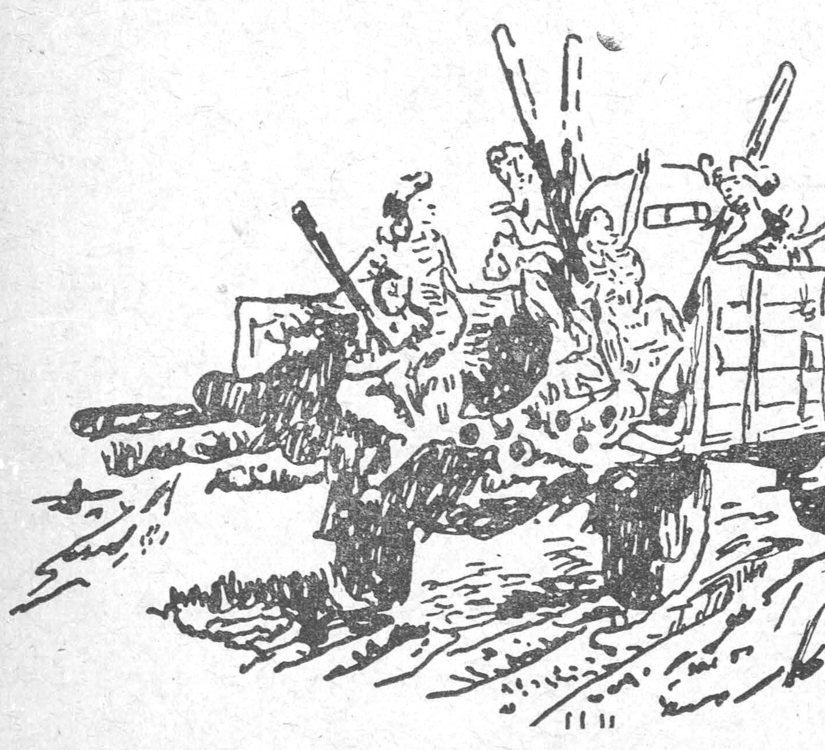
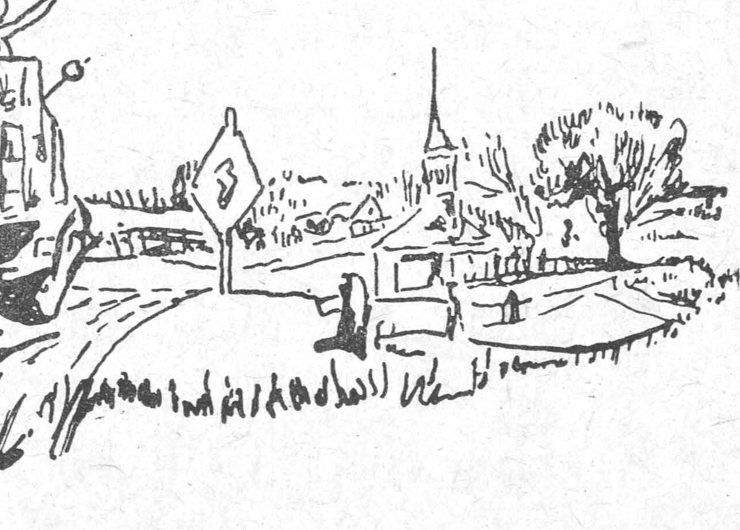
Hollywood, in Maryland, was a small, sleepy town — until Lewis moved there with his family and settled beside one of the banks of the river, near the harbor.
The press commentator Lewis — who, besides, is a writer and lecturer — had grown tired of the noise of the city of Washington and of living in it, so he moved to Hollywood and bought three acres of land fit for farming, built upon it a modern house, and fitted it with a broadcasting studio. In this part of the town, called Placid Harbor, the Lewis family (his wife Alice, his son Fulton Lewis, and his daughter Betsy) settled down to the simple, quiet living that prevails in the life of small towns.
The arrival of that famous personality shed an air of enthusiasm over Hollywood, for Lewis lost no time in opening the way to brotherliness and drawing close to the people. In 1947 he offered to broadcast the town's own Christmas program from the little church whose building the inhabitants had lately completed. At the last moment Lewis gathered a band of youngsters, formed of them a small choir, and
recorded some carols for it, though it had no training in the tunes. But these youngsters, athirst for amusement, added no breadth to his fame.
Lewis was a bold and outspoken commentator, big of frame and thick of hair, weighing 190 pounds, capable of drawing the serpent from its lair if he chose... To the children he seemed a magician: he could sing and play the piano in church, and beyond this he was a sociable man, close to people's hearts. The youngsters wasted no long time; they made up their minds, gathered some of their parents and relatives, and all marched toward Placid Harbor to ask Lewis to be the leader of their choir.
The offer was tempting to Lewis, who possesses a fine voice, and who is moreover a skillful musician, an expert hand at fitting out halls, a professional player of the organ — and then a man of work and a seeker of amusement at one and the same time, to lighten the weight of boredom that comes of steady work.
Lewis looked at those sweet young faces and said: "Very well — only,
if we begin the work, it must have a good result. You must do your utmost, and attend every night."
Lewis began working with 15 of them, between the ages of eight and nineteen; they would reach the church before him, learn well everything he set before them, and obey and respect him.
Then he divided them into sections according to the kinds of their voices, and they gave themselves up to exact training, on which they spent every second of their time.
And one day Lewis awoke to a sweet truth: he had succeeded in forming a successful choir in a period of no more than six months.
Lewis felt this success, and he sensed that those little sparrows needed greener pastures than the one they were in; so he arranged for them the chance to sing in a great church in Washington, where they won so great a success that Lewis felt the road of success had opened before him. When he returned to his house he felt a heavy weariness after his work as head of the troupe, made up of fifteen youngsters, every one of them eager for experiment and discovery; so he asked his wife that no one should disturb him, since he had to prepare a broadcast for the following day:
But he had scarcely settled down for a few minutes when he heard the sound of the bell ringing in the house, and then a young voice saying directly after: "But the
"Children can do anything!" And if you are in doubt of this, then read, dear reader, the following story: