at suppertime, and everyone endorsed the husband's remark that the family was not properly fed. So we settled on four points to be applied to every member, including the husband and the children themselves. They were as follows:
1 - Clothes to be laid out before bedtime for the following day.
2 - The children must dress before breakfast, not after it, as they used to do.
3 - The husband to get up as usual — that is, a little after half past seven — but with a new responsibility that delights the baby, the two-year-old. This responsibility is to change the child's clothes and then let him spend the next few minutes watching his father go through the operation of shaving.
4 - The husband likewise to help the children tie their shoelaces when they cannot manage them; he is also responsible for fastening the buttons beyond the little ones' reach and for buckling the belt that will go into its loop only with difficulty.
5 - The children are free to change their minds about what they wear — but on their own responsibility.
I found great difficulty, of course, in teaching the children self-reliance in dressing — it was easier for me to dress them myself — but after a while they grew used to the new arrangement, and everything went smoothly. And I was confident that whatever small success the family achieved in its system, the credit for it belonged to the mother.
Thus Mrs. Ray Dewey ends her engaging article, drawn from the very heart of life, saying: perhaps the situation differs from family to family. Or perhaps tomorrow will not be like today, and this very same arrangement will prove hard for our own family; we must not, then, cling to one fixed arrangement, letting life fall into
a single rut. But whatever the situation, if the matter concerns a number of persons setting out for different places at nearly the same time, this particular solution is indispensable: a little time, pencil and paper, discussion, and the finding of a democratic solution
shared by all the members of the family — and, most important of all, a father who is happy to cooperate, and a mother who makes it easy for her children to bear responsibility.
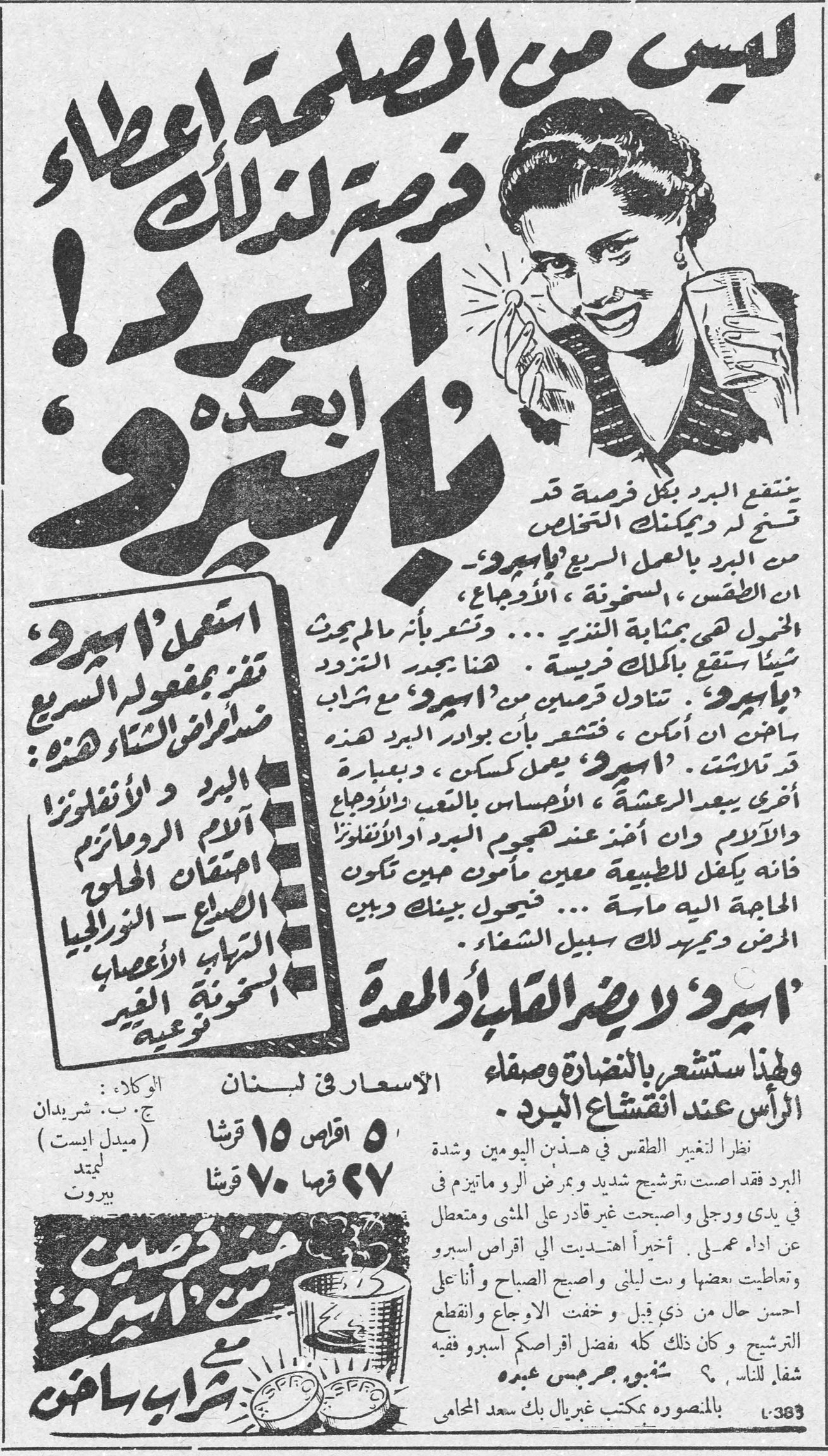
Aspro
It does not pay to give a cold its chance — so drive it off with Aspro!
A cold takes advantage of every opportunity that may come its way, and you can rid yourself of a cold by prompt action with 'Aspro.' Chill, fever, aches, sluggishness — these are the warning signs... and you feel that unless you do something you will fall a prey into its claws. This is the moment to arm yourself with 'Aspro.' Take two 'Aspro' tablets, with a hot drink if possible, and you will feel these first signs of the cold melt away. 'Aspro' acts as a soother; in other words, it drives off the shivering, the feeling of fatigue, the aches and pains; and if taken at the onset of a cold or influenza, it assures nature of a trusty helper just when the need for one is pressing... So stand between yourself and illness, and smooth your road to recovery.
'Aspro' does not harm the heart or the stomach.
And that is why you will feel fresh and clear-headed when the cold has lifted.
Use 'Aspro' and you will acknowledge its swift action against these winter ailments:
Colds and influenza — rheumatic pains — sore throat — headache — neuralgia — neuritis — fever — malaise
Prices in Lebanon:
5 tablets, 15 piasters
27 tablets, 70 piasters
Agents: G. B. Sheridan (Middle East) Limited, Beirut
Owing to the change of weather these last two days and the severity of the cold, I was stricken with a heavy catarrh and with rheumatism in my hands and legs; I became unable to walk and was kept from doing my work. At last I was guided to Aspro tablets and took some of them; I slept the night through, and in the morning I found myself in better condition than before. The pains eased and the running cold stopped — and all of this was thanks to Aspro tablets, in which there is healing for people. Shafiq Girgis Abdo, in Mansoura, at the office of Gabriel Bey Saad, the lawyer.
Take two Aspro tablets with a hot drink