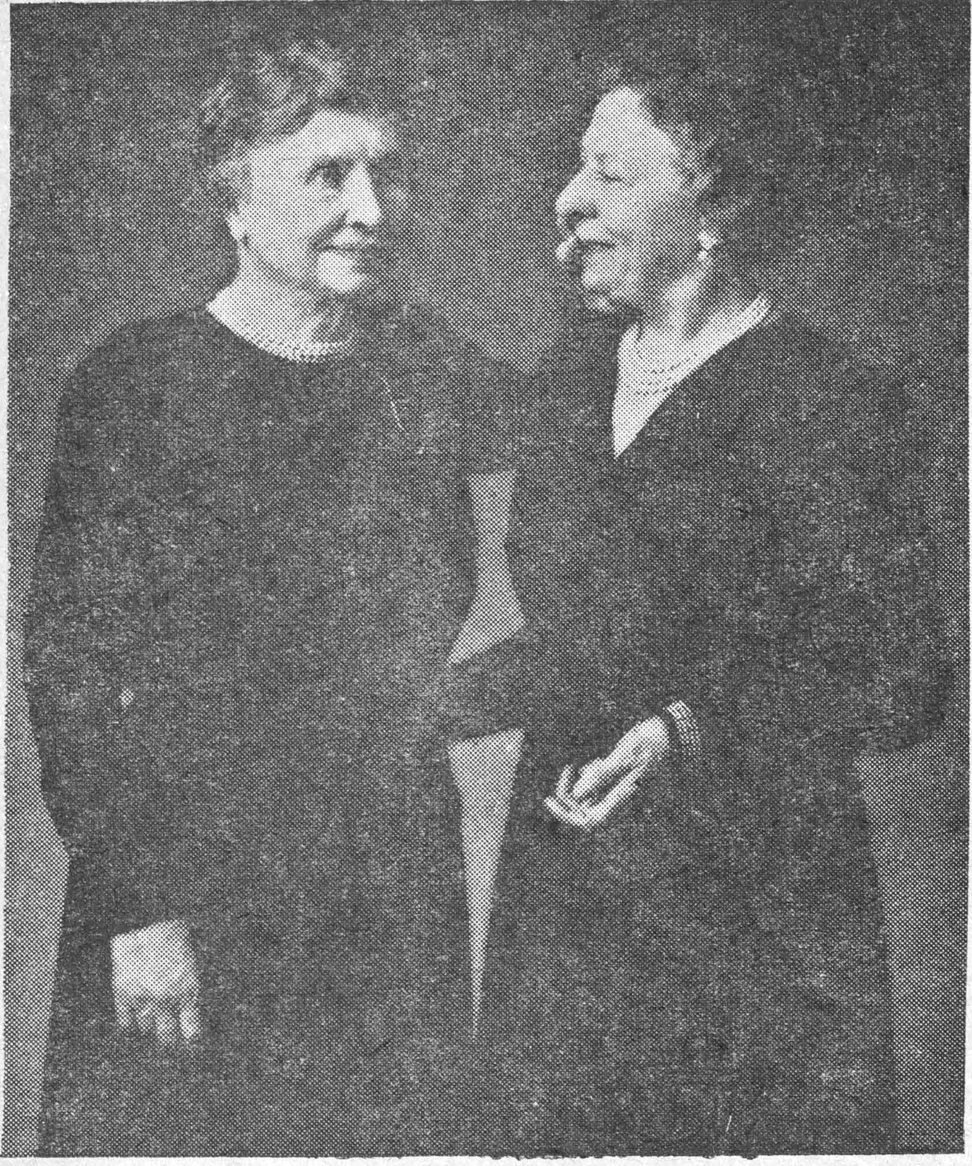
who translated for her, by means of the hand signs, all the lectures she had to attend; she encouraged her always and stirred her ambition by planting in her a great confidence in her own success and ability.
Then too, the numerous reference works for the subjects to which Helen had to return were translated by the hand alphabet through Miss Sullivan, who herself nearly went blind from the many long hours she spent in the necessary reading and in conveying the information to Miss Keller.
Two years before she took her degree, Helen was swept into the current of writing and published her first work, "The Story of My Life," which appeared serially in the "Ladies' Home Journal" in 1902. From that time her pen has never once been idle. She uses the typewriter with Braille letters in preparing her publications and then copies them out on the ordinary machine, and the reader rarely finds errors in what she types!!! She has also contributed many articles, continually, to a large number of American magazines, among them: the "Century Magazine," the "Youth's Companion," "McClure's Magazine," the "Atlantic Monthly," and others. She has likewise published several books besides her work "The Story of My Life," among them "Optimism," a valuable essay which appeared in 1903; then "The World I Live In," in 1908; "The Song of the Stone Wall," in 1910; "Out of the Dark," in 1913; "My Religion," in 1927; "My Later Life," in 1930; "Peace at Eventide," in 1932; "Helen Keller in Scotland," in 1933; "Helen Keller's Journal," in 1938; "Let Us Have Faith," in 1941.
Helen Keller received the degree of Doctor of the "Humane Mission" from Temple University in Philadelphia. And in June 1932 the University of Glasgow in Scotland honored her with the degree of Doctor of Laws.
Helen was and still is a woman who loves travel and movement without weariness or boredom. She has made several tours through all parts of the United States and Canada, and delivered many lectures on behalf of the blind. She has also made several journeys to Europe and the East, and even to South Africa and Japan.
From childhood Helen Keller dedicated herself to work for her fellow blind, and for the deaf-blind. She was always ready to serve her cause before legislators, and by means of lectures, and above all by making herself that shining lamp and that lofty example which showed the public, and every doubter, what an individual can accomplish despite the harshness of difficulties.
After the death of her teacher in 1936, Miss Keller moved to the suburbs near New York City. In 1946, while she was on her fact-finding journey in Europe, fire consumed her beautiful white-frame house, in which she had spent many years, gathering during
them a sweet bouquet of precious memories after continuous striving. On her return, her friends hastened to her service and helped in rebuilding the house, which they succeeded in restoring exactly as it had been. They are now working to restore that precious treasure which was lost — her library, filled with books printed by the Braille method for the blind.
Helen Keller is a person always at work, of an energy that never flags or tires. Her time is always taken up with writing, with lectures, with contributing to the service of the blind, and with other projects that keep arising for her.
She is a lover of dogs and has a large number of them, and she spends her leisure hours playing with them. She loves the garden too, where the flowers know in her a devoted friend and a lover of nature. She is full of life, feeling everything around her; she takes great delight in people, and so she is always awake and alert to whatever change comes over their feelings; she relishes a joke, and she has the gift of drawing pleasure from life, and a constant longing to read and to learn; her favorite books are the Bible and certain volumes of poetry and philosophy.
In 1914 Miss Polly Thomson became one of the family, for from the time she took up her work, Miss Keller could no longer do without her; she was also an assistant to Mrs. Macy
(Anne Sullivan). Her responsibilities kept growing with the passage of time, and it fell to her to make