
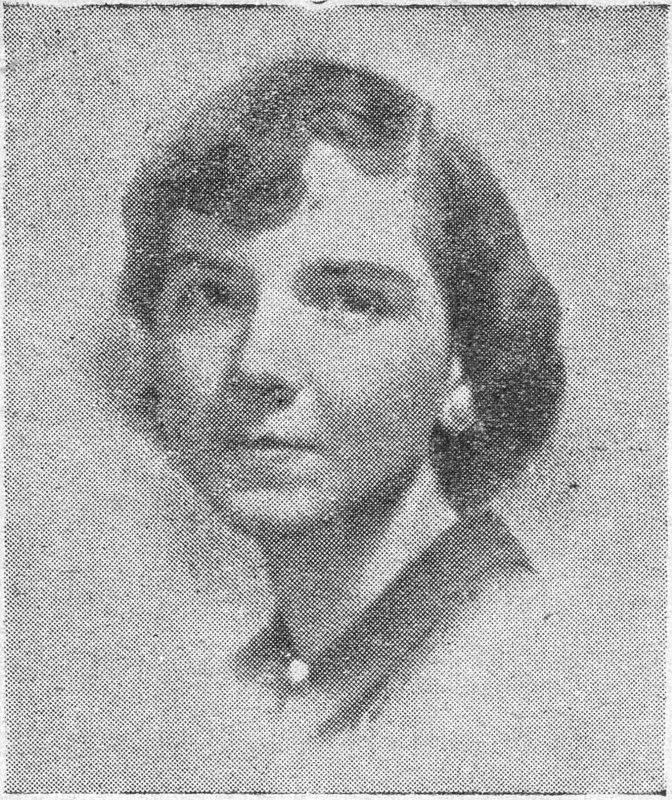
These are quick sketches — some may run long, some short — in which I present selections from certain of the women writers of this land and recount scraps of their lives and their letters. I am anxious to point out from the very start that treating America's “great” women writers, and them alone, is not the aim of this series: the purpose, rather, is to acquaint the women readers of “The Woman's Voice” with faces and pens that I hold it needful they should know (and it is a pride for me to be the boat that carries them from one language to another and from one heritage to another) — whether these faces and pens are seasoned veterans or still fresh in bloom. And if it be said: why this writer and not that, and that piece and not this, I shrug my shoulders, name no standard by which I measure literature, and break my silence with a single word: it is taste, and taste alone, Madam!
*
On my first day in Cambridge I found, in Harvard's various halls, large notices announcing the opening of the current season of the poetry readings held by the Morris Gray foundation, with a program at which Adrienne Rich would read selections from her poems. The name stirred a fresh echo in my memory, for I recalled a poem of hers I had read in Beirut in the magazine “Poetry” (a magazine founded in Chicago in 1912, from whose founding the contemporary poetic renaissance is dated; often mere publication in it was a ladder by which a poet climbed to glory). She was among the first of America's writers I came to know — after the storyteller George R. Stewart, with whom I traveled for twenty days, from Greece to New York, during which he wrote a story for young people and gave me proof that modesty may be joined to talent without diminishing it!; and after the poet John Ciardi, who, while still in the middle of his third decade, has published four volumes of verse and has in press a mighty translation of Dante; and the critic Mark Schorer, to whose works there will shortly be added a study of D. H. Lawrence.
Adrienne Rich is twenty-two springs old. My use of “springs” instead of “years” is not mere affectation: for if her poems do not yet contain the experiences of summer, the wisdom of autumn, and the visions of winter, they hold the gaiety of spring, its free flight, its fragrance, and its song. And in her style
is the sweetness of spring: rarely do you see in her verse the contortion that is almost one of the marks of modern poetry; rather you see her write the poem as though she were caressing a flower — with gentleness, brevity, and delight, and with something of reverence. She was born in Baltimore, in the state of Maryland, and received her university education at Radcliffe (Radcliffe being a college for girls, who live there but take their classes at Harvard, which is confined, nominally, to men!), where she took her degree “with great distinction” last summer and was awarded the Caroline I. Wilby Prize, as well as a Phi Beta Kappa key, the highest thing to which undergraduates in the United States aspire before graduation.
Her love of poetry goes back to the years of childhood: she too lisped her poems! Before she was twenty a number of pieces had gathered to her, from which she chose forty and submitted them to Yale University, which conducts an annual competition for the country's poets under forty; collections pour in upon it from every corner of the vast land, and a great poet is entrusted with the office of judge, selecting from them only one each year, to be printed and published at the university's expense. A glance at the list of the poets who have won this prize in past years, between the First War and the present time, shows us that a number of them afterward rose to prominence and took their place in the heritage. The Yale prize for 1951 fell to Adrienne Rich. Her forty poems were published in an elegant book entitled “A Change of World,” and the poet W. H. Auden (whom the critics do not dispute to be the successor of T. S. Eliot and his second in the field of contemporary English and American poetry) wrote a five-page introduction to the collection — he being the judge who chose the winning book. In this introduction Auden
praised the craftsmanship in Adrienne Rich's poetry (and craftsmanship, in Eliot's view, is the best measure of the budding poet), her strong sense of