died one day before
the appointed term ran out, a victim of hunger and cold. The news of his death weighed heavily on Barnardo, who held himself responsible for it; he prayed and grieved until he resolved to make practical atonement by hanging a large board on the door of the Home, on which was engraved the following declaration:
No homeless child is refused refuge in this Home
And this noble motto still stands and is still acted upon to this day, despite the financial difficulties the project has passed through on many occasions.
By the year 1905 — the year of Barnardo's death — his Home had succeeded in rescuing 60,000 waifs, and had worked to spread the idea, to awaken consciences, and to stir them to concern themselves with this social problem and to treat it — treat it effectively.
Barnardo's Home as I Found It
I was invited to visit the main center in London, and I found that it consists not merely of the original Barnardo house, which was presented to him as a wedding gift, but of a quarter — a small town — comprising 68 buildings, besides the church, the hospital, the library, and the many gardens; in the middle of one of these Barnardo sits upon a high marble pedestal, with three boys at his feet reading from a book, and behind him a woman clasping her three children. This headquarters has branches in London itself and in most of the other English cities and villages — indeed, in many parts of the world, such as Canada, Australia, and elsewhere.
I found, too, that each one of those buildings contains a reception room, another for reading, a third for eating, and several bedrooms, with a kitchen and a bath — all of them completely fitted out with the most modern furniture and the means of comfort and heating, and with curtains... Over the management of each presides a woman called an "Aunt," with one assistant or more, as need requires.
Since the Home accepts the
homeless of both sexes, provided their ages do not exceed 16 years, its residents have been distributed among those buildings according to age. If the homeless child is under two years old, he is placed in a special house called the "nursing house," which is furnished with all kinds of toys and means of amusement; if he is older than that but has not passed five, then in another house; and after five, the boys' rooms are separated from the girls' rooms, on the condition that no more than ten souls live in a single room. And when a homeless boy or girl reaches the age of adolescence, every two of them have a room of their own.
The first thing to catch the visitor's attention is that merry
spirit which pervades the Home, and the contentment shown by everyone. For Dr. Barnardo left no occasion or cause that might weigh upon the homeless children or make them feel that they are living in a refuge, an orphanage, or a home for waifs. They are asked to do no housework at all beyond tidying and arranging their own beds and their own rooms; all other tasks and services, we find, have been entrusted to maids and workers hired for this purpose... And so everyone in the Home — even the workers and the hired hands, the women supervisors and the men — may be seen cheerful and glad, each doing his work with energy and zeal, unmarred by any grumbling or criticism.
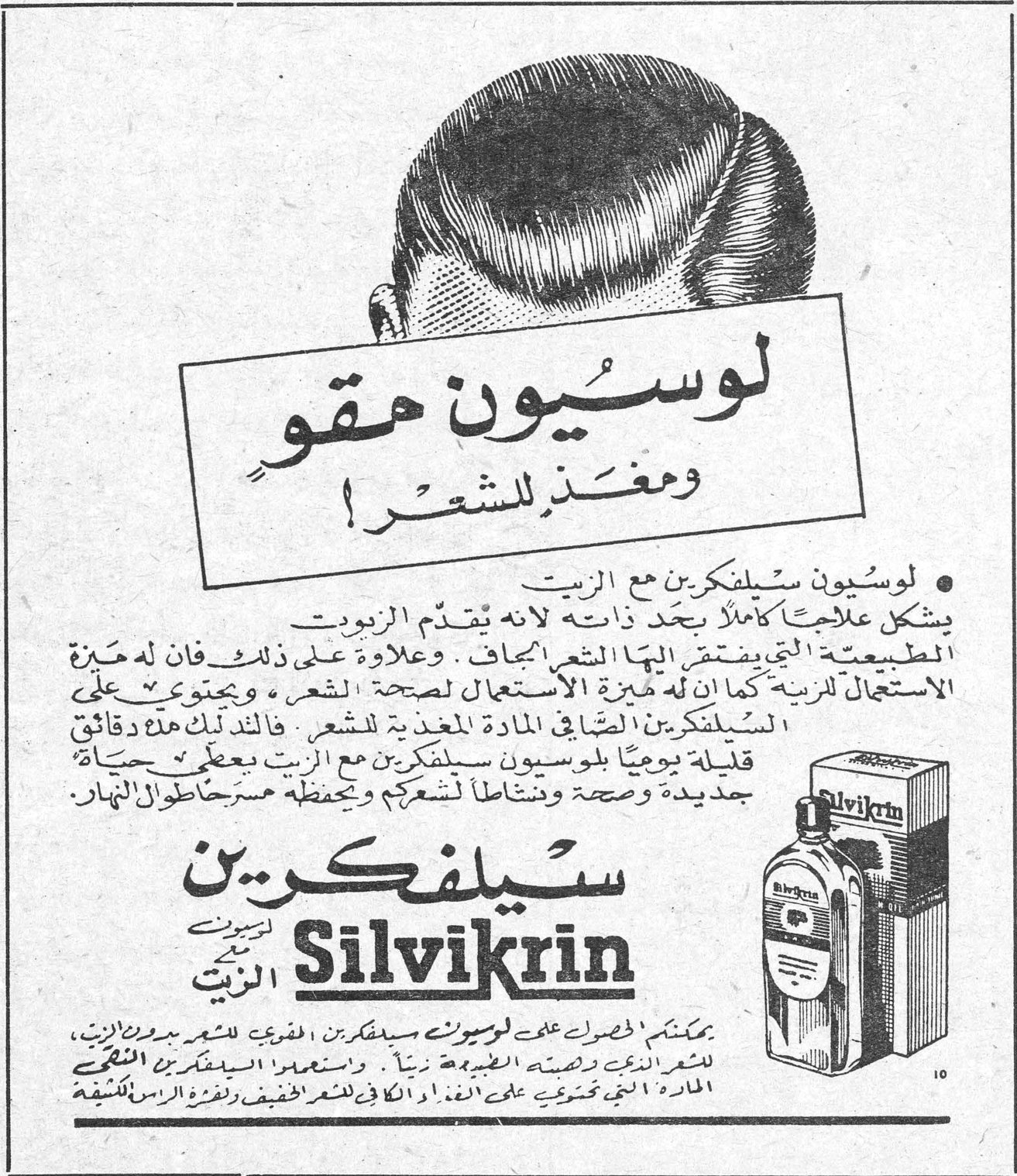
Silvikrin: A Tonic Lotion for the Hair
A lotion that strengthens and nourishes the hair!
• Silvikrin Lotion with oil constitutes a complete treatment in itself, for it supplies the natural oils which dry hair lacks. Over and above that, it has the advantage of serving as an oil dressing as well as the advantage of serving the health of the hair. It contains pure Silvikrin, the substance that nourishes the hair. A few minutes' massage daily with Silvikrin Lotion with oil gives new life, health, and vigor to the hair and keeps it groomed all day long.
Silvikrin — the oil lotion
You can obtain Silvikrin hair-strengthening lotion without oil, for perfect hair with its natural set, without oil. And use pure Silvikrin, the substance containing the nourishment, for thinning hair and for a weary scalp.