from the very start. The children had a special turning table of their own, from which they picked out their records before they could read their names. The children could sing the songs of infancy and kindergarten before they learned to talk. The parents could not but join in with their children, having found in them all these encouraging musical signs.
Father's share in the singing went according to the children's ages, for Mother gave him her advice: 'If you can learn the songs a short while before they come to appreciate their worth, you can keep step with them to the end.' Nor was she surprised at anything when he added the songs of Brahms to his collection. The children grew used to asking their father for a song exactly as other children ask for a story.
When Father discovered that he could recognize a piece and follow its singing by ear, he began to use this musical faculty at home first — where no one would criticize him — and then at the club. In every song he would begin by following the melody itself at first, then try to sing all the parts of the chorus. In a short while he became a regular member of the singing club, sitting at rehearsals pretending to read the score and following the conductor for the sake of good expression in his singing. He often dreamed of trying out his voice before a jury of musicians.
For lack of time, he cut down his singing at home; but he tried all the while, in cooperation with Mother, to see that all their children's parties and gatherings with their small visitors always turned to singing and dancing. His ambition was to influence all the neighboring families.
In this period the radio and the gramophone became useless, so he brought home a small piano. From that time on he has been thinking of the possibility of being a player and a singer. No one criticized him at the beginning as he tried out all the tunes and the musical keys, for he took care to play without noise
or clamor. Often Mother and the children helped him by singing along with him, and then he would feel magnificent.
Father had bought a book entitled 'Fun with Music,' and this book taught him to play on three chords only. He found them enough to help him with the songs he knew, and discovered after a while that all songs and tunes can be played from any key; nor was it beyond him to add something here and there to the tune. Up to this point his musical education had needed no special teacher. But when he decided to bring in a music teacher for his children, he wanted to make sure that they would not play music merely to show off with it; he wanted them to sing and play for fun, in the easiest of ways.
The piano was the foundation of the musical band in Father's
family. He brought one of the children an accordion and another a harmonica, and after a short while they were able to join in on the guitar and other instruments. And when the neighbors came with their records to make recordings, they found the violinist straying in his playing from the rest of the band; but the din was enough to disperse that annoying scratching.
This is the story of the father who successfully led his children's lives toward music. It is rare in other homes — though many parents have discovered the music of recreation in the same way, they do not hasten to nurture it and bring it to success. And so the old inferiority complex vanished entirely.
From the magazine House Beautiful Translated for 'The Woman's Voice' by Karam Tanir
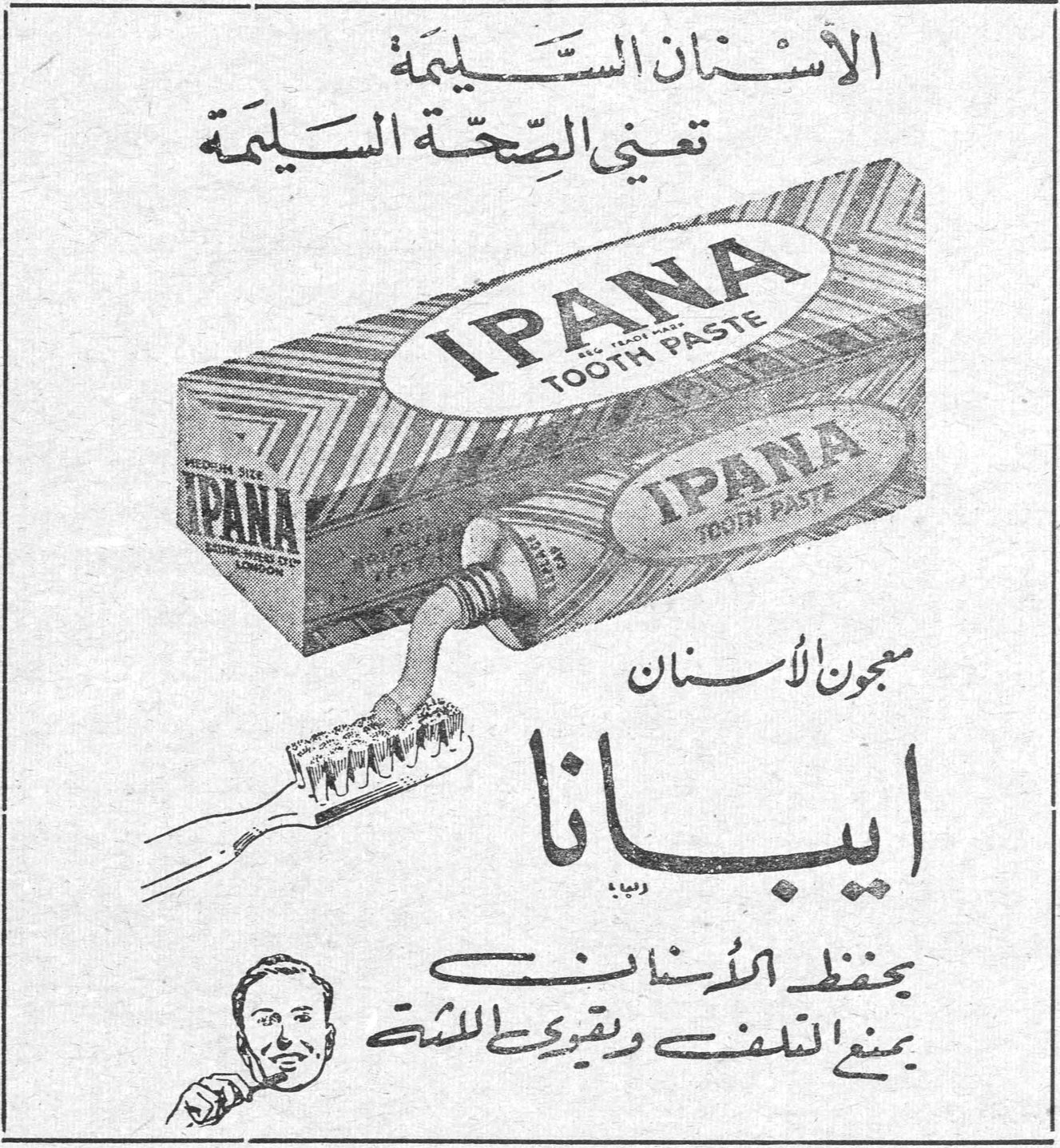
Ipana Toothpaste
Sound teeth mean sound health
IPANA TOOTH PASTE
Ipana Toothpaste
Protects the teeth, prevents decay, and strengthens the gums