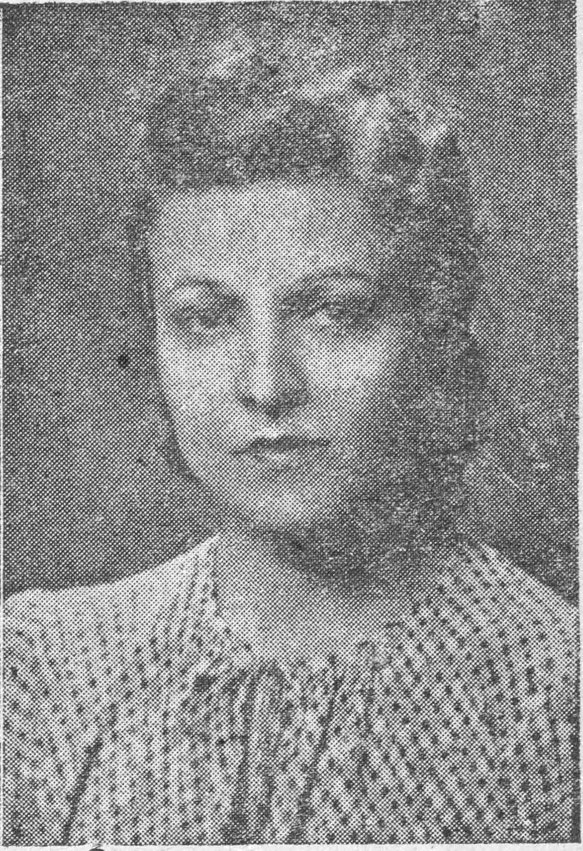
Miss Rose Ghorayeb
* A Lebanese woman of letters, graduated with distinction from the American University of Beirut with a master's degree in Arabic literature.
* Known for her instructive articles and her solid scholarly powers.
* She has composed for children two delightful collections: 'Songs for the Little Ones' and 'Plays for the Little Ones.'
* An able educator, she holds the post of director of Arabic studies at the Evangelical College for Girls.
* Her book 'Aesthetic Criticism and Its Influence on Arabic Criticism' has lately appeared.
* In the following radio session from the Beirut station, a glimpse of the sides of her intellectual activity.
Q — What circumstances, or what influences, inspired you to compose songs and plays for children?
A — There are deep causes and immediate causes. The first is my inclination, ever since childhood, to memorizing Eastern and Western songs; and I found myself in surroundings that strengthened this
inclination in me. Then, from my early youth, I inclined toward composing light verses that go well with singing. In my view, composing poetry for children requires a musical ear, and practice in composing short-metered pieces, classical and zajal alike, and setting them to melody directly, so that word and tune are created at one and the same moment.
Q — Those are the deep causes; and you said there are immediate causes — what are they?
A — My feeling of our society's and our schools' need for children's literature. Circumstances and pressing need are the immediate cause.
Q — In your experience, what kind of song is dearest to children?
A — I have observed by experience that songs that come closer to the colloquial, drawn from the very heart of our surroundings, bearing our particular stamp and our local color, meet with a success that Western melodies and songs composed in the classical tongue never attain.
Q — What is your view of using the colloquial language with children?
A — My view is that the nearer a song or a recitation piece comes to the colloquial, the easier it becomes for the child to memorize. This shows us that among the chief causes of the difficulty of the Arabic language, and of the weakness of its spread, is this gulf standing between the language of speech and the language of writing, and the inability of speakers of Arabic to use the vocabulary of the classical tongue in their talk. They learn a language which they soon forget for lack of use.
Q — What do you propose, then, to fill in this deep gulf?
A — This is a problem worthy of the utmost attention from the men of letters and of learning in our country. I do not claim to be equipped to treat such a subject; all I can say is that there must grow up among us a language of conversation which we can use, that very same language, in
writing — so that if we are obliged to improvise a speech, or write a letter, or deliver a talk, we can do it easily, without stumbling, and without carrying the paper and reading it out to the listeners. For a long time now they have been proposing to simplify the classical and to raise the level of the colloquial, so that the two languages meet on a single plane; this is still the view of many investigators, but until now no practical attempt has appeared to put this view into effect. And so our classical remains half dead, because it is used only in writing, and the colloquial likewise half dead, because it is used only in conversation.
Q — What, in your view, are the qualities of expression, and the materials, that should be offered to children?
A — The first quality is that the expression be free of abstract words whose meaning is closed to the child — such as sacrifice, patriotism, good and evil, greatness and gallantry, etc. Words like these should be put in the form of epithets attached to a human being, not an animal. Speak to the child of blueness, tallness, cleverness, and he does not understand them; but fasten them to things described — as when you say: a blue sea, a tall man, a clever boy — and he understands them at once. And children's literature must abound in examples, pictures, and little tales, and must draw its meanings from the child's surroundings, his experiences, and the things he sees.
Q — A sound view, which I have tested for myself. And now let us pass to another question. Which, in your eyes, is harder: composing songs for children, or plays?
A — Composing plays is without doubt the hardest of the literary arts, whether for the young or for grown-ups, and it requires special study and long practice, because the play embraces several arts — like a speaking picture into which enter
colors, lines, and voices.
Q — And from what is a play usually