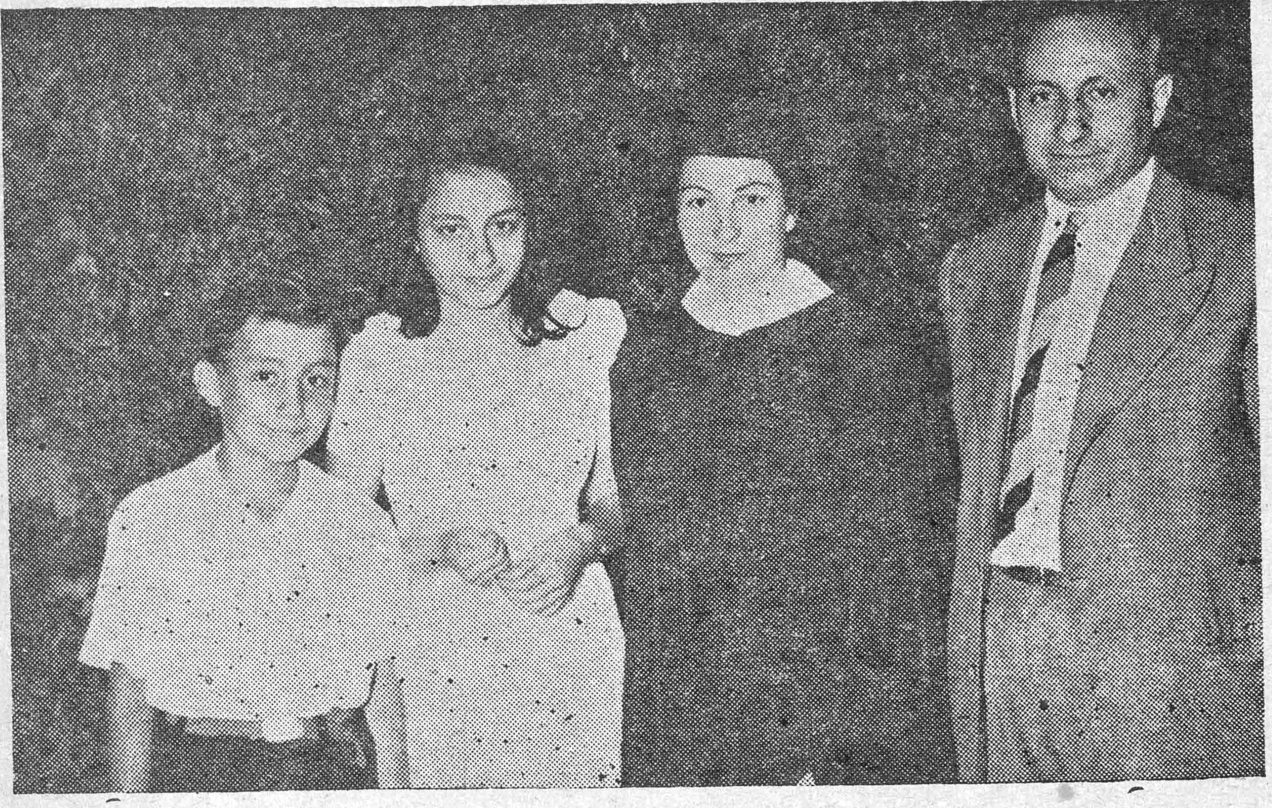
Mrs. Faiza Maalouf Antiba amid her happy family
They charge woman with incompetence and want of skill in managing her home if she demands her rights and goes out into the field of professional or administrative work. They say that a man's life will become a hell if his wife shares with him her interest in associations or hospitals. They expect the streets to fill with children the moment the mother begins to take up duties other than her home and her children. But what will these people say if we bring them certain ladies who take pride in being guiding mothers inside their homes and conscious trainers outside them? We have mothers who still drink from the springs of learning on the student's bench at the very time that they are mothers and housewives — how, then, have these managed to reconcile the two exhausting labors? Our society is full of charitable associations headed only by ladies, by virtue of their gentle nature and their wise management — how, then, can the woman who is a mother 'carry two watermelons in one hand'?
This is what was running through my mind when I went knocking at the doors of some of the ladies who contribute to these noble works alongside the management of their little kingdoms. And from my meetings with them I make bold to say that every mother can share their efforts, if she knows how to divide her time and follow an ordered program in her private life. And here I set down, in the ink of pride, the delightful talk that passed between us — talk which, if it proves anything, proves a managing mind, a broad understanding, and a refutation of all that has been said and is still said against this creature, of whom it was no lie to say that 'she who rocks the cradle with her right hand rocks the world with her left.'
In a simple atmosphere far removed from affectation I sat with Mrs. Faiza Maalouf Antiba in her charming salon, putting to her the first round of questions. Mrs. Antiba is the mother of two children,
and at the end of this school year she received the B.A. degree with high distinction from Beirut College for Women. I questioned her and she answered me; I argued with her and she defended her views with great frankness and boldness.
Q — How were you able, being a housewife, to reconcile your work as a mother with your duties as a student?
A — My children are all of school age, so I am not obliged to stay at home to look after them. I drew up a program for each week covering the purchase of household needs, foodstuffs and the rest, and their keeping in a refrigerator. The maid does the cooking on modern appliances that are easy to use. As for my social duties, I performed them all — visits and receiving guests — on condition that each family visit me separately; and so my life went on in good order all year.
Q — Did no friction arise between you and your husband
because you were obliged to attend to your lessons and leave some of his affairs?
A — I felt nothing of the kind, because my husband, being a teacher, worked continuously. In his free hours I never let him feel that I had lessons; I joined him in visits and sat up extra hours to finish whatever duties had fallen behind. And by nature I know how to use every minute of my time.
Q — What do your children feel toward you when they see you studying like them?
A — Study has brought me and my children together more than it has parted us: we eat together in the morning and study together in the evening. My lessons taught them what study means, and the result was that they advanced in their results this year; I also created in them a desire for study and a delight in it. They are proud of me, and answer everyone who asks them about me that I am at the college in pursuit of learning.
Q — Do you advise