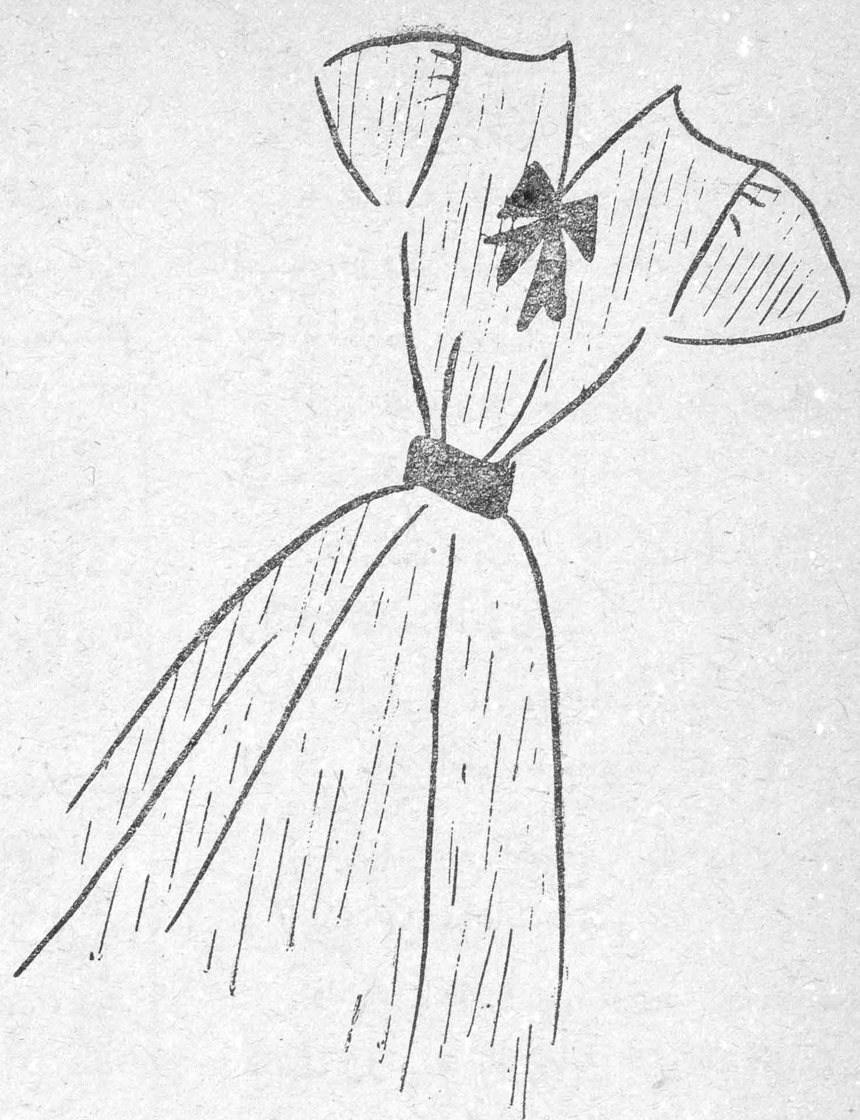
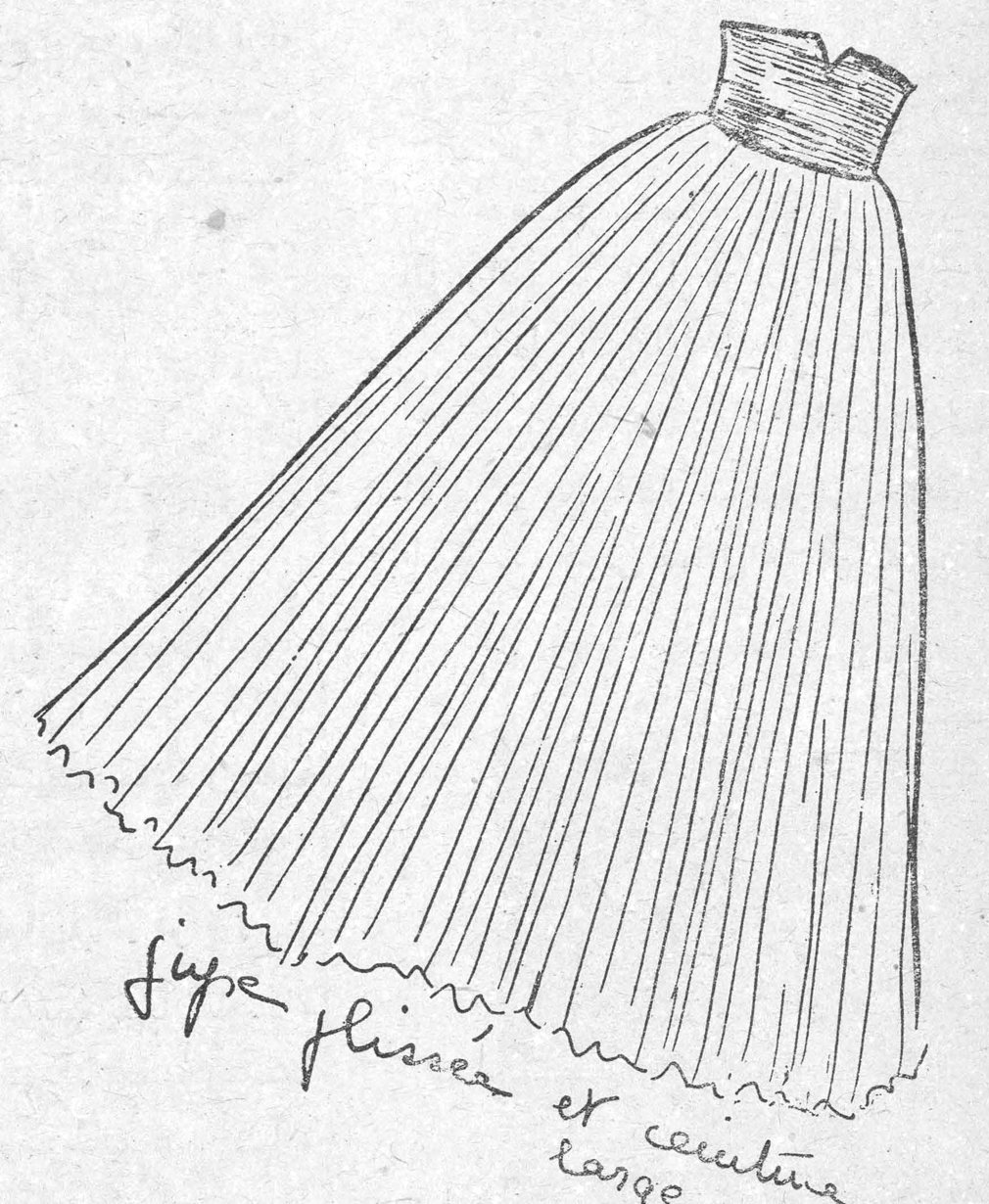
The drawings were made especially for 'The Woman's Voice' by the artist Mrs. Marie-Louise Aziz.
*
I have brought you, Madam, the latest trends in fashion for this season. And as it is the custom of all the countries of the world to follow the French, Parisian fashions, so I have taken care to describe the fashions invented by the dressmakers of Paris and its fashion designers, who thereby decree the shape of summer dress for all the women of the world.
White is counted the king of the season. The fabric is white, trimmed with black or navy, or with a black bow and sash. For evening gowns the dressmakers use linen, mousseline, and organdy, and they make such abundant use of pleating that the body appears like the wings of a butterfly. And the skirt has returned to what it was in the days of the Second Empire — the wide, standing skirt. Evening fashions, most of them short, have been designed to leave the lady room to move with ease; and with the short evening gown the lady wears shoes of a golden color.
As for everyday dresses, their designers have made much use of veined fabric with pleating. White is almost dominant on all occasions, coming either trimmed with navy or veined. But the length of the dress is one of the matters on which the Parisian fashion makers have disagreed: some have set it 33 centimeters above the ground, and others 35 centimeters.
The tailleur appears short and drawn in at the waist. Its skirt is narrow, as it was in winter, though it is sometimes wide. Its fabric is of the rough Damascene silk or of thick veined linen. Shantung and the veined weave have returned after their disappearance from the markets. As for buttons — in contrast to their abundance in the winter season — they have vanished. And the sashes are broad..
Summer coats are made of faille or Damascene silk, in three-quarter length, or so short that the dress shows beneath them.
They have made much use of white piqué in trimming;
The dress is white and the trimming black
The pleated skirt is very common, with the broad belt.