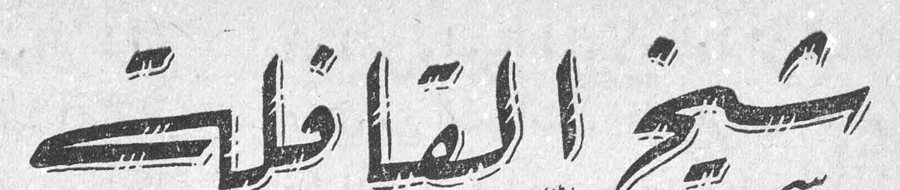
"Abu Salman" gripped the tail of his beast, "al-Ghabra," and cried, "Easy now, bride!" Then he shook the snow from his sheepskin coat and heaved a sigh whose vapor froze before his eyes in that bitter, freezing night, and breathed, "Praise God, we have arrived." Whoever heard him might well suppose that this Abu Salman had come to the threshold of his house, where a hot bath and a soft bed awaited him. But it was not so: the world was darkness and snow and cold and winds, and our friend, in the first hours of the night, was on the summit of Mount Barouk, with hours of hard travel over snow and ice between him and the nearest house, and no companion but his beast al-Ghabra, and a Mauser rifle holding in its belly five mute words — eloquent, though, in battle.
As for Abu Salman, he felt no loneliness. Here he was on the summit, having climbed the flank of Mount "Barouk" from the "Bekaa" side; and there was "Ain al-Lajja," its waters frozen, at his side; and here he was, beginning the descent toward the village of "Barouk"; and there stood the "Abhal" cedars turbaned in snow; and there lay "the Shouf country," spread beneath Abu Salman's eyes, wrapped in darkness. And Abu Salman was a son of "the Shouf" — nay, he was sheikh of the caravan of "Baakline," princess of "the Shouf." "Ain al-Lajja" might be, in the winter of that year — 1917 — a den of vagabonds and a stage for highwaymen, but it looks down on "the Shouf" — and so Abu Salman sighed, tied his rifle onto his donkey's pack-saddle, and cried out joyfully, "Praise God, we have arrived." And he set off down the mountain on his way to "Baakline."
And who could blame that sheikh for rejoicing? The Great War, which starved the sons of Lebanon, had made an exception of Abu Salman, and his family, and his people. Here he was, having left "Baakline" in a caravan of
thirty armed men — they had left the villages of the Shouf with empty grain bins, gaunt — and now they were returning from "Hauran," their beasts loaded with wheat. And Abu Salman was sheikh of the caravan: if it failed in smuggling the grain, his was the blame; if strife broke out among the caravan's young men, he was the judge; and if a man of it perished, his was the responsibility. And here they were, by God's help, returning to the Shouf safe and sound — all but one of them, Shahin Qasim Abu Ali, in whose upper arm a bullet had come to rest. No harm will come to him, God willing. The fault is Shahin's. Why did he not listen to his uncle Abu Salman in the battle?!
Abu Salman remembered the battle, and his eyes shone. "I told the rascal: don't shoot standing — kneel and shoot. Glory be to God, how foolish the young men of these days are; the moment they hear the whine of bullets they go mad. What shall I tell Shahin's mother about her boy's wound? God forgive you, Shahin. No harm will come to him, God willing." And Abu Salman went on calling: "Ho, Ghabra — easy now, bride!"
Abu Salman spoke these words to himself out loud, for he who grows used to solitude discovers in himself the best of companions.
And tonight Abu Salman was stirred by the intoxication of triumph, and he fell to hauling up his past joys. Forty years of his life slipped away, and he saw himself, his mustache barely sprouted, emigrating from Lebanon with his father to earn a living in Hauran. "Mamdouh Pasha" invades the mountain of Hauran with the Turkish armies, and our young man takes part in its battles and witnesses his father's death there. Strife breaks out between the Druze of Hauran and "the Dahham tribe," and our young man plunges into its melees. He returns to his Lebanon to plow and to sow.
Then he enters the ranks of the Ajaweed — the initiated among the Druze — donning the turban and shaving his head. Until the great catastrophe descends with the World War, and the grain is cut off from Lebanon, and its people go hungry. And the Turkish army stands with its weapons between mountainous Hauran with its grain and hungry Lebanon. Then Abu Salman turns his eyes upon those around him, shakes his head, and threatens. Then he speaks to his kinsmen: "God is great and almighty — glory, glory be to Him. We have denied His blessings, and so He has sent down upon us hunger and disease. Here are our retreats emptying of worshippers. And these young men of today — their whole care is drinking arak and going to law. In Hauran there is grain, and we have weapons and mules — but where are the men to break through the ranks of the soldiers, where?" The young men of these days heard Abu Salman's talk, and they respected him and loved him. He might accuse them of laziness and drunkenness, and they held their peace. He might forbid them blasphemy and smoking, and they bore it. But that he should accuse them of cowardice — this was too much. So a delegation of them came, saying: what would it cost Abu Salman — since he is certain there are weapons and mules in the Shouf — what would it cost him to head a caravan that would attempt the march to "Hauran" and the return from it with grain, and let him find out whether there are men in the Shouf.
And the caravan was formed and marched, and its fame marched among the people, and its battles became history; indeed, "the caravan of Baakline" won such a name for prowess that the Bedouin bands and the soldiers steered clear of it, and — after being a chain of battles — it became as safe as a school outing.
This time, however, the journey had been no school outing. For the officer of the post at "Tell Abu Shajara" — "Sherif Effendi" by name, a soldier of mettle — could not stomach being bested by a caravan of plowmen. So he went down to "Damascus" and sought the help