From the corners of the bookshops I buy my books. I blow the dust off the works from which people have turned away; and it is in my nature to turn away where they flock, and to flock where they turn away. I shy from the puffing of any thing, and keep my distance from the "genius men of letters" and the "creative writers" and the "inspired poets" and the "sheikhs of criticism" and the "imams of eloquence," from the "literary masterpiece" and the "bombshell of the season," and all the other phrases, descriptions, and epithets bestowed on most of the books issued in these days. And I confess that I have never read one of these books set out in the bookshops' windows, resplendent in their typesetting and printing, without finding it tedious expositions which their author begins and then regrets, trying to slip free of the subject by whatever means he can — to say nothing of the affectation and the artifice, and their emptiness of any new idea, or of any precise inquiry bearing a close bond to mind and feeling within the circle of the soul, whether the book be poetry, or story, or criticism.
And the strangest thing in criticism is that you see the critic, for instance, who lays claim to the sheikhdom of letters, defaming whoever has fallen under his wrath, analyzing the features of his bodily shape and his character — while of his literature and its quality he says not a word. And with whoever enjoys his favor it is the exact reverse: praise, and appreciation, and genius. The calamity of literature among us is the dominion of money over most of our men of letters in what they produce and compose; and he who has no money, his valuable production dies, and if he does succeed in bringing it out, the corner of the bookshops will be its resting place. Even literature we have weighed in our mistaken scales and divided into two kinds: the literature of the moneyed writers, and the literature of the poor writers.
And from this corner, where the production of the poor writers
lies sleeping, I look out at you this hour, dear reader, with Memoirs of a Wounded Man by Ustad Boulos Salama.
Memoirs of a Wounded Man is an edition brought out at its author's own expense, on flimsy paper, and its price does not exceed 150 piasters. It is the story of a wounded man of letters, who has written its chapters, up to this hour, himself. And is there any story greater than when a man tells you of his own soul — the stages of its faith and its unbelief, its love and its hope, and its many faces — making of it a laboratory from which he looks out upon the world with the best of life's experiments, whose bitterness he has tasted and whose burdens he has carried alone? A
literary story in which he lays out before people the creeping of pain through his body, and the doctors' Sindbad-voyages in search of it, for fifteen years and up to this hour; and the calamities that came upon him — in Shakespeare's phrase — in battalions like armies, not as single spies like scouts; and the surgeons' scalpels in the wounds that have become caverns in his body.
Nailed to his bed without motion. The flower of his youth withered in the hospitals, and his lifeblood flowed upon the scalpels' edge. Yet he tells his story with a touch of playfulness now and then, and offers you the "entr'acte" sugared with gaiety and jokes, so that you do not weary of listening to the tragedy
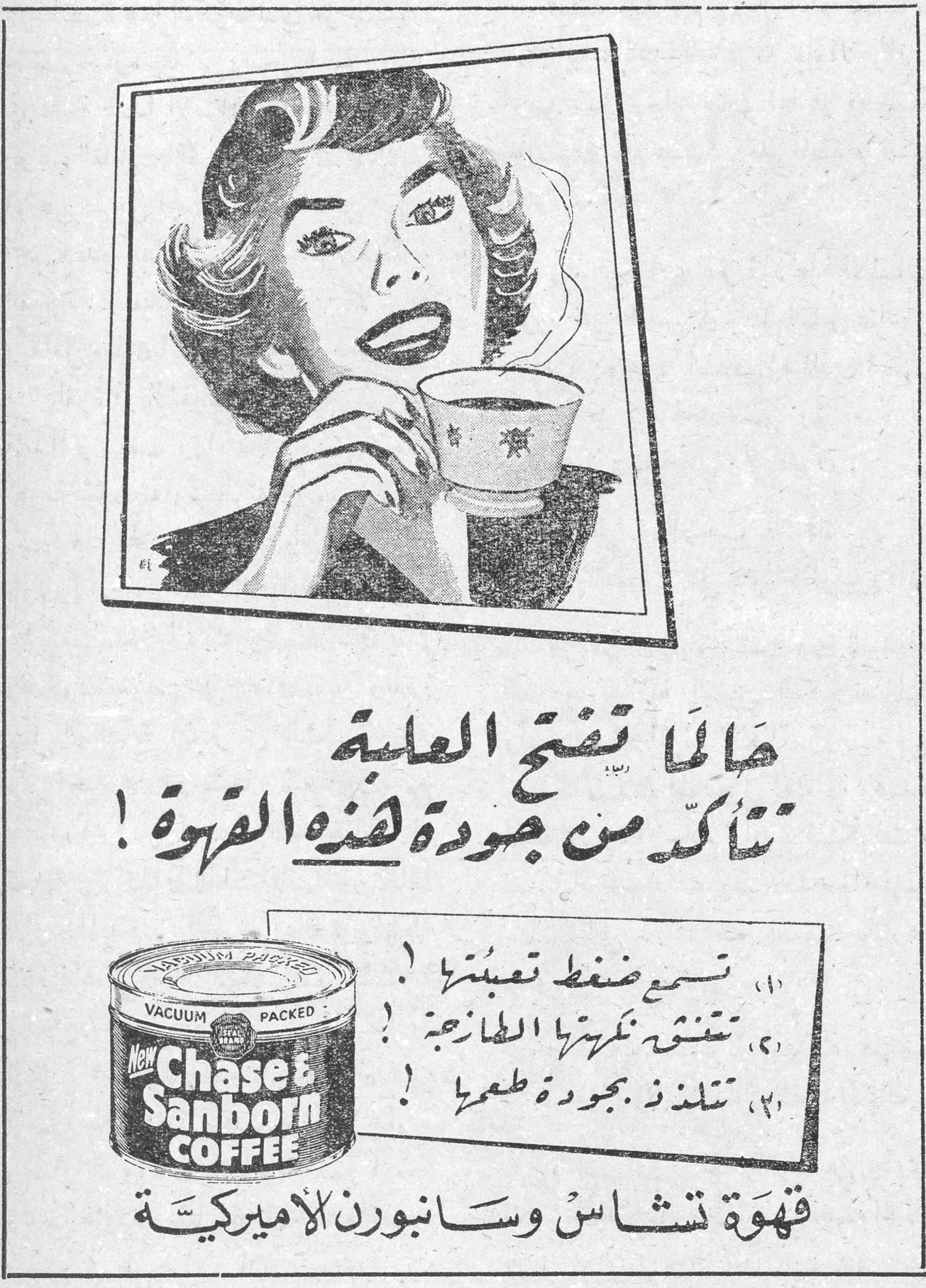
Chase & Sanborn Coffee
The moment the can is opened, be sure of this coffee's quality!
1) You hear the pressure of its packing!
2) You breathe in its fresh aroma!
3) You delight in its fine taste!
Chase & Sanborn COFFEE
Chase & Sanborn American Coffee