
* A graduate of the National College in Shweifat. * An educator, a social writer, and an orator. * An active member of a number of women's associations, chief among them: the General Arab Women's Union, the Lebanese Women's Union, the Lebanese Women's League, Tahdhib al-Fatat, and others. * Mother of three married daughters. * The government awarded her the Lebanese Order of Merit in recognition of her services and her contribution to the education of the rising generation.
Q — How did you come, step by step, to writing and public speaking some forty years ago, at a time when the Lebanese woman was feeble of strength and faint of voice?
A — I began writing while I was still at my school desk. The teacher of Arabic, Mr. Salim al-Khoury — God rest his soul — discerned in me an inclination for writing and encouraged me; and in the Arab Society victory was my ally in every debate. Nor do I deny my women teachers' influence in guiding me: after every speech they would congratulate me on my success.
Q — And what was the incentive that led you to accept invitations to deliver speeches on all sorts of occasions?
A — The first incentive was my sincere feeling of the injustice done to the Lebanese girl. I was once listening to the conversation of some lady visitors at our house. My mother asked them: Why do you not send your daughters to school, now that they have become young girls? They answered her: We should like our daughters to be educated, but our husbands say: It would be a sin to spend on a girl's education when we are not well off — tomorrow she will marry, and what will we gain? Better to educate the boy: the benefit comes back to us, and we shall have ease in our old age.
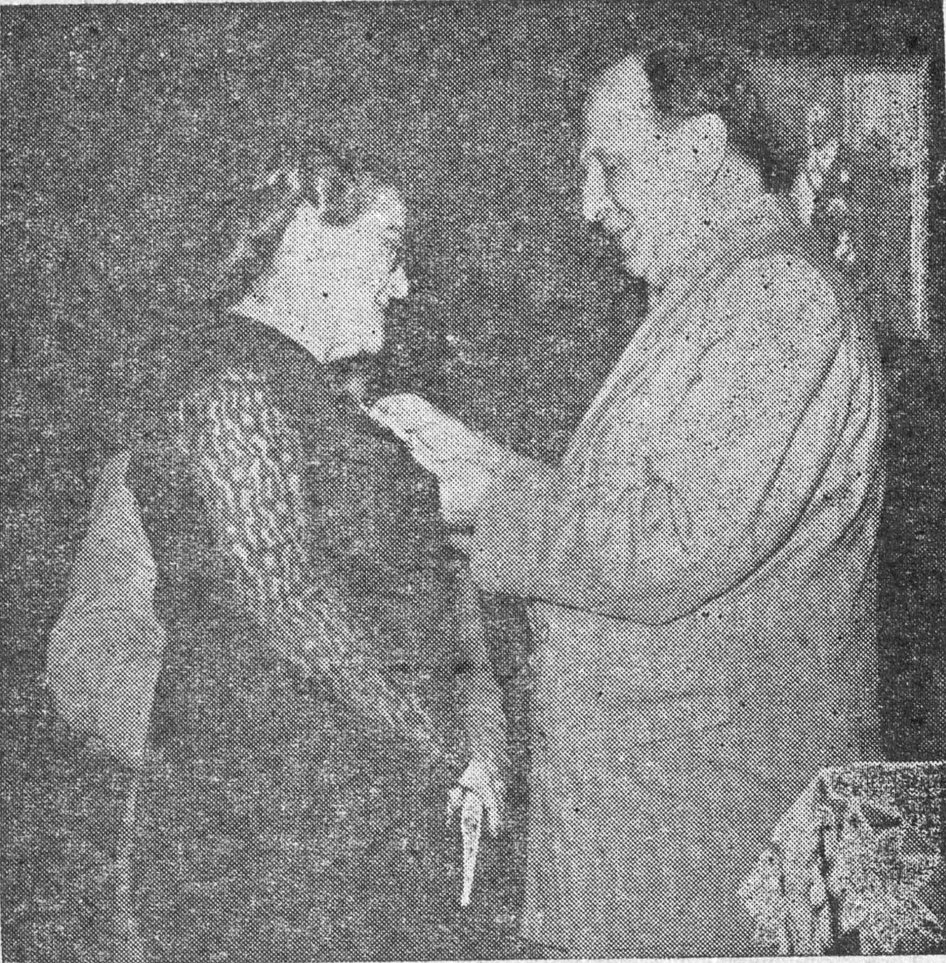
His Excellency Sami al-Solh pins the medal on Mrs. Sarkis's breast
Q — Do you remember your first appearance as a speaker, and when it was?
A — Yes, I remember. It was at a party of the Tahdhib al-Fatat Society — the associations in those days used to hold oratorical parties, for which nowadays they have substituted dances or "Garden Parties." My subject was "Who Is to Blame?" and I concluded by saying: it is the man who is to blame, for neglecting the girl's education and burying her talents, ignorant — or feigning ignorance — that her education is a duty, for the rearing of the men and women of the future. The audience — most of them men — kept interrupting me with warm applause, as if to say: how true these words, and how noble this defense — but the time has not yet come. Yet it was not long before their eyes were opened to the truth, praise be to God.
Q — Did any particular personality have an influence on your direction?
A — I admired three ladies, whom I took as my models. The first was the late Louisa Procter, founder of the National College in Shweifat some 67 years ago. She was principal and teacher; I knew her when she was over eighty, working from seven in the morning until ten at night without weariness or flagging, out of love of raising the level of the Lebanese girl, and for the sake of God. The second lady who had an influence on me was the late Ijni Saad, wife of the Reverend Tanios Saad — the right arm of Louisa Procter, who also assisted in administration and teaching, and the founder of the Tahdhib al-Fatat Society in 1909, its aim being to educate girls whose