

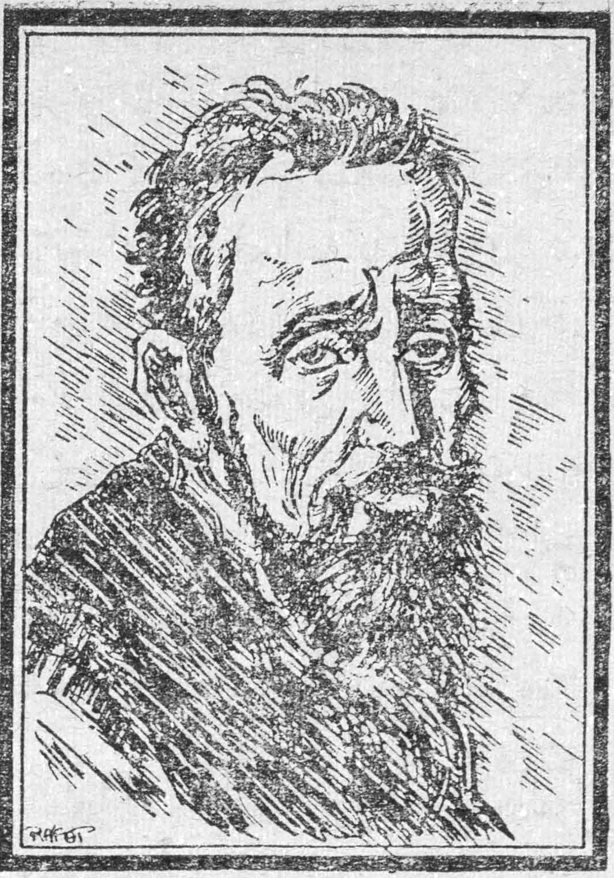
The elegant Leonardo da Vinci was walking down one of the streets of Florence with a sweet smile on his face, while on a bench on the other side of the street sat a group of men debating Dante. When one of them caught sight of Leonardo he said:
“Brothers, here is the man who can put an end to our dispute.”
At that very minute there appeared in the middle of the road a young man whose bearing showed him to be a man resentful of humanity and of the whole world. When Leonardo’s eyes fell on him he said: “Here is Michelangelo, my friends; you had better ask him to explain Dante to you.”
But Michelangelo paid them no attention and went on his way, saying: “Why don’t you explain it yourself, Leonardo!” — which was proof of how little he cared for people and how deeply he was withdrawn into himself. Michelangelo in those days was a young man at the beginning of his fame, while Leonardo was twenty-three years his senior and surpassed him in experience and renown, being among the foremost artists of that age; nor could Michelangelo have realized then that he would outstrip his colleague in glory and outshine him, in the near future, in greatness and fame. His father was governor of the town of Caprese; he had four brothers and no sisters, and his mother died when he was six years old. His father, though of noble stock, was poor, and often without work; he was harsh with his children, and how he would rage and storm whenever his son Michelangelo stubbornly declared his wish to become an artist, answering him that the Buonarroti were not made for such trades, but were made to be directors of banks and men of business. The quarrel between him and his father would end in insults and sometimes blows; yet none of that bent him or weakened his resolve, until his father was forced to take him by the hand, when he was thirteen years old, to the artist Ghirlandaio, to study art under him. When he left him there he said: “I wash my hands of this boy.”
This professional artist was then painting the walls of the church of Santa Maria Novella, and Michelangelo’s task was to mix the colors and copy certain models; and it soon appeared that the copies came out better than the originals, which stirred the master’s envy of his pupil, and he resolved to be rid of him. That was Michelangelo’s good fortune, for the artist Ghirlandaio sent him to old Bertoldo, who taught the young the art of carving; and through him Michelangelo came to know the world of learning and art, of music and poetry, beauty and brilliance: he came to know the things for which his ambitious artist’s soul had longed.
In the meantime he made the acquaintance of the famous Lorenzo de’ Medici, who admired his brilliance and quickness of mind, and invited him to the Medici palace, where he was allowed to sit at his table and play with his children. In that palace Michelangelo came to know beauty and wisdom, for there he met many of the philosophers, scholars, and artists who flocked to it from every part of the world; and in that palace, too, Michelangelo produced his first drawings. When Lorenzo the Magnificent died, political conditions in the city were troubled, so he left it for Bologna and began his work there by erecting a statue for the church; but he met with no success in that town, and returned to Florence, his birthplace, then left it for Rome to build his future in the Italian capital — twenty-one years having passed since the founding of the Vatican City.
Michelangelo reached Rome in 1496 and found it a city of music and crime, of culture and money, of dancing, festivals, poetry, painting, and the rest... Art there was without peer, and he said: “I have no friends, but I have no
need of them, nor shall I have friends in the future.” Michelangelo was then twenty-three years of age. He submitted an application to make a statue of Christ the Lord and the Virgin for the church of Saint Peter, and among what he said in his application was this: “The statues I shall make will be of such beauty and splendor that no other artist can make anything more beautiful.” He won the competition, and made the statue of Christ and the Virgin which is counted today among the most magnificent statues in the world. This success of his left a far-reaching echo, and his fame reached the new Pope, Julius II, who was a lover of renown and wished to immortalize his memory in history by building himself a tomb the like of which the world had never seen before. He summoned Michelangelo and asked him: “How much will the building of this tomb cost?” When the artist gave him the figure he had imagined — an enormous one — the Pope said: “Let it be double what you have named.”
And on that they agreed.
But Michelangelo’s enviers among the artists soon put it into the Pope’s head that it