verses that celebrated its charms. These shadows continued to surround it until 1878, when there was found among them one who possessed the boldness to dispel those shadows and to proclaim the secrets they had been hiding.
Tommaso de’ Cavalieri was a refined young Roman who had devoted himself to art, and those who have written of him affirm that he was of a beauty without parallel. He met the great artist for the first time in 1532, and their friendship grew firm until, within two years, it reached its height and inspired Michelangelo’s finest poems and letters.
It appears that de’ Cavalieri greatly prized the old artist’s love for him, for he remained faithful to him until his last hours, at which he was himself present; nor were his concern for the old man and his care of him confined to his lifetime only, but continued after his death as well, for he devoted himself to executing his will with the same eagerness and warmth with which he had carried out his wishes while he was still alive.
It was Tommaso de’ Cavalieri who persuaded our artist to complete the wooden model he had made for the dome of the church of Saint Peter, and it was he who preserved the plans for the building of the Capitol after him; so it was ordained that their two names should go forever side by side — even had the young man’s beauty not, in truth, inspired some of the old man’s songs and poems.
This romantic friendship was the essential source of some of the artistic treasures counted among the most important of Michelangelo’s works... Vasari, one of the Italian historians, said that the artist lavished many precious gifts upon the beautiful youth, and among these gifts were drawings of dazzling beauty and a rare splendor without equal.
Nor was Michelangelo, at the same time, unmoved or cold
toward the fair sex, for his spiritual bond with the nobly born beauty Vittoria Colonna, though it was a Platonic bond, became widely famous. This woman was forty-six years old, and Michelangelo sixty-three, when the ties of friendship between them grew firm; they spent most of their hours together talking of poetry and philosophy, and she was perhaps the only beautiful woman who showed Michelangelo more than admiration and esteem.
Vittoria was the wife of the Marquis of Pescara, and he treated her badly despite her love for him; nor was her friendship confined to Michelangelo, but extended to a number of the great artists and men of letters of that age. The letters and poems exchanged between Vittoria and Michelangelo are counted among the most precious and most exalted things in Italian literature.
The historians say that critical hours passed in Michelangelo’s life, but the most critical of them were those in which three dear ones died.
First — a boy of fifteen who bore on his face the marks of great promise, for whom a great future in the world of art was hoped, and whom Michelangelo loved as a father loves his son.
Second — the death of this boy’s uncle, who was Michelangelo’s financial adviser...
Third — the death of Vittoria Colonna... perhaps one of the severest of the blows that hastened his own death. Michelangelo stood before her body, contemplating it — he who had never once embraced her in her life, nor tried to — then took up her cold hand and kissed it. He later remarked to one of his close friends: “Nothing in my life has grieved me more than my sorrow that I did not dare to kiss her lips, even after her death.”
Michelangelo died at the age of eighty-nine, and until the last
week of his life he was absorbed in painting and sculpture... When he felt his end drawing near he said, on his deathbed: “I do not regret the approach of my end; but I regret that I am dying at the very time when I have begun to understand the principles of art and to leap toward my true work.”
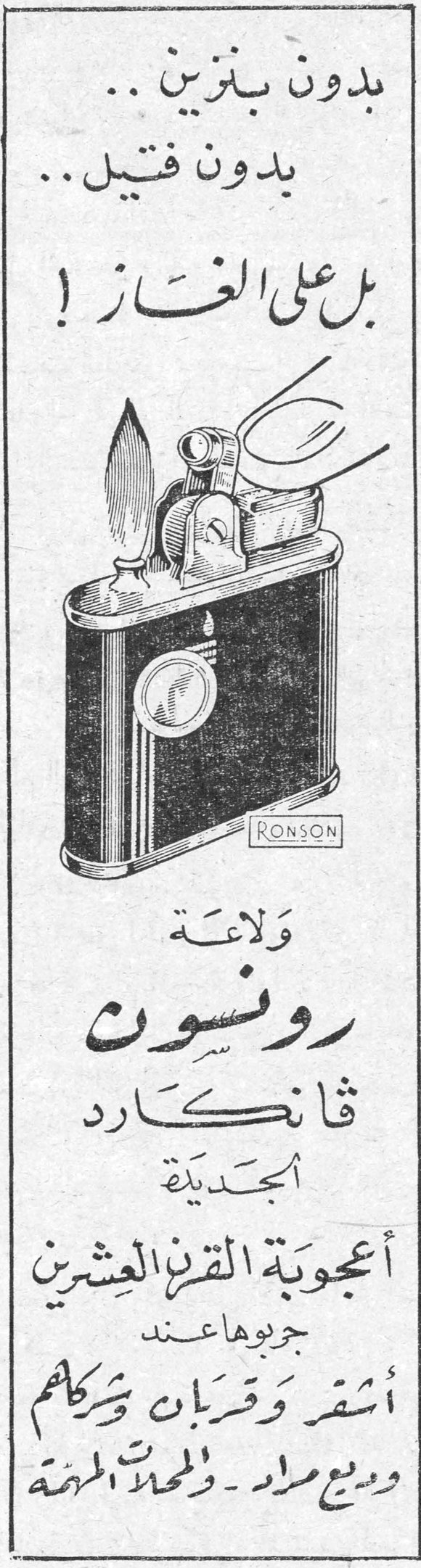
The Ronson Lighter
No gasoline... no wick... it runs on gas!
RONSON
The new Ronson Vanguard lighter
The marvel of the twentieth century
Try it at Achkar & Kurban Co. and Wadih Mrad — and the leading shops