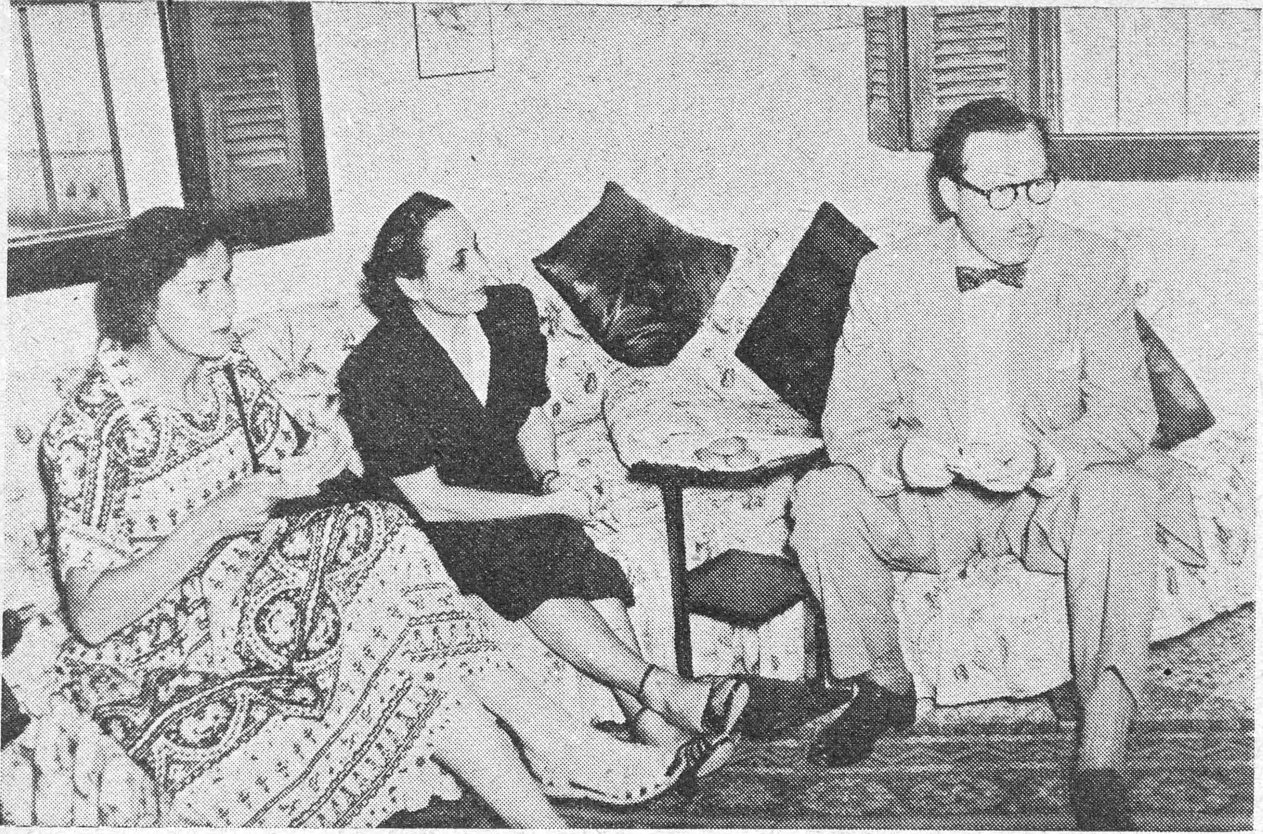
Mrs. Widad Cortas; to her left, Dr. Hopkins of the Friends of the Near East society in America, and to her right an English journalist, during a tour in the East
Last month Mrs. Widad Maqdisi Cortas, president of the Ahliah National College for Girls, returned from a journey to England, where she represented Lebanon, together with her husband Mr. Emile Cortas, at the world conference of the "Quakers" held in the city of Oxford.
We are pleased to have her speak here of her educational impressions from this journey, in view of the distinguished place Mrs. Cortas occupies in the higher cultural circles...
Q — Do you feel, Mrs. Cortas, now that you are back in Lebanon, that your journey, and the impressions you formed of it, brought a benefit equal to the effort spent on it?
A — I am with those who say that travel is a second school, for the benefits and pleasures a person reaps in the course of a well-planned journey are beyond counting and beyond price.
Q — I do not think I differ with you there; but I should like you now to be kind enough to speak to our dear readers of what you observed in whatever concerns educational and family matters — I mean what relates to woman. Is what we hear about the collapse of the Western family in general true?
A — In my opinion, the collapse that has befallen the Western family in general has had but little effect on the English family, because "tradition" holds a distinguished place in the upbringing of the English; the Englishman forever holds fast to it and keeps it..
Q — True, this is a clear feature of the English character. Do you think, then, that woman has had a hand in preserving the English family from collapse?
A — Of course. I believe the
greatest credit for the steadfastness of the English family in the face of the current of family disintegration goes to woman: it is she who saved the family and society from collapse... Wondrous is the serenity that shows on her face, despite the tight rationing and the stinting in daily life; she is forever ready to work, and wholly content with the present situation, however harsh and straitened, without any grumbling...
Q — And perhaps this way of hers in living is reflected in every member of her family, so that none of them shows any contrary behavior — that is a well-known educational theory, and it is fine to see it applied with such simplicity and meeting with such results.
A — If you could only see how astonishing the results of this upbringing are... The English woman has so managed the present circumstances — harsh as they are — that the family is able to secure a happy, contented life..
Q — And how did she manage that, Mrs. Cortas?
A — By resorting to simplicity of living; for one of the most striking features of English life today is the subordination of material things to spiritual values.
Q — Would that you would kindly
make clear what you mean by giving some examples..
A — I visited a number of middle-class families and lived among them for days, and I watched closely how these families live in small houses, some of them no larger in area than one big room, yet fitted with all the necessities of life, most comfortable and clean. I noticed, for instance, that the bookcase holds first place in the home; in some of these families the wife was working while the husband completed his higher studies, and the two cooperated in the affairs of the household. In short: the English people have given up their material comforts and settled into simplicity of living in all its aspects..
Q — And what place do dinner invitations hold, for example, in the life of the modern English family?
A — As regards invitations, I noticed that the family there has turned away from them entirely; occasions of eating do not take up much of their time. Most of their hours are given to broadening their study and learning,
and to general social service.
Q — ... And does their view of learning differ from our own view of it?