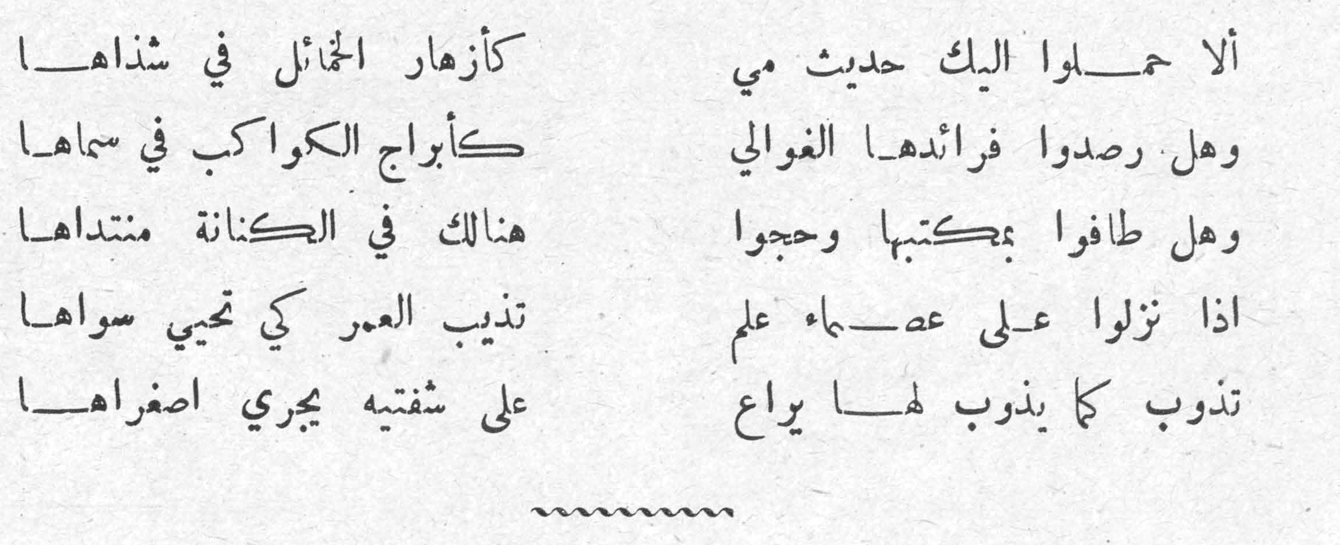
Have they not carried to you the talk of May, like the flowers of the thickets in its fragrance? And have they watched her precious gems, like the constellations of the stars in her sky? And have they circled her study and gone on pilgrimage there, in Egypt, to her salon? They would have alighted upon a peerless lady of learning who melts her life away to give life to others, melting as the reed pen melts for her, upon whose lips her heart and her tongue run.
With these verses — in which surges the tale of a free-flowing, generous soul; in which one breathes the fragrance of the flowers of the meadows and glimpses on their horizons fleeting flashes of vast learning and a kindled genius — they show you beauty and nobility in their most resplendent fresh attire, in a new shade of women's literature that rests upon the heart and the tongue: the heart in its throbbings, melting with tenderness and release, and the tongue in its fluency and its skill.
Yes, with these verses the poet Shibli Mallat opened his poem on May at one of the celebrations held for her in Lebanon when she came there on a visit in 1922.
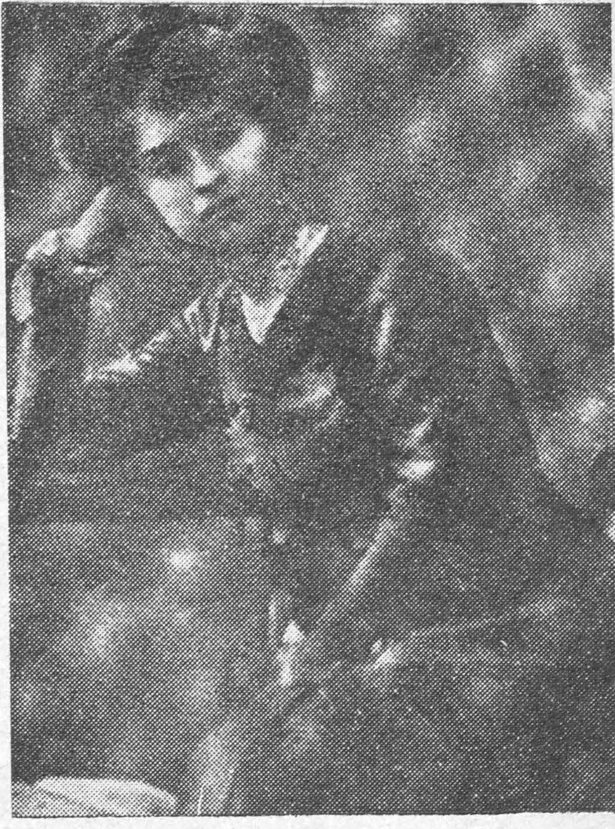
And whenever I call these few verses back to mind, my imagination calls back for May a splendid artistic portrait that represents her in person more than any other picture — for all the many happy canvases the artists painted of her, which remained to them afterward an immortal legacy, and for which
their fascination with her at the time was pretext and inspiration.
As for May's talk, nothing of it has been carried down save the verse that was composed about her, and the rare scraps that clung to the memories of the living men of letters of her age — Taha Husayn, al-Aqqad, Mansur Fahmi, al-Tanahi, and a few others.
As for her living gems, she herself gathered them into fourteen books up to the year 1924. The first of them was Sawanih Fatat (“A Girl's Musings”) — and it will be noted that it was compiled in response to the correspondence and admiration of the poet Wali al-Din Yakan — and the last was Kitab al-Sahaif (“The Book of Pages”), a valuable collection of her studies of certain personalities she admired, such as Dr. Shumayyil, Michelangelo, Madame de Sévigné, Ismail Sabri, and Gibran Khalil Gibran in his Processions.
As for the articles her pen adorned in al-Muqtataf, al-Risala, al-Hilal, al-Muqattam, and other fine magazines, from 1924 until her death, they still sleep in the bellies of those papers and magazines, with no rising or resurrection in prospect — because not one of the men of letters capable of lending an expert hand to literature is willing, or has even thought, to take upon himself the trouble of digging and searching to rouse those articles from their slumber.
As for May's private letters to the distinguished elite of her eminent friends — Rihani, Shumayyil,
Sarruf, Antun al-Jumayyil, and others still living — they remain in the keeping of the unseen; no one but their possessors knows their fate or what has become of them. They are, I believe, a precious treasure that would open wide horizons for tracing the age of the intellectual renaissance in the Arab world by the light of the plain facts, in the days of that renaissance's flowering, growth, and cross-fertilization.
There are also works of May's not yet published, and they deserve attention and publication. Among them I mention “The Nights of the Asfuriyya,” the second part of “Words and Signals,” and Voix des Femmes d'Orient; together with the rest of the manuscripts she left behind, they all remain under heavy sequestration — as though an eternal vengeance were intended against the pride and nobility of that rare genius: a vengeance that inflicted grievous wrong on their author while she lived, and after her death gave license to some of those who wished to write her life in a volume or a booklet to flounder in an endless sea of absurdity — above all on the sentimental side — placing her in a station unworthy of her: she who, by the loftiness of character and nobility of soul with which she was molded, so long inspired the nation of letters with immortal poetry, beautiful prose, and splendid writing, in a stretch of time when she was a radiance before which every radiance on the brow of Arabic literature grew dim.
From this side we see that history