ing his concubines. And good choosing was smooth and easy, especially as the slave dealers had become widely experienced in their trade, offering only such girls as would yield them ample profit: possessors of ravishing beauty, burning intelligence, sound taste, and a broad culture versed in the varieties of the fine arts, above all song.
The dealers and the masters grew accustomed to spending great sums upon slave girls of perfect attributes, to educate them to the highest culture of every kind, above all in the arts and polite letters. No wonder, then, that the slave girl — such being her attributes — should compete with the free woman for her position and for her husband's heart, armed with the fullest armor of culture, delicacy, refinement, coquetry, and charm for the conquest of that heart. Is it any wonder if the slave girl's scale outweighed the free woman's in this arena? Are the unarmed man and the man bristling with weapons ever equals on the field of battle?
The exorbitant sums that were spent on the slave girl's education are decisive proof that man desires woman only when she is cultured, understanding him and keeping pace with him in his life; that he needs to feel her near him in society, sharing his joys and his sorrows, his play and his earnest; and that without her, life holds no savor for him. Had the institution of slave girls not been, matters standing thus, within his reach, necessity — the mother of invention — would have shown him the duty of teaching and educating the free woman to fit her for this role; but since the slave girls and concubines existed, this feeling remained faint.
And when we know that these slave girls were of different races, we know that the concubines represented the most perfect traits and qualities of each of those races. In their company, taken all together, the man found the dearest bodily pleasure he yearned for and the loftiest intellectual delight he longed after. He found, for instance, in the Indian girl,
meekness, gentleness of manner, calm, and skill in tending the child; in the Sindi, the slender waist and the long hair; in the Berber girl, the blind obedience that tickled his pride, together with sweetness of character and pliancy of temper. He delighted in the whiteness of the Turkish girl's skin, in the softness of hair and blueness of eyes of the Greek girl, and he took comfort in the Sudanese girl's gleaming teeth. Thus the man hurried forward what he had been promised in the hereafter: he wanted a paradise on earth whose houris he might enjoy — and so came the institution of the slave girls.
Poor Arab woman, such being her state! She felt her standing sink in the man's heart, and she rose up to fight the slave girls to regain that standing; and when she lacked the weapons with which those women were armed, she resorted to other weapons — intrigue, dissembling, conspiracy, and hypocrisy — until, with the generations, these vices became a token by which the Arab woman was known. If in Arab society one said “woman,” they answered: she is the devil and temptation; she is lying and hypocrisy; she is dissimulation and cunning.
Nor did the danger of concubinage stop at this limit; it passed beyond it to the condition of the state. For concubines multiplied of another sort — a dangerous sort — the sort of the “umm al-walad”: that is, if the master got a child by his concubine and attached the child to his lineage, the child acquired the same rights as his brothers by the lawful wife. Likewise the current of marrying bondwomen instead of free women swelled, for many
reasons: among them the ease of the dowry, and the abundance, variety, and strangeness of beauty compared with what the Arab was used to in his surroundings; and among them the primary reason to which al-Jahiz pointed when he said: “Some of those who have argued the cause why most slave girls stand higher in a man's favor than most high-dowered free women have said: before a man owns the slave girl he has examined everything about her, and he proceeds to buy her only after she has met with his approval; whereas about the free woman's beauty only women are consulted — and women see nothing, little or much, of women's beauty, of men's needs, or of what suits them; and men are the better judges of women...”
Among the Arabs' traditional sayings on this subject: “The slave girl is bought by the eye and returned for a defect, while the free woman is a shackle on the neck of him to whom she passes,” and “Strange, that a man who has known slave girls should venture upon free women!”
The harm of this second danger was not confined to the Arab woman; it passed beyond her, as I have said, to the state. For the state — in which the half-breeds multiplied (the hajin being he whose father is Arab and whose mother is foreign) and which teemed with many sons of bondwomen — became exposed to disintegration and division; for it was natural that these should band together, whatever the races of their mothers, to form a strong front against the sons of free women. The books of history and of literature are full of this struggle, which occupied
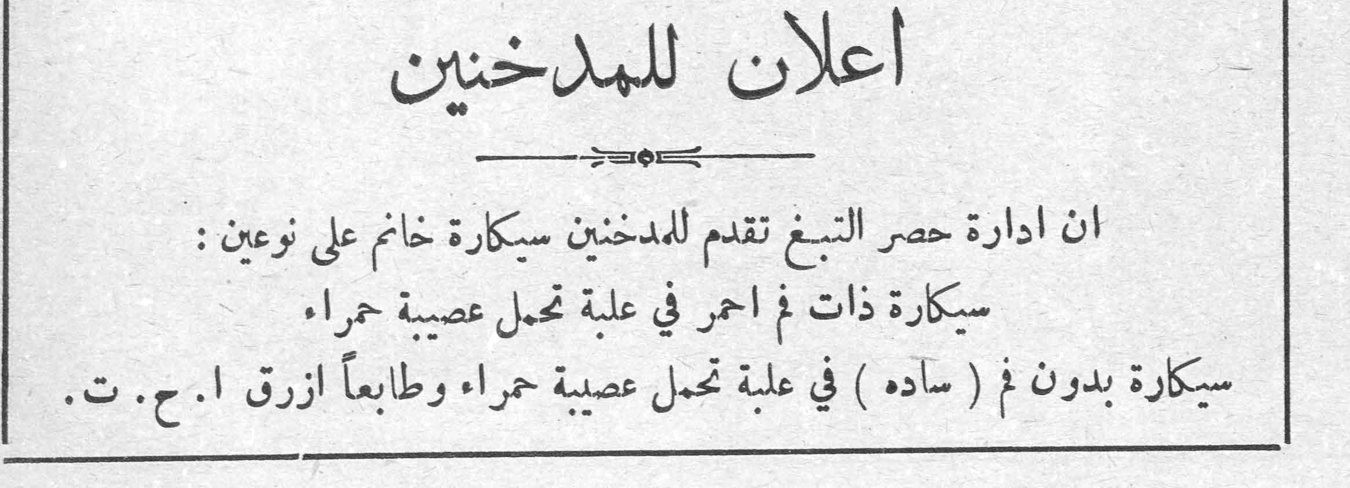
A Notice to Smokers — the Khanem Cigarette
The Tobacco Monopoly Administration offers smokers the Khanem cigarette in two kinds:
A cigarette with a red tip, in a pack bearing a red band.
A cigarette without a tip (plain), in a pack bearing a red band and a blue stamp, I.H.T.