the last days of Umayyad rule and was an essential cause of the fall of the Umayyad state, and which kept pace with the Abbasid state throughout its life: at one moment raging until it produced violent upheavals and brought down disasters, at another calming down and taking peaceful forms built upon intrigue and conspiracies — making the state a stage for affairs that did it no honor, either much or little.
And what is truly regrettable is that strength was mostly on the side of the half-breeds. The hajin, being the son of parents of two different races, was stronger of body, keener of intelligence, and more luminous of insight than the son of two Arabs, whose parents were so often the children of a paternal uncle or a maternal uncle, a paternal aunt or a maternal aunt. Their success in life helped to swell the Arab mother's rancor against them, and her scheming and her spite grew fiercer; and if she was a woman of enterprise,
she turned the world upside down and organized parties to back her against the other current — as was the case with Zubayda, mother of al-Amin. She felt always that her husband, al-Rashid, preferred al-Ma'mun — the son of a Persian bondwoman — to her own son, and she reproached him for it. Despite the multitude of his concubines she held a high place with him, and he wished to answer her with shining proof: he seated her at his side, soothed her feelings, and sent that very hour a slave to each of al-Amin and al-Ma'mun, to say to each privately: “What will you give me when you become caliph?” The slave came back with the answers while al-Rashid and Zubayda were still in her sitting room. Al-Amin's answer was: “When I become caliph I shall grant you fiefs” (that is, bestow lands on you) “and give to you” (bestow money on you). But al-Ma'mun answered by striking the slave with a brass inkstand that lay before him, saying: “You ask me what I shall give you on
the day the Commander of the Faithful, the caliph of the Lord of the Worlds, dies — may we all be made his ransom!....”
•
This brief glimpse shows us woman's evil condition in a state that reached the summit of civilization in its age, just as it shows us that state's inability to preserve what it had attained — so that its life, as the lives of states go, was shorter than the life of a shadow. Will this truth, then, be a lesson to the Arabs in their modern renaissance, so that they hold sacred woman's important role within it, and restore to her her confidence in herself — so that she understands that she is to be cultured and educated, and the field of progress is opened before her, in her capacity as mother of the new generation upon whom their renaissance rests, and not in her capacity as an instrument of amusement, song, and merriment, like that slave girl, the umm al-walad?
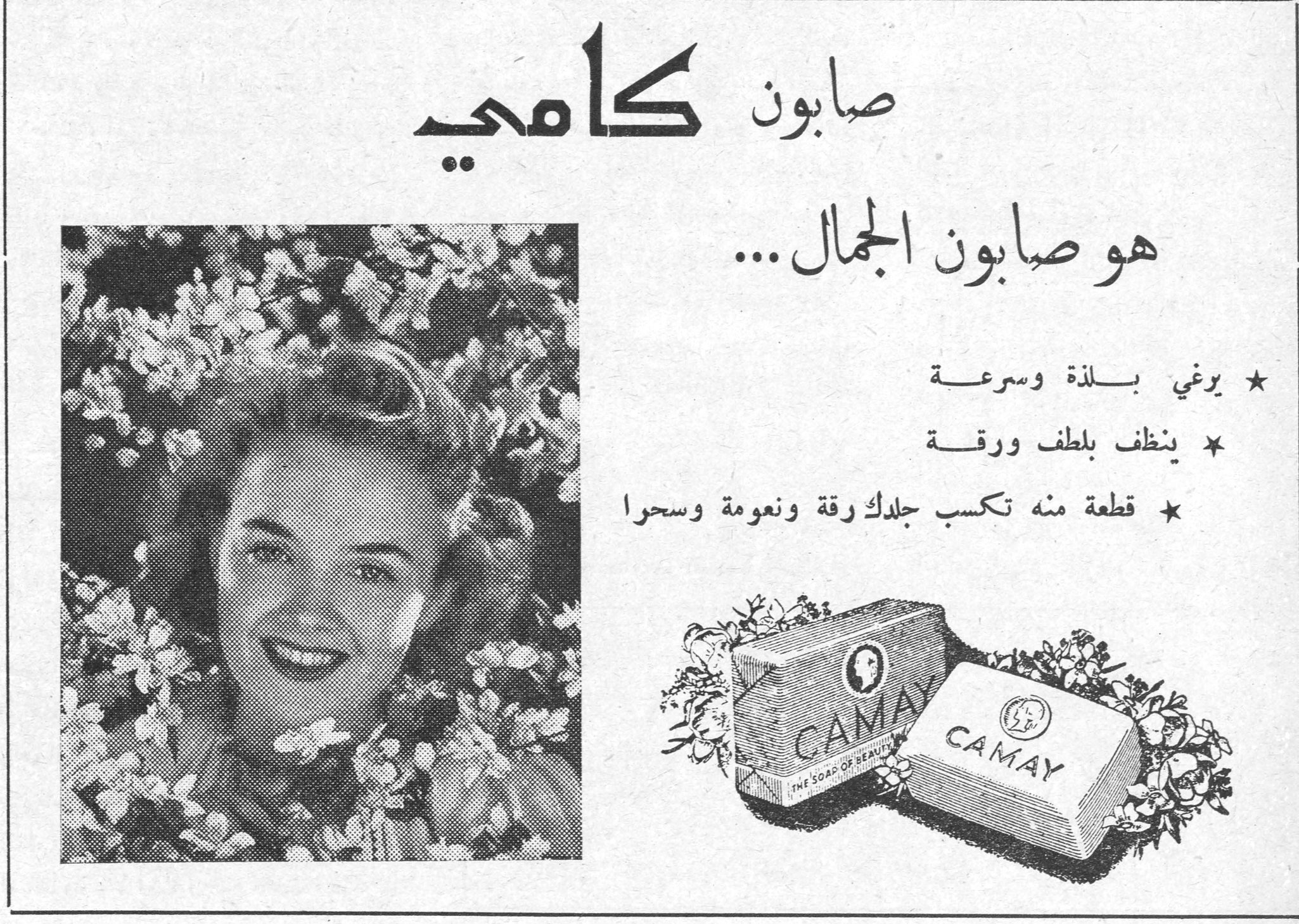
Camay soap
It is the soap of beauty...
• It lathers delightfully and quickly
• It cleanses gently and delicately
• One cake of it gives your skin delicacy, softness, and charm
CAMAY - THE SOAP OF BEAUTY